Tag: syndicated

  • What’s Next for SQL Clone?

    I think SQL Clone is a useful, handy product. It’s what I’ve needed in a number of organizations, or it’s what would have saved us (literally), $100,000s of dollars by avoiding larger SANs with snapshot technology. At one company, we actually bought a second six-figure SAN when our customer service people wanted a copy of our SQL Server database from a point in time overnight that they could use to respond to customer requests and test issues on the next day.

    Now that v1 is out, and many of you were impressed by the demos and details from our Livestream launch, what should we do to the product?

    Let us know: sqlclonefeedback@red-gate.com.

    We are getting feedback from some customers, we are getting a few questions here and there in presentations, at conferences, and on Twitter. However, it helps to give feedback directly in a way that we can tally things up.

    Do you need more than 2TB clones? Send us a quick email.

    Do you need better permissions and security? Send a quick email.

    Is there something else?

    As much as I like getting feedback, and Grant does, it’s good to vote with your voice and send a note to the company. If you want a louder voice, send a few emails to the salespeople. They can really put some emphasis on feature requests.

  • DevOps at VSLive–Austin

    You can see me in May at VS Live in Austin, where I and many others will be talking DevOps. There are lots of sessions to choose from, including some all day pre-cons. If you work in multiple areas (data, development, ops), or want to get ideas about how to better build and manage software, come to VS Live in  Austin.

    auspk14


    Use my code, AUSPK14, to register and save $400. We can talk about DevOps and enjoy some Austin TexMex.

  • The Foundry–Data Masking Research

    For most of the time I’ve been working for Redgate, we’ve had some sort of R&D group that tries out new ideas. Over the years we’ve done this in a few ways, evolving things over time. I had the chance recently to meet with The Foundry, which is formally investigating ideas for feasibility, interest, and general knowledge. Not all their ideas will move forward to actual pieces (or parts) of software, but it was interesting to meet with them.

    One of the areas they’re investigating is data masking, which is a much larger topic than you might think. I got the chance to review some of their research areas and thought a few of you might be interested in helping research and giving your thoughts.

    Data Masking Demos

    In looking at data masking, the group spent some time getting feedback from individuals, trying to understand the challenges and possible solutions, and then build some interactive demos. These aren’t really software, but they are a bit more than wireframes. you can see all the demos in the Data Masking Demo section of their site.

    Each of the items deals with a different aspect of data masking. The demos aren’t completely intuitive, which is both interesting and frustrating. It’s good that there is some open-ended-ness that gets me to think. Hard that I don’t always quite get the intention. I had the luxury of getting some time where someone would sit down and explain a scenario, but I’d be curious what some of you think.

    If you have a few minutes and want to play with potential areas of data masking research, try a demo and give some feedback. I particularly think the Manage Test Cases and Realistic Generation demos are things I’d like to see engineered, particularly together. I would really like the idea of some production-like data and some real test cases being moved into good, not-production, data sets that I can use for development and testing. I’ve given some feedback, but I’ll play more and leave notes here, and at foundry@red-gate.com .

    If you have a few minutes, maybe you want to do the same.

  • Good DevOps Books to Read

    I was interviewed recently at DevOps.com talking about the database as a part of DevOps. As part of the interview, Alan Shimel asked me for a book recommendation. After that, I decided I should recommend a few books that I’ve read and think have helped me to understand DevOps.

    Tl;Dr: The Phoenix Project, The DevOps Handbook, Continuous Delivery.

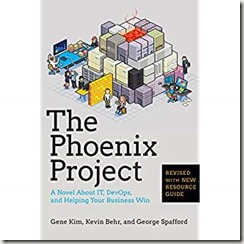
    The Phoenix Project

    I actually read The Goal first, which applies the principles of DevOps, grown out of the lean movement, to manufacturing. The Phoenix Project is based on the Goal, but looks at Information Technology.
    5170sr05QAL._AC_US327_QL65_

    The book is a good, light read. It felt like a repeat of The Goal, but it cemented some ideas, and I enjoyed it. The guru character is a little overdone, but certainly the “Brent”,  jack of all trades, the one everyone depends on rings a bell. I’ve been Brent in a few places, where I had to be involved in everything. While flattering, it’s tiring and annoying.

    This is a good, semi-satirical look at IT projects that helps you to realize the somewhat silly ways we build and deploy software sometimes. A nice overview for DevOps.

    The DevOps Handbook

    I read The DevOps Handbook the most recently of these three. After looking for more information on how DevOps is evolving, and following the research of Gene Kim in talks and articles, I decided to give this a try.

    51WMrr2knUL._AC_US327_QL65_

    The book is long, though if you read on the Kindle, you’re at the end around 70%. The rest of more details and additional material. It was interesting, using case studies and information from a variety of companies to explain the three ways that Gene Kim has postulated as the principles of DevOps. They are:

    • Systems Thinking
    • Amplify Feedback Loops
    • A Culture of Experimentation and Learning

    Those are discussed in chapters with examples of how companies implement these, along with the shift left and shift right concepts. I’d definitely recommend this one.

    Continuous Delivery

    I actually read this book first. Continuous Delivery was recommended to me when Redgate got serious about DevOps and DLM (Database Lifecycle Management). I was reading this as I attended FlowCon and had the chance to meet Jez Humble. That was a great conference, and I’d like to go back to another (or similar) one.

    51NbiDn81NL._AC_US327_QL65_

    This book talks mostly about how CI, automated testing, CD, automated deployments, and other specific parts of good software development and deployment practices that come under the umbrella of DevOps. When you look for specific things to implement as you adopt DevOps, this is a good book to give you ideas.

    Remember, DevOps isn’t a tool. It isn’t a think you buy or a specific way you do something. DevOps is an idea, a set of principles, by which you get better. If you have a way of doing that, no matter what you call it, others might call this DevOps.

    Conversely, if you aren’t getting better, if you struggle to get software changes to customer, have quality issues, or stressed staff that don’t collaborate, it’s not DevOps, no matter how much “stuff” you do.