Tag: T-SQL

  • New SQL Server 2022 Functions

    At the recent 2024 PASS Data Community Summit, I saw a lightning talk from Mikey Bronowski on the New T-SQL Functions in SQL Server 2022.  Before the talk, I made a joke with him that none of these were new because it’s 2024. They’d been out for 2 years.

    Mikey did a nice job, given that he only had 10 minutes, but it was enough to give attendees an idea of some new things they might investigate to use in their own code. If you missed the talk, or you don’t have access to the recordings, we have a series on SQL Server Central that covers these (Part 1, Part 2, Part 3) and helps you understand the new options. The list of language changes is also in the MS Docs under What’s New in the Language.

    I’m curious if any of you are using these new functions? There are a few time series ones, though I think GENERATE_SERIES is the one many of you might have used. Are any of you using DATE_BUCKET? That looks interesting, but I have to admit I haven’t played with it. STRING_SPLIT with the ordinal is my guess for the most popular function people use.

    There are also some new JSON and bit manipulation functions, which might be of use in some situations. GREATEST/LEAST are there, but I’ll have to say these functions haven’t come to mind as solutions in any of my queries or answers I write for questions. I do use the trim functions, though still only with spaces. I guess that some of you might find ways to incorporate trimming with other characters and possibly change old code.

    I do think that many of you can likely refactor code and make it cleaner with these functions, but you should test them extensively. As we’ve seen with some language changes, performance isn’t always better, and some changes (like FORMAT), can cause you resource issues. At the same time, if the code performs well, using cleaner code is a good way to perhaps update your codebase and gain some skill with new techniques.

    One warning. While I like refactoring code, make sure you do some testing, preferably automated, to be sure you aren’t introducing bugs or missing edge cases that your old code covers well. A cleaner codebase is nice, but having working code is more important.

    If you’re using any language features, leave a comment today.

    Steve Jones

    Listen to the podcast at Libsyn, Spotify, or iTunes.

    Note, podcasts are only available for a limited time online.

  • Rename a Database: #SQLNewBlogger

    I had someone ask me how to rename a SQL Server database recently. They were doing some development work and wanted to rename databases to test an application. I thought I remembered, but in this post, I show I learned something.

    Another post for me that is simple and hopefully serves as an example for people trying to get blogging as #SQLNewBloggers.

    Using sp_rename

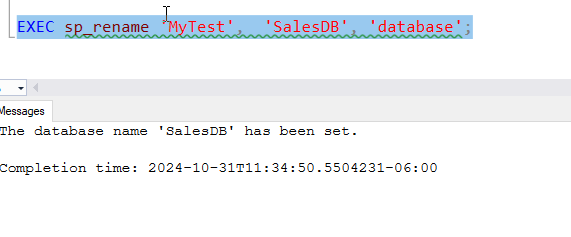
    I thought sp_rename would work, and sure enough, it did.

    2024-10_0232

    However, I need to object type. If I remove that parameter, it fails:

    2024-10_0233

    The command is looking for an object in the current database by default.

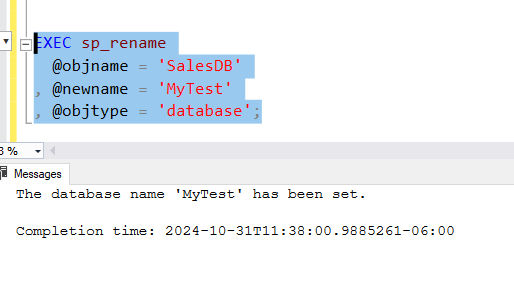
    Technically, I ought to do this to be explicit, naming the parameters.

    2024-10_0234

    I have a better way, however. Note: it’s not sp_renamedb, which is marked for deprecation.

    ALTER DATABASE

    I don’t know when this changed, or if, but you can use ALTER DATABASE to change the database name. There is a MODIFY NAME option for this command that works well. You can see this below.

    2024-10_0235

    This is very clear and seems like better DDL For this process, which can easily be captured as code without worrying about parameters or ordering or anything else. I’d recommend using this.

    SQL New Blogger

    This post took me about 10 minutes to write. Easy. I had done a few experiments and I had code ready (which went to the customer), so I didn’t spend time there. Just rewrote what I did and learned in a few minutes.

    You could do this, add to your blog, and maybe get an interviewer to ask you about this after they saw your post.

  • Counting Groups with Window Functions: #SQLNewBlogger

    I looked at row_number() in a previous post. Now I want to build on that and do some counting of rows with COUNT() and the OVER clause. I’ll show how this differs a bit from a normal aggregate.

    Another post for me that is simple and hopefully serves as an example for people trying to get blogging as #SQLNewBloggers. This is also part of a series on Window Functions.

    The Raw Data

    Let’s use AdventureWorks as a sample database. In the Sales.SalesOrderHeader table there are lots of customer orders, each with a Customer ID. I’ll limit my results to these customers, which has a spread of orders:

    WHERE soh.CustomerID IN (11011, 11015, 11019, 11012)

    We’ll use this WHERE clause to help us decide

    Counting Orders

    If I wanted to count the number of orders each customer hasplaced, I can use this code:

    SELECT
       soh.CustomerID
    , COUNT (*) AS OrderCount
    FROM Sales.SalesOrderHeader AS soh
    WHERE
       soh.CustomerID IN ( 11011, 11015, 11019, 11012 )
    GROUP BY soh.CustomerID;

    I see these results:

    2024-10_0175

    We can see that each of these customers has different numbers of orders.  If I want a simple summary, this is the best code. However, what if I want to add other columns?

    Supposed I want to add not only the customer ID, but also the shipdate. I’m wondering when orders were shipped. If I use the code above, I’d need to add this in the column list, and the group by. If I do this, I get this code:

    SELECT
       soh.CustomerID
    , soh.ShipDate
    , COUNT (*) AS OrderCount
    FROM Sales.SalesOrderHeader AS soh
    WHERE
       soh.CustomerID IN ( 11011, 11015, 11019, 11012 )
    GROUP BY
       soh.CustomerID
    , soh.ShipDate;

    And this result:

    2024-10_0176

    The results are cut off, but they repeat with a 1 for each row. The front end can sum these, but it’s easy to make a mistake here. Especially if there are filters.

    With an OVER() clause, my aggregate changes a bit. I would use this code, where I am paritioning, or essentially grouping, the data by the customer ID. I don’t have a group by, so I don’t need to add other fields in two places. Here is the code:

    SELECT
       soh.CustomerID
    , soh.ShipDate
    , COUNT (*) OVER (PARTITION BY soh.CustomerID) AS OrderCount
    FROM Sales.SalesOrderHeader AS soh
    WHERE
       soh.CustomerID IN ( 11011, 11015, 11019, 11012 );

    And the results.

    2024-10_0177

    I have the count repeated, but if I am showing this in the front end, I can hide that column in a table, but I can also access the total count from any row.

    Differences with Group By

    Let’s say I decide to add something else, like the account number and the SalesOrderNumber. If I do this in a GROUP BY, I need to add this to the column list and the group by, as shown here:

    SELECT
       soh.CustomerID
    , soh.AccountNumber
    , soh.SalesOrderNumber
    , soh.ShipDate
    , COUNT (*) AS OrderCount
    FROM Sales.SalesOrderHeader AS soh
    WHERE
       soh.CustomerID IN ( 11011, 11015, 11019, 11012 )
    GROUP BY
       soh.CustomerID
    , soh.ShipDate
    , soh.AccountNumber
    , soh.SalesOrderNumber;
    GO

    The change the Window function is as shown:

    SELECT
       soh.CustomerID
    , soh.AccountNumber
    , soh.SalesOrderNumber
    , soh.ShipDate
    , COUNT (*) OVER (PARTITION BY soh.CustomerID) AS OrderCount
    FROM Sales.SalesOrderHeader AS soh
    WHERE
       soh.CustomerID IN ( 11011, 11015, 11019, 11012 );

    Maintenance is easy, and what’s more, I don’t have to worry about ordering my group by in different ways. If I do care about grouping, then I can alter the partitioning, but often I just want to add other columns without making the code more complex in a second place.

    The results for the group by have the fields, but all 1s in the count again.

    2024-10_0179

    The window function has the counts for each customer.

    2024-10_0178

    Small things, but those points of maintenance can be annoying and they can cause problems. For complex data, the other fields might not group well, or the order of grouping might change what is shown.

    There are more things to be concerned about here, but one of the big things might be a running total, where I count the orders over time. I’d like results like this:

    2024-10_0180

    My window function code is:

    SELECT
       soh.CustomerID
    , soh.AccountNumber
    , soh.SalesOrderNumber
    , soh.ShipDate
    , COUNT (*) OVER (PARTITION BY soh.CustomerID ROWS BETWEEN UNBOUNDED PRECEDING AND CURRENT ROW) AS OrderCount
    FROM Sales.SalesOrderHeader AS soh
    WHERE
       soh.CustomerID IN ( 11011, 11015, 11019, 11012 );

    The regular code with group by is this:

    select soh1.customerid, soh1.AccountNumber, soh1.SalesOrderNumber, soh1.ShipDate
    , count(*) 'running_total'
    from sales.salesorderheader soh1
    inner join sales.salesorderheader soh2 on soh2.salesorderid <= soh1.salesorderid
                                        and soh2.customerid = soh1.customerid
    group by soh1.customerid, soh1.AccountNumber, soh1.SalesOrderNumber, soh1.ShipDate
    order by soh1.customerid, soh1.ShipDate

    Not bad, but the big difference is in resources used. The statistics IO below shows the difference. Can you guess which is which?

    2024-10_0183

    Hint, the one using less reads is the OVER() code.

    SQL New Blogger

    Setting up a good scenario is a little tricky, and that took time. I messed with a few data sets that helped explain this to me, and you, in a way that made sense. I have a few other scenarios, which I will write about because an OVER() isn’t magic and it might not be the right choice.

    Those will be other blogs.

    This is a good way to showcase that you understand part of how this works. There’s a whole series to be written on different aspects of how the OVER() clause works. Spending 15-30 minutes each time you experiment helps showcase your knowledge and learning to employers.

    That’s what employers need: experimenting and learning.

  • Adding Row Numbers to a Query: #SQLNewBlogger

    I realized that I hadn’t done much blogging on Window functions in T-SQL, and I’ve done a few presentations, so I decided to round out my blog a bit. This post will start with the ROW_NUMBER() function as a gentle intro to window functions.

    Another post for me that is simple and hopefully serves as an example for people trying to get blogging as #SQLNewBloggers. This is also part of a series on Window Functions.

    A Basic Set of Data

    I’m going to use some fun data for me. I’ve been tracking my travels, since I’m on the road a lot. I’m a data person and part of tracking is trying to ensure I’m not doing too much. Just looking at the data helps me keep perspective and sometimes cancel (or decline) a trip.

    In any case, you don’t care, but I essentially have this data in a table. As you can see, I have the date of travel, the city, area, etc. I also have a few flags as to whether I was traveling that day, if I spent a night away from home, and how far I was.

    2024-09_0199

    I have a travelID in here, which is a sequence, but what if I wanted to the trips I took in August 2024. I’d want a distance > 0 (not at home) and filters by dates. Adding that to my query, I’d run this:

    SELECT
       TravelID
    , TravelDate
    , TravelCity
    , Area
    , Province
    FROM travel
    WHERE
       TravelDate     > '2024/07/31'
       AND TravelDate < '2024/09/01'
       AND Distance > 0
    ORDER BY TravelDate;

    This gives me these results:

    2024-09_0202

    There are 9 rows in here, but they have a weird ID number, plus these are different trips. I can just add a row_number to this data, and I’d see this result. Ignore the OVER and track I used, but you can see an incrementing number added to each row. The second column in the result set matches with the number added by SSMS on the side.

    2024-09_0204

    What if I wanted to see the separate trips with some row number for the day in each city?

    That’s where a row_number() can help.

    Creating a Window

    The window comes from the OVER() clause, which is added to a number of functions, including Row_number(). The OVER() clause lets me set a window or rows on which the function works. I can set a partition and an order.

    The partition is a column where we are essentially grouping data. For me, this would be the city. When I change city, I want to reset the number. Looking at the data above, I’d expect to see 1, 2 for the first 2 days in Minneapolis, then a 1 for a day in Fort Collins, and another 1 for day in Aurora

    The ordering is what order is the data in the partition. In this case, I want to have the data in the window ordered by traveldate, so I’ll use that. I now have this code:

    SELECT
       TravelID
    , ROW_NUMBER () OVER (PARTITION BY TravelCity
                           ORDER BY TravelDate)
    , TravelDate
    , TravelCity
    , Area
    , Province
    FROM travel
    WHERE
       TravelDate     > ‘2024/07/31’
       AND TravelDate < ‘2024/09/01’
       AND Distance > 0
    ORDER BY TravelDate;

    And I get these results, where I can see that I essentially had 4 trips (all with number 1s), and these were the trips:

    • Minn – 2 days
    • Fort Collins – 1 day
    • Aurora – 1 day
    • New York City – 5 days

    2024-09_0205

    This shows how row_number() gives me a sequence based on the partition. The select null part in the earlier query just ignores the order by, which is required for row_number(). With no order, how do we know what sequence?

    Let’s change this slightly. What if I partition by Province? Then I see this:

    2024-09_0206

    We put the data in date order, and ran through each province. In this case, my two 1 day trips around Colorado are bucketed (partitioned) together and I see one less trip. If I did this by country, I’d see all of this as one sequential list, since all my trips were in one country.

    However, if I did countries for June, I’d see this, with the raw data on the left and the row_number() on the right. There’s a weird sequence in here; can you see it?

    2024-09_0208

    The weirdness is that my trips to England were broken up by a trip to Italy. So while my sequence looks good for the first part of the trip to English for 6 days, when I returned a week later, we get numbers 7, 8, 9. That’s because the data is grouped first by country, and the sequence added. The ordering of the sequence is by date, so the later days (June 13,-15) are marked with the higher sequence that continues on.

    Hopefully this gives you a basic look at row_number() and some of the possibilities. I’ll examine it further in another post, along with various other window functions.

    SQL New Blogger

    Complex coding and finding weird situations are things employers want you to be able to do. If you work on algorithms or you’re learning new language elements, blog about them. That will impress people.

    This post took me about 30 minutes, plus about 15 minutes or playing with code to set things up. You could likely do this in an hour if you’ve never blogged, though let someone proof things for you.