Tag: T-SQL

  • The Basics of TRY CATCH Blocks–#SQLNewBlogger

    I was working with a customer and discussing how to do error handling. This is a short post that looks at how you can start adding TRY.. CATCH blocks to your code.

    Another post for me that is simple and hopefully serves as an example for people trying to get blogging as #SQLNewBloggers.

    TRY CATCH

    This is a common error handling technique in other languages. C# uses it, as does Java, while Python has TRY EXCEPT. There are other examples, but these are good habits to get into when you don’t know how code will behave or if there is something in your data or environment that could cause an issue.

    In SQL, I think many of us get used to writing one statement in a query and forget to do error handling, or transactions. However, this can be a good habit as your code might grow and people might add more statements that should execute.

    A classic example of code is someone writing this:

    DECLARE
       @id INT = 2
    , @name VARCHAR(20) = 'Voice od the DBA'
    , @stat INT = 1;
    BEGIN TRAN;
    INSERT dbo.Customer
       (CustomerID, CustomerName, status)
    VALUES
       (@id, @name, @stat);
    IF @@ERROR = 0
       COMMIT;
    ELSE
       ROLLBACK;


    Note that this does look for an error and then decide what to do. However, we could be better, especially if we wanted to possibly add a second insert or other work. We could do this:

    DECLARE
       @id INT = 2
    , @name VARCHAR(20) = 'Voice od the DBA'
    , @stat INT = 1;
    BEGIN TRY
         BEGIN TRAN;
         INSERT dbo.Customer
         (CustomerID, CustomerName, status)
         VALUES
         (@id, @name, @stat);
         COMMIT
    END TRY
    BEGIN CATCH
         ROLLBACK 
    END CATCH


    It doesn’t look like much, but this code could easily be enhanced with a better pattern. We can capture the various error messages like this:

    DECLARE
       @id INT = 2
    , @name VARCHAR(20) = 'Voice od the DBA'
    , @stat INT = 1;
    BEGIN TRY
         BEGIN TRAN;
         INSERT dbo.Customer
         (CustomerID, CustomerName, status)
         VALUES
         (@id, @name, @stat);
         COMMIT
    END TRY
    BEGIN CATCH
        DECLARE @ErrorMessage NVARCHAR(4000);
        DECLARE @ErrorSeverity INT;
        DECLARE @ErrorState INT;
    
        SELECT 
            @ErrorMessage = ERROR_MESSAGE(),
            @ErrorSeverity = ERROR_SEVERITY(),
            @ErrorState = ERROR_STATE();
    
        RAISERROR (@ErrorMessage, -- Message text.
                   @ErrorSeverity, -- Severity.
                   @ErrorState -- State.
                   );
    
        WHILE @@TRANCOUNT > 0
        BEGIN
            ROLLBACK TRANSACTION;
        END 
    END CATCH


    In this case, we have a few statements that work with the error, in this case using RAISERROR to raise this. We could also use THROW or add something else. If we had more inserts, like to a child table, we could encapsulate them all here. What’s more, if we had logging, we could log this before the rollback to another system if our logging were not transaction dependent.

    Using TRY CATCH is really just structuring your code differently. Ideally, using something a snippet in SQL Prompt so your developers have an easy way to standardize error handling.

    SQL New Blogger

    This post took me about 15 minutes to structure and test. I looked at a few patterns, and I liked the one in this Stack Overflow answer as a good way to generically implement this structure.

    You could write a similar post showing your next boss how you implement error handling, transactions, anything. Give it a try.

  • Knowing String Defaults in T-SQL–#SQLNewBlogger

    For years I’ve assumed I knew the string defaults, but I realized that’s not right. This post looks at what I learned.

    Another post for me that is simple and hopefully serves as an example for people trying to get blogging as #SQLNewBloggers.

    Declaring VARCHAR variables

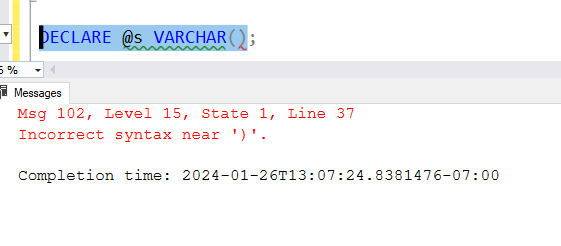
    I learned a couple things. First, this is invalid code:

    2024-01-26 13_07_31-SQLQuery8.sql - ARISTOTLE_SQL2022.sandbox (ARISTOTLE_Steve (52))_ - Microsoft SQ

    The parenthesis aren’t needed, and cause an error. But if I declare just the word, I can add a string. The string in this code is more than 30 characters, which I’ve always assumed is the default length.

    DECLARE @s VARCHAR;
    SELECT @s = 'this is a test of a fairly long string'
    SELECT @s

    When I run this, however, I only get one character back.

    2024-01-26 13_09_00-SQLQuery8.sql - ARISTOTLE_SQL2022.sandbox (ARISTOTLE_Steve (52))_ - Microsoft SQ

    Why is that? Well, the default length is on, according to the docs.

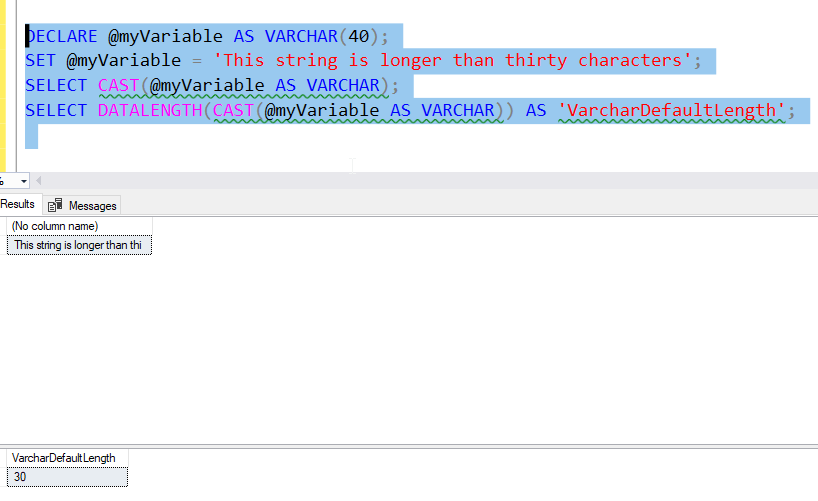
    When is it 20? When we use CAST/CONVERT. In that case, it’s 30. Code from the docs shows this:

    2024-01-26 13_10_55-SQLQuery8.sql - ARISTOTLE_SQL2022.sandbox (ARISTOTLE_Steve (52))_ - Microsoft SQ

    I’ve known this happens with CAST, but I didn’t realize the default length was 1. That’s interesting, and hopefully something no one lets slip into production when it would cause a problem.

    A good lesson is to always declare your length, and don’t make that MAX if you don’t need it.

    SQL New Blogger

    This post took me about 10 minutes to write, once I realized the issue. I spent a few minutes grabbing links, as I’d had some of the code written once I was testing what I’d read.

    You could do the same thing. Show some learning, show some code, show how you change things.

  • Using the T-SQL Error Functions–#SQLNewBlogger

    I was working with a customer that was doing some error handling in procs and helped them do some error tracking. As we were working through things, I realized that some of functions working with errors operated differently than I expected.

    Another post for me that is simple and hopefully serves as an example for people trying to get blogging as #SQLNewBloggers.

    The Error Functions

    There are a number of error functions available to you in modern SQL Server. We have:

    All of these functions have the same clause in their docs, which says, “ xxx returns NULL when called outside of the scope of a CATCH block.”

    That was something I didn’t realize. I’d assumed I could run this:

    SELECT 1/0
    SELECT ERROR_SEVERITY(), ERROR_MESSAGE(), ERROR_STATE()

    However, if I run this, I get the error, but my results are NULL, NULL, NULL.

    If I want the values, I need to do this:

    BEGIN TRY
       SELECT 1/0
     
    END TRY
    BEGIN CATCH
       SELECT ERROR_SEVERITY(), ERROR_MESSAGE(), ERROR_STATE()
    END CATCH;

    This will return my 16, Divide by zero error encountered., 1

    In general, you ought to be using TRY..CATCH blocks for error handling. We do want to ensure that we are doing our best to deal with problems in code and not just expect all errors will be managed by the application. As much as possible, we should try to gracefully fail and give the application or client something useful.

    Along with TRY..CATCH, learn to use THROW, and ensure you’re adding some error handling to older code. This is an easy refactoring add to existing code, and it’s simple to enhance future code to make it more maintainable.

    SQL New Blogger

    This is a quick look at the functions that capture error information, and noting a limitation I didn’t realize. It’s short, simple, and took me about 10 minutes.

    This is one of those topics that dev managers, especially front end based ones, appreciate. Doing a post on this topic on your blog might get someone to ask you about error handling, and with a little practice (and a few posts), you’ll be able to talk about this topic confidently.

  • Using DATETRUNC–#SQLNewBlogger

    I saw someone using DATETRUNC recently in some code and realized I hadn’t really looked at this function before. It’s one that was added in SQL Server 2022, though it’s been in other platforms for years.

    This post looks at the basics of this function.

    Another post for me that is simple and hopefully serves as an example for people trying to get blogging as #SQLNewBloggers.

    DATETRUNC

    One of the challenges for years in SQL Server is dealing with dates. For years we had datetime, and we used this for everything. However, this includes dates and times. The DATE datatype was eventually added, but we have lots of legacy data that includes dates and times mixed together.

    Since we don’t always want dates and times, or we want some cutoff, the DATETRUNC function was added to help us. This function takes two parameters, a datepart and a date.

    The datepart is any sort of potion of a datetime value. This can be quarters, months, hours, minutes, milliseconds, etc. Of course, all as singular, not plural.

    The date is any valid date type: smalldatetime, datetime, date, time, datetime2, datetimeoffset.

    We use it like this:

    SELECT GETDATE(), DATETRUNC(DAY, GETDATE())

    That returns on my system:

    ----------------------- -----------------------
    2023-12-13 18:23:00.337 2023-12-13 00:00:00.000

    If you look, this has truncated the date at the day, replacing everything after this with zeros. In this case, the datetime output of getdate() is turned into a date value.

    Another example, what if I want to get rid of seconds? I can do that easily like this:

    SELECT GETDATE(), DATETRUNC(SECOND, GETDATE())

    ———————– ———————–
    2023-12-13 18:24:19.557 2023-12-13 18:24:19.000


    You can see that I have the same date and time for hours, minutes, and seconds, but I’ve gotten rid of the partial seconds.

    Using This Function

    This is a function, and using it in the WHERE clause (or ON) can impact performance. This often (maybe always) messes up your index usage. However, we often want to display something cleaner, and perhaps in the SELECT clause we want to just order things and show hours.

    I might to show shipments during an hour and this code helps:

    SELECT TOP 50
            o.OrderID
          , o.Customer
          , o.OrderDate
          , DATETRUNC (HOUR, o.OrderDate) AS OrdersByHour
    FROM dbo.[Order] AS o
    ORDER BY o.OrderDate desc;

    770         0SW2LZ               2023-12-12 23:14:35.220 2023-12-12 23:00:00.000
    830         X6SYVULIQQGMZLPN0LL  2023-12-12 23:08:22.450 2023-12-12 23:00:00.000
    731         NB3                  2023-12-12 23:03:45.120 2023-12-12 23:00:00.000
    883         UDPUS144L1SL1Z1KPD   2023-12-12 22:56:25.100 2023-12-12 22:00:00.000
    171         M28F5EYLB            2023-12-12 22:56:07.950 2023-12-12 22:00:00.000
    775         P9LET1EBNFN          2023-12-12 22:53:48.580 2023-12-12 22:00:00.000
    209         S1I4Q04SUOP          2023-12-12 22:19:49.470 2023-12-12 22:00:00.000
    654         5O4GBEWZZVDII        2023-12-12 22:14:53.420 2023-12-12 22:00:00.000
    967         NWA9                 2023-12-12 22:06:04.400 2023-12-12 22:00:00.000
    458         JYD4TZU0S35XPW3WD7   2023-12-12 22:01:14.350 2023-12-12 22:00:00.000
    584         ZDQ2J348SRI6D3HW     2023-12-12 21:59:34.910 2023-12-12 21:00:00.000
    718                              2023-12-12 21:54:32.740 2023-12-12 21:00:00.000
    359         I4YDWI               2023-12-12 21:54:20.970 2023-12-12 21:00:00.000


    If I look at these results, it’s cleaner to see the hours, and this certainly is easier than parsing our and combining years, months, days, and hours.

    There are likely lots of uses for cleaning up output, or limiting input parameters to certain groups of date values. Definitely a function I can see myself using to simplify and group date data in new ways.

    SQL New Blogger

    This post took me about 15 minutes to write, including the mockup of some code and generating some data with SQL Data Generator. I did a basic exploration of this function, and wrote about it.

    This is something you can easily do, and include your own thoughts on where you’d use this. Search your old code for DATEPART stuff and see if you can replace some complex expressions with DATETRUNC.