Tag: work

  • Poor Work Management

    The future of how we will work is uncertain. Every time I read something or talk to someone, I hear different thoughts and experiences, which influence how I feel. Actually, I’m not sure how I feel. Some companies are pushing back their office openings (Google, Microsoft) to a future time, while others are bringing people back part or full time. I had lunch with some friends working at a financial institution, and they are allowed to work at home a day or two a week, but otherwise, they’re in the office every week. I know some other people that are back in the office five days a week.

    There are mixed feelings among many people. While I don’t know many technology people that want to be in the office every day, some do want the option to go periodically to the office. Depending on your commute, you might feel differently, as there are plenty of data pros that want to remain at home full time. Both groups, however, feel that we can be effective at our jobs while working remotely.

    Not all management feels thtat same way, for various reasons. I ran across this piece that speculates that poor management is more likely to fear remote work than embrace it. The example in the piece, from Cathy Merill, certainly seems to indicate this is the case. While I’ve seen some great managers, I feel many managers aren’t good at adapting to dramatic changes and struggle to change their own view of how to do their job.

    I do think culture suffers when we can’t get together in person. Hallway conversations and chats over coffee aren’t as easy remotely, and we don’t build the same bond we get in the office. Working separately at home can work, and we’ve had a lot of success at Redgate, but I also feel more separate from lots of co-workers and miss the chance to get together and catch up. The remote meetings are not the same, and scheduling a quick call is much more of an intrusion than being able to walk by someone’s desk or stop for a minute when I see them in the hall.

    Perhaps it’s the energy from being around lots of people that CEOs and other management miss. It can be invigorating and exciting when lots of people are working together towards a common goal and succeeding. Perhaps management prefers to look someone in the eye and put pressure on them for a lack of performance. That is harder to do virtually, and I know lots of managers that work through intimidation.

    There’s also the investment made in offices. Over the years I’ve seen various configurations and amenities in offices, often to encourage more work and comfort away from home. I know plenty of CEOs and leaders that feel this investment needs to be used by staff for lots of hours each week because of the cost, which seems like a poor excuse to me. That money is spent. These days I suspect more employees push back on longer hours, as they should, and find comfort at home, which might also bother management.

    This issue is complex, but I do know that whether we’re remote or in an office, we can be effective and get work done in teams. Management should know that and use it to try and build an environment that gets the most out of all their staff, whether in the office or remote.

    Steve Jones

    Listen to the podcast at Libsyn, Stitcher, Spotify, or iTunes.

  • The Post Pandemic Office Experience

    I traveled to Pasadena, CA this week to work with a few other Redgaters in an office. There was a get together planned this week for the entire staff, many of whom have not seen each other in a year. Some have never met. When I heard about this, I requested permission to go. My request was approved, and I spent a couple of days in our LA WeWork space.

    I had mentioned I was coming in our Slack channel, and reached out to a few people, hoping to get some people in the office while I was there. I flew out early one morning, with a view I hadn’t seen in a long time.

    20210721_094016

    I enjoy flying into LA, crossing the mountains and desert, seeing landmarks along the way, watching the transition from nature to very developed (and large) city. It always makes me smile. In this case, I arrived and quickly got a Lyft up to the office. Along the way I had gotten a note from someone that masks were needed in the common spaces, and a few phone numbers to text for admission.

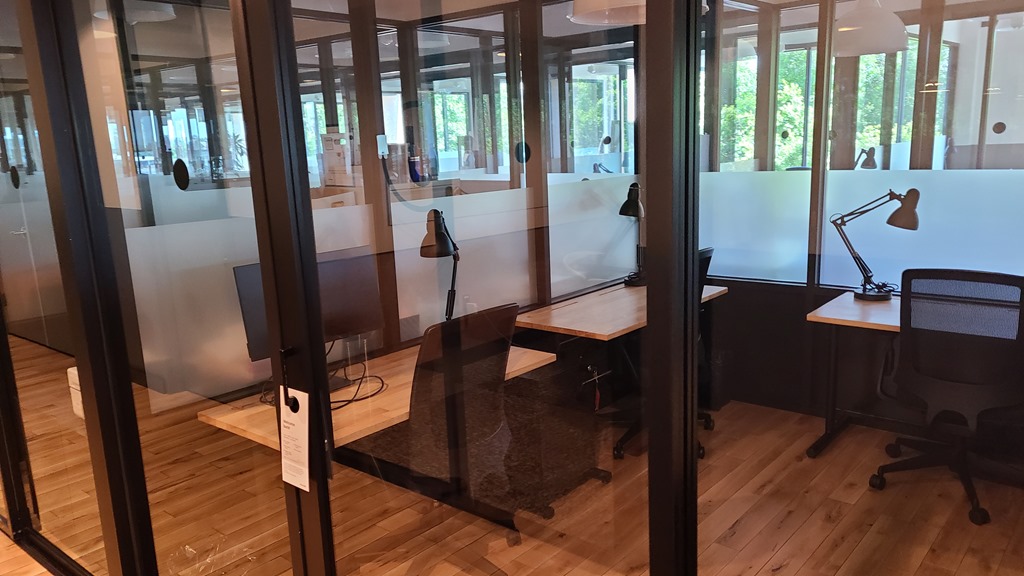
    I wasn’t sure what to expect, as I’ve seen various incarnations of co-working spaces. In this case, WeWork is a large space that’s been cut down and separated with lots of glass walls. There is a lot of security in our building, and I needed someone to use a card to activate the elevator, as well as leave the elevator lobby area. Inside, there are lots of small offices, containing 1, 2, 4, or more desks. While it’s a space where you can see far through the glass walls, it’s also small as there are lots of walls.

    Here’s an example of a larger space, with 5 desks, but I saw plenty of much smaller offices with 1 or 2 desks.

    20210721_150957

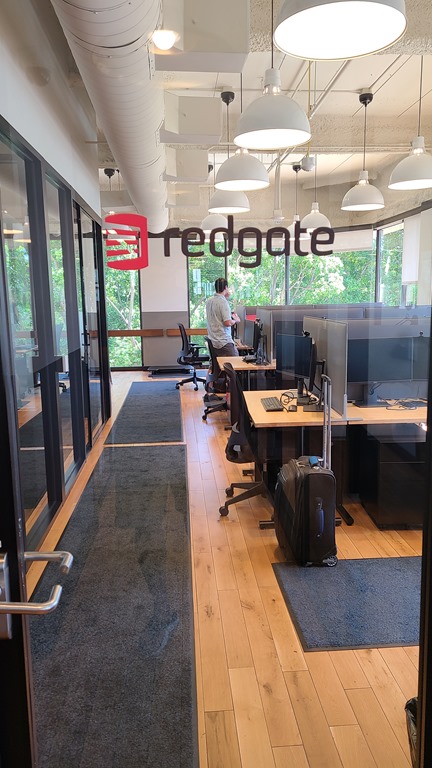
    Redgate has their own space, which is separated from others. Almost all offices have a separate key card entry system.

    20210721_152106

    My first day, there were 4 of us in the office. I knew them all, and I contact them regularly on Slack or in Zoom calls, but it was nice to sit and be able to chat with them in person. Inside our offices, we didn’t have to wear masks, but the coffee machine and bathroom were outside, so I kept mine handy in a pocket.

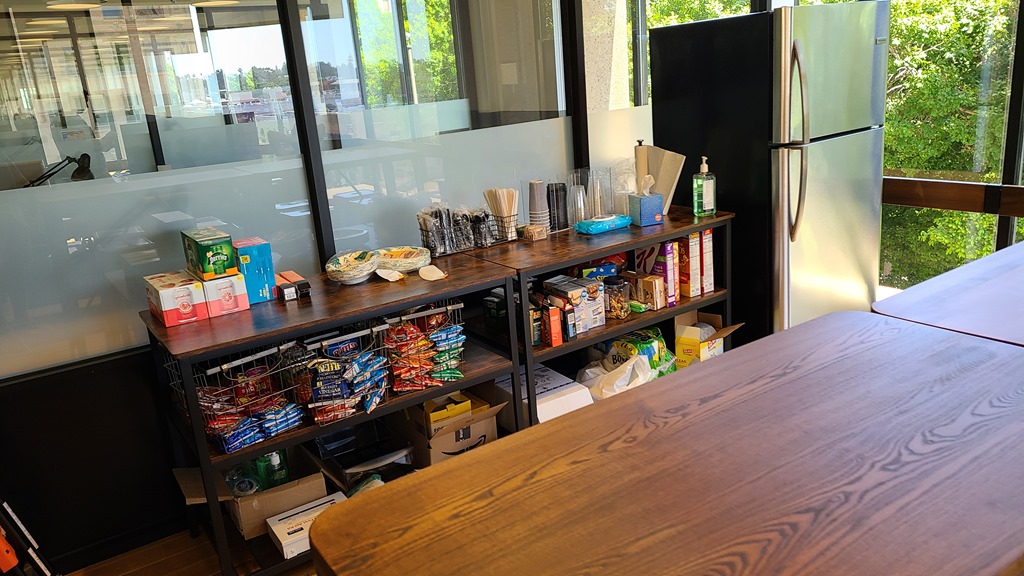
    We did have a small snack area, which was nice. It felt a little abandoned though, with few of us around.

    20210721_152121

    There were really 4 separate areas of desks, and I had one to myself. I almost started to set up next to someone, but then a few people got on the phone and I realized how loud it can be. All the glass and relatively low ceilings make it hard to work in a group, at least in our space.

    20210721_111949

    We went out to lunch, and took some breaks to talk about work or life, and it felt normal, albeit rather limited with so few people.

    The second day was better, with about 10-12 people in the office. It was much louder and a little harder to work, but it felt like a busy organization again. I liked it, and was glad I had the chance to experience it.

    As with many things during this pandemic, things changed. There was an order from the Pasadena Health Department that took effect between my first and second days noting that we had to wear masks, even in our own space. Annoying, but not that much of a problem. I suspect that might keep some people from coming back, or at least make them think about coming less frequently.

    We also had a get-together at a local pub. We were outside, and most of the California staff came. It was interesting in that 8-10 were people no one had met. People hired during the pandemic, who had been working 100% remote while with the company. That was a little strange, but it’s how life goes.

    We talked, laughed, and appreciated the time to get together. I realize that I do enjoy going to an office some time, and I’m hoping I’ll get back to Pasadena 2-3 times a year. It was a good trip, long and tiring for me with two early flights, but great for my mental health, and a way to catch up with people that I haven’t seen in a long time.

    I hope more people come back, at least part time, as it seemed we all missed the chance to get together and talk.

  • Working Predictable Hours

    I was listening to Kendra present at Redgate recently and she said this: Working predictable hours makes me better at my job. Actually, she said she was not better at her job by working longer.

    Kendra has been very successful, she’s driven and a bit of a workaholic. I used to think I was, but after spending a few years at Redgate with her, she can outwork me these days. Of course, she has a bit of youth on her side. We both, however, realize that more work isn’t sustainable, or even good for either the employer or employee.

    There is plenty of research that shows working above 50 hours constantly makes you worse at your job, at least when you are doing thought work. For more physical work, your body breaks down, and likely you will struggle with health as you near retirement.

    Kendra has a good list for setting boundaries in her life. Many of these are things that I’ve implemented over the years in my life. In the last few years I’ve gotten rid of many notifications that interrupt life, as well as set Do No Disturb hours on my phone. Rarely have I missed anything important, and I’ve avoided plenty of early am “quick questions” from the UK. Apparently they are as bad at calculating time zones as I am.

    At the same time, I like unpredictable schedules, but fairly predictable hours. I don’t like a rigid schedule, and I try to ensure if I have standing items, they are on a few days so I have flexibility on other days. I like being able to take breaks during the day to go to the gym or work on something around the house. I certainly like the freedom to stop working on a Tuesday if I don’t feel productive and making up time on Saturday or Sunday.

    This past year has really been a very predictable schedule for me and others because we couldn’t go many places. We woke up, walked to another part of our house, worked, and then repeated that over and over. Some of us did a better job of learning to stop working after certain hours, and some did a worse job and spent more time working.

    No matter what type of structure you use, remember that you need to take care of yourself. Your physical and mental health aren’t worth sacrifice for an organization. While you do owe your employer an honest day’s (or week’s) work, you also owe yourself a balance. Do your best work, which also means limiting how much you tackle every week.

    Steve Jones

    Listen to the podcast at Libsyn, Stitcher, Spotify, or iTunes.
  • A Work Conference

    I like the idea of a work conference. We’re actually having one at Redgate this week, though it’s all virtual. I’d like an in person one, and it sounds like that will happen at Atlassian four times a year when they require employees to be in the office. That’s it.

    Four times a year.

    They are going all in on work from home, allowing employees to be in any place that Atlassian has a legal presence for work. As someone that’s dealt with this, it is a hassle for a company doesn’t have any setup for an employee in a new locale, especially in the US. So I understand them limiting employees to places where the company has a corporate entity. Still, that’s a lot of places for Atlassian.

    Many Atlassian employees do expect to go to offices about half the time, but they won’t be required to do so. I think there are lots of their staff that want to be able to go to an office, at least some time.  I do wonder how they will handle meetings and collaboration with people being able to move their schedule around and be in or out of the office. At Redgate we’ve said remote first, but sitting at my desk for a meeting with one person that’s at their desk in the same room and one person that is remote feels strange.

    Getting everyone in a region together a few times a year is a really interesting idea. It will feel like a SQL Saturday or other event when you know everyone will show up. I can see this generating some excitement. Especially if those days are different from normal workdays.

    It’s something I think I’d be interested in, and perhaps excited by. I think I’ll suggest each Redgate office have a few days a year, and then see if I can get invited to each office on those days. Fingers crossed that it happens.

    Steve Jones

    Listen to the podcast at Libsyn, Stitcher, Spotify, or iTunes.