You could win an Amazon Echo from Redgate. Our contest is still open for a few days, so post a comment on my blog and take your chances. I’ll be picking from the comments next week.
Author: way0utwest
-
Becoming a Data Scientist
Data Science is hot. There are lots of companies excited by using machine learning and AI to enhance their applications. There are new jobs, some of them well paying, and certainly not enough people to fill them. In many ways this reminds me of previous “hot” areas, such as Novell Networking in the late 80s/early 90s. Companies wanted new CNEs and paid dearly for them. The same thing happened in the mid 90s with MCSE’s for Microsoft networks. Many of the people hired weren’t remotely qualified, having just completed some multi-week boot camp.
You could go to school. If you have completed college, there are a list of data science graduate programs that you could choose from and pursue a masters degree. There’s even a blog where someone is documenting their masters degree path to becoming a data scientist. This isn’t a quick or east path, but it is one way to gain data science skills.
If you don’t want to spend the time or expense of a formal college program, Microsoft has a data science curriculum on the EdX platform that you can complete. These are low cost programs that you can complete to get a certificate. The value of that certificate is debatable, but the same could be said for any program. A few people that are working through this program have found it to be a good set of resources that is teaching them valuable skills.
There are other options, no shortage of books, blogs, and other resources on data science and data analysis techniques. It’s up to you, however, to learn what you need to know and become competent at a level that is useful for some organization to pay you. I dislike people choosing to study a topic for a job, so I would say that if you wish to go down this path, do so because you enjoy the work and find it interesting. Build some skills, build a portfolio of data science projects, and best of luck.
Our industry has thrived for a long time on simple analysis, and I think there will be jobs in this area for some time to come. I do expect that better looking reports and dashboards are going to be expected rather than simple tables, so I’d suggest everyone work on their visualization and report polishing skills. I also think that more complex data science techniques will be in demand, though I wouldn’t expect job growth here that overwhelms current jobs. Tackle data science if you like, but be aware this isn’t a simple or easy chore. There are lots of math and statistics involved and it looks like this is more science than just data.
Steve Jones
-
DevOps Basics– git Cloning Repos
Another post for me that is simple and hopefully serves as an example for people trying to get blogging as #SQLNewBloggers.
This continues my series on git, because I think it’s good to know what the command line is and how to use it.
Once you have git running, the thing I’ve often wanted to do is go get code from somewhere. Certainly the creation of a repo and new code is something you might do, but often you’ll be looking to get code from somewhere else, so let’s look at how we can do this.
Find a Repo
Most of the time I find a repo somewhere in the company or on the Internet. Fro example, I have a simple database structure that I’ve used for demos at Github. This is my ASimpleTalkDB Repo, which is at: https://github.com/way0utwest/ASimpleTalkDB. You can see it here:

Off to the right is a “clone” button, which is what we want to do. We want to perform a git clone. If you click the button, a URL is in an edit box. The URL is: https://github.com/way0utwest/ASimpleTalkDB, the same as the repo above.
Let’s clone this. First, get a folder to store code in. I started with a Documents\Github folder on my various machines. I’ll use that, and as you can see, this is a place I have a number of folders, each one a repo. I don’t have this repo set up yet.

I’ll clone this from the command line. The various tools do this, but now you’ll understand how this works. First, open a command line in this folder and then type “git clone https://github.com/way0utwest/ASimpleTalkDB”. This will clone the code, as shown below:

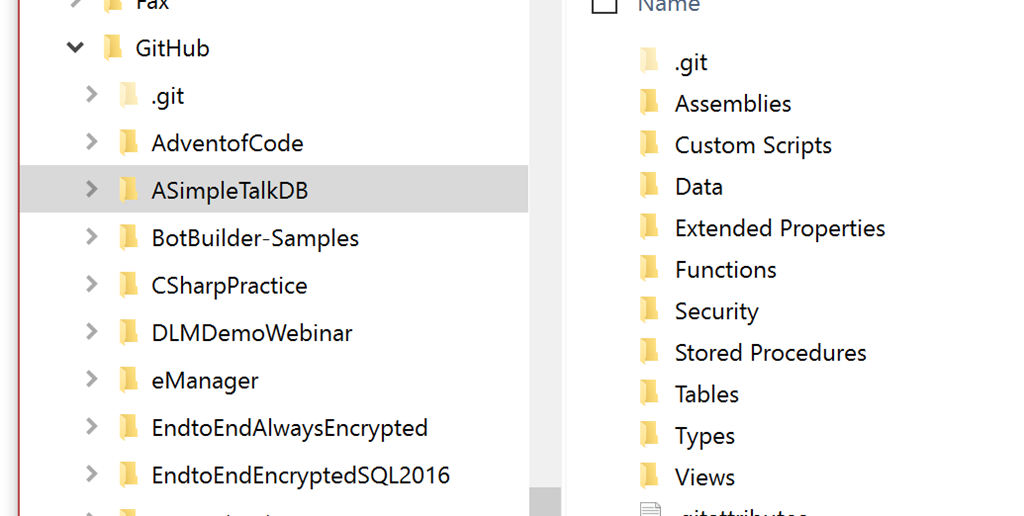
By default, the name of the repo becomes a folder name, with all the code below that. If I look in Explorer, I can see this.

However, I can control this. I’ll delete the folder and do this again. That’s the power of a VCS. I don’t need to worry about this code, because I’ll go get it from another repo.
Once I delete the folder, I’ll re-run the git clone command, but with the name of a folder added to the end.

These objects, 264 of them, copy to my machine in a few seconds over hotel wi-fi. This is code, just text, and it’s quick. If I change to the folder and check the status, I see it is a real repo:

Cloning Folders
What if I have code inside the company, and not in Github, Gitlab, BitBucket, VSTS, etc. Can I clone things? Yep, you can, but don’t use this to get a copy of your own code. That’s what branches are for. We’ll talk branches later, but for now, we can assume you might have a repo in your company.
For example, let’s assume for a moment that my C:\users\%username%\source\repos folder is on the network. I can clone one of these repos like this:

Again, this isn’t the way to get a copy of my own code to work on. This is for getting a repo that I want to work on for myself, where I’ll then merge changes back to the original repo on another machine. On my own machine, I’d just use branches.

This will help you get some code, and I’d encourage you to copy some code down and see how it works. Go get some code from my repo and build a db if you have SQL Source Control (point this to your cloned repo), or grab something from Microsoft and play.
That’s it for this post. There are lots of places to go. I’ll talk about how to now push your code elsewhere once you’ve changed it in another post as well as how to branch and accomplish a few other things.
A few resources (more boring, but will help you learn if you want):
git clone (git)
Create a Repo (Channel 9)
-
Python in SQL Server
The Microsoft Data Amp event was this week, with a number of SQL Server announcements. We now know this is going to be called SQL Server 2017, which is no surprise. CTP 2.0 was also released, which includes a few improvements, but one in particular caught my eye. Python code can now run inside SQL Server, meaning we are not limited to the R language for data analysis. That’s exciting to me and I think that’s a great change. It’s one that’s been rumored for some time. I like Python, and think it’s a nice, elegant language. My son has been learning it in college and I’ve spent some time playing with it after the SDTIG got me interested with their beginning Python and Data Science modules. Since then I’ve spent a little time learning R, but find it to be a cumbersome language to work within. Having code embedded in a string in a SQL Server stored procedure made things harder, and I kept hoping that Python would be added.
It’s there now and you can play with it. While you might debate whether this is a good use of SQL Server resources, I think for quick, short, specific analysis calls, it’s a good choice. Certainly complex calculations and data manipulations are not always efficient in T-SQL and having another option is great. You’ll want to be careful when you run Python or R code, but these are good options to have. There is also GPU processing support is available to take some load off your main CPU.
CTP 2 is supposedly feature complete and there are more changes than just Python. Tempdb has a better setup experience, we get the first version of graph data and query support, resumable online index rebuilds, adaptive query processing, and more. You can read the announcement, which isn’t heavy on technical details, but gives you an idea of what’s changing. I’m not much of an SSAS person, but there are some enhancements in this platform as well.
There are other improvements and announcements this week. Azure Analysis Services is generally available (no longer beta), as as Azure Data Lake Analytics and Data Store. DocumentDB is improved and some Cognitive Services are GA, and in general, Microsoft is all in on the analytics and deep learning.
The world of data in the Microsoft world is growing and changing rapidly. We’ll have a new version this year, just a little over a year after SQL Server 2016. I expect that we will continue to see more, and new changes, occurring at a rapid pace in the future. None of us will completely keep up and become experts in all areas, but we have lots of options for new learning and experimenting with advanced features. I’d encourage you to take a little time here and there and read about and play with the new features. If you have Docker, you can get a version of SQL Server 2017 up and running without installing anything on your machine to see if there are any changes that might help your organization take better advantage of the data you work with every day.
Steve Jones