Author: way0utwest

  • Another Re-Release

    If you haven’t noticed, SQL Server Release Services dropped an updated CU6 for SQL Server 2014 SP1 this week. This replaces a previous CU6 that had a NOLOCK bug in it, and the old KB article (and patch) have been deprecated. You can install the new CU#6 on top of the old one, and you should. The old patch could cause you some issues, so if you’ve applied CU#6 previously (build 12.0.4449), go download the updated patch, test it, and apply it to your instances.

    However, there’s a couple issues with the process here. First, re-releasing a patch under the same name (with a different build) is confusing. I am sure there are going to be plenty of people, especially accidental DBAs, that think they’ve applied CU 6, and they don’t realize there has been a change. There will be others that apply the patch from an old download that’s shared on their file system. I’d much rather have fixed patches released as a new CU. What does it matter if CU #7 is released now instead of in a few months? There’s no limit I’m aware of for the number of CUs allowed for a particular version, so let’s just increment numbers.

    The second issue, for me, is that this eats up time. Releasing quickly is one of the problems with an agile approach, where you update software quite often. There isn’t necessarily enough time to completely test the the fixes, and as comprehensive as the Microsoft testing suite is, there will be things that are missed. I certainly think Microsoft deserves kudos for finding the issue and releasing a fix so quickly. However, will this patch be distributed as quickly as the original CU #6?

    If you are used to applying these CUs, are you going to notice there is a new version of this CU to apply? The blog entry title doesn’t note this is re-released. If you look for the latest patches and see CU #6, will you realize this fix has been updated? If you know there’s a new patch, will you have time to re-test the update and schedule another release? I know from experience in a large organization, re-applying Service Pack 3a for SQL Server 2000 was a chore, with limited time to re-deploy a patch among all the other work we had scheduled.

    One thing I’ve noticed is that more and more companies are depending on their databases more often, demanding higher uptime and fewer maintenance windows. The more patches we have, the more troublesome it can be to get permission to apply these patches, especially across a large server farm. Microsoft is building a better engineering process, that allowed for more comprehensive (internal) testing and quicker releases, but this process doesn’t necessarily prevent all mistakes. Those mistakes are not only bad press, but they reduce confidence in the entire process.

    I do think these CUs will start to take the place of Service Packs at some point, though I think the pace will become problematic for many organizations, especially those running third party software. I’m guessing that at some point, a good portion of the SQL Server community will start treating these patches like upgrades, and not applying every one. Many people will end up applying only every fourth or fifth patch, much like people seem to be upgrading many instances every 6 or 8 years.

    Steve Jones

    The Voice of the DBA Podcast

    Listen to the MP3 Audio ( 4.1MB) podcast or subscribe to the feed at iTunes and LibSyn.

  • Another Recursive CTE–Doing Math

    Another post for me that is simple and hopefully serves as an example for people trying to get blogging as #SQLNewBloggers.

    I showed how to write a simple recursive query recently that calculated an amount of money paid out each day. Now I want to extend this a bit to include a few math formulas.

    Note: These aren’t terribly useful, but they are good practice for just writing recursive queries.

    Fibonacci Series

    I’m sure many of you have dealt with a Fibonacci series at some point in your life. This is a series where the current value is the sum of the two previous values. In other words,

    term 3 = term 1 + term 2

    term 4 = term 2 + term 3

    etc.

    The series starts with 0, 1 and goes from there. Can we do this in SQL? Sure.

    Let’s start by looking at what we need. We need some counter, a current term, and a previous term. That’s 3 columns in our query. We start by building an anchor, which has the first two terms. The counter is n and the two terms are i and j.

    — Anchor

    select n = 1

    , i = 0

    , j = 1

    Now we add the recursive part. In this case, the counter increases by 1. I only include the counter so I know when to stop. SQL Server has a finite size of various values, and we can exceed that without a way to stop.

    The first value will be calculated from the current value + the next call. The current value will become the second one on the next last call, so we move that over. This gives us.

    select counter + 1

      , first = first + second

    , second = first

    With this, we can then add a WHERE clause to stop. I’ll stop at the first ten terms. Here’s the CTE.

    WITH myFib (n, i, j)
    AS
    (
      — anchor
      SELECT ‘n’ = 1
           , ‘i’ = 0
           , ‘j’ = 1
       UNION ALL
       — recursive section
       SELECT n + 1
            , i + j
            , i
           FROM myFib
    WHERE myFib.n < 10
    )
    SELECT
    ‘Level’ = myFib.n
    , ‘Fibonacci’ = i FROM myFib

    If we run this, we see:

    2016-05-17 19_16_28-Cortana

    We can extend this by altering the WHERE clause.

    A Little Calculus

    What about math functions? Have any of you worked with a series in calculus? If so, you might remember something like this:

    eq0018M

    This is a repetitive calculation, and should either converge or diverge. Can we implement this as a recursive CTE? Sure.

    This one is really simple. I use the POWER() function in my recursive member to raise –1 to whatever counter I’m using for n. I then use a SUM() across all previous values in the outer query to get the sum.

    WITH myPartialSum (n, s)
    AS
    (
    SELECT ‘n’ = 1
         , ‘s’ = POWER( -1, 0)
         UNION ALL
         SELECT n + 1
           , POWER(-1, n)
           FROM myPartialSum
           WHERE n < 100
    )
    SELECT myPartialSum.n
          ,myPartialSum.s
          , ‘partialsum’ = SUM(s) OVER (ORDER BY (SELECT NULL) ROWS BETWEEN UNBOUNDED PRECEDING AND CURRENT ROW)
    FROM myPartialSum

    Note: This series does not converge, as it alternates to infinity.

    Neither of these is terribly useful, but they do allow some practice in writing CTEs that will recurse.

    SQLNewBlogger

    Implement some other series or sequence yourself and explain how it works.

  • The Coffee Routine

    My daughter had a birthday recently, and one of the things she asked for as a present was a French Press. She loves coffee and is willing to wake up 15 minutes early each day to grind beans and make a nice cup of coffee each morning before high school. This has been a routine for her this past year, one that has generated requests for me to return home from my trips with new coffees for her.

    In a chat with Andy Warren recently, he mentioned that his new company has a few different coffee machines, with different choices available for employees. Some simple machines, some French Press, and other ways that employees can get their morning coffee fix. This is a small perk, but one that often goes a long way in the technology world as many developers I know aren’t morning people. They appreciate getting coffee provided by their workplace.

    This is in contrast to the situations I encountered early in my career. Back then there was no Starbucks available during my commutes, in fact, with few choices for coffee shops. I started in a large company where each department was in charge of their own coffee. We pooled money together to buy a cheap Mr. Coffee (replacing it ever year or so) and each of us contributed to fund to buy a large tin of Maxwell House every few weeks. I’m sure quite a few of you couldn’t imagine that scenario: cheap, bad coffee every day. In other companies, the same Mr. Coffee was provided, along with the buckets of ground coffee. After a decade and a half in this business, I finally worked at a company where we had a better machine.

    I was thinking about this on my recent trip to the Redgate office( after a quick stop in Copenhagen where I was instructed to be sure to get a bag of coffee for my daughter). The Redgate coffee machines (4 of them) are all located on the ground floor, in the atrium. This means that anyone wanting a cup gets to leave their desk, or make a trip before a meeting, to the open area. Lots of conversations start here, and certainly there are interactions between departments that might not otherwise occur. Plus, we have great machines, as you can see in my video.

    Despite the hassles, I visit the machines a bit too often while I’m there. At least 4 or 5 times a day, which means it’s probably good I’m not in the office full time. Now if I could only get them to put soy milk in one of the machines…

    Steve Jones

    The Voice of the DBA Podcast

    Listen to the MP3 Audio ( 3.0MB) podcast or subscribe to the feed at iTunes and LibSyn.

  • Running Multiple Threads Quickly

    Recently I was looking to generate a quick workload against an instance. I wanted to add to the amount of work my system was doing by executing a number of queries simultaneously. There are a variety of ways to do this, but I just wanted a quick set of queries. I’ll show a couple ways to do this and then look at a few other tools in later posts.

    The Cumbersome Way

    I can open queries in two windows in SSMS. Note, each of these will execute 50 times.

    2016-05-20 14_17_34-SQLQuery1.sql - 192.168.1.71.SQLServerCentral (sa (56))_ - Microsoft SQL Server

    Now I have two windows, and I can click execute in one, then click to the other, and click execute again. That’s easy. When I do this, I’ll have two threads, each running a query 50 times.

    A Better Way

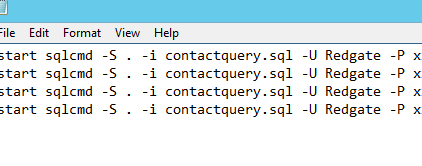
    A better way is to use a SQLCMD call with my query in it. In this case, I’ll create a notepad file and add multiple SQLCMD calls in it.

    2016-05-20 14_29_03-SalesDemo-2015-12-01-1745-export-i-fgod4b6h - VMware Workstation

    The key here is the “start” at the beginning of the line. This will spawn a new thread with the program being called in it. In this case, I’ll get 5 windows very quickly, each running my query. My query is in another file:

    2016-05-20 14_28_19-SalesDemo-2015-12-01-1745-export-i-fgod4b6h - VMware Workstation

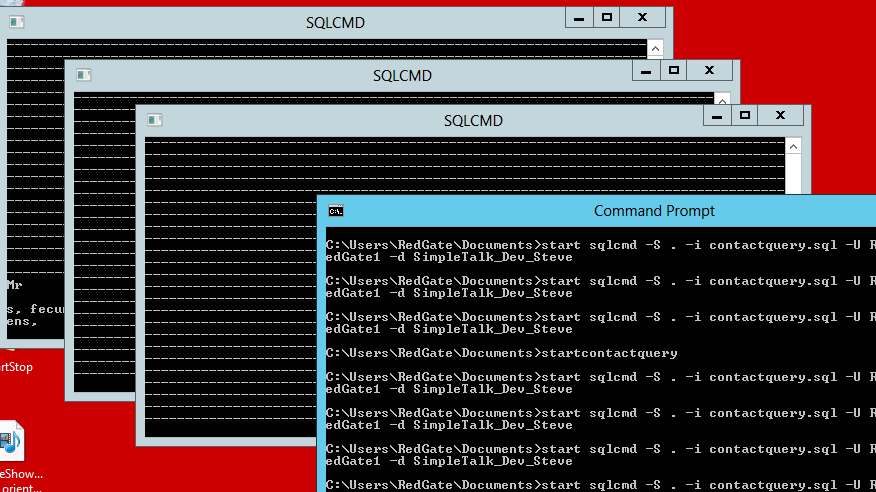
    If each query is set to run multiple times, I’ll have a simple load generated. In my case, I’ll run the .CMD file from the command line, but I could double click it. When I do, I see this:

    2016-05-20 14_30_13-SalesDemo-2015-12-01-1745-export-i-fgod4b6h - VMware Workstation

    You can see the window where I started the queries in front. Three of the command windows are in the background, each of them running queries over and over. The output from the query, with all the dashes for spacing between the headers and data, are in each window.