Author: way0utwest

  • What We Want and What We’ll Pay For

    I’m sure many of you see surveys that note IT job growth is up 30%. Or that executives want to hire 20% more people. Or that the market dictates that salaries will be going up 12%.

    Those are exciting numbers, and I see them too. However I saw a great post that summed up the fact that those are just quotes, perhaps even desires, but not necessarily realities. This answer notes that what we want and what we’ll pay for are often two different things.

    Many IT executives would like to hire more staff. They know that there’s a backlog in IT that can be reduced with additional staff. They might also believe that hiring more staff increases the chances of talented staff that can produce higher quality work, playing a game of numbers. They also know that newer hardware or software technologies can often produce better results for the organization.

    However whatever their beliefs, they will often be constrained by budgets. There are always going to be other priorities in an organization that compete for additional resources. Sometimes IT will get what they want; sometimes they won’t. Often the end result will be less than they want, but more than other groups would have spent on technology.

    The surveys and quotes we see published, good or bad, aren’t worthless. They’re often a reflection of a best case hope, like so many of the estimates that developers give about their work. The numbers can indicate a trend, but take them with a grain of salt. Apply a little skepticism and treat them like averages. Remember, an average of 50 can come from 49 and 51 or from 1 and 99, both pairs of numbers reflecting different realities. Above all remember that an average or ideal also doesn’t necessarily reflect what you, personally, will experience in your career.

    Steve Jones

    The Voice of the DBA Podcast

    Listen to the MP3 Audio ( 2.3MB) podcast or subscribe to the feed at iTunes and LibSyn. feed

  • Is Skynet Coming?

    That’s the question this week: Is Skynet coming?

    I read a piece recently that noted Stephen Hawking, Elon Musk, and Bill Gates have warned us about artificial intelligence. They have been quoted as this is potentially something that the human race needs to be cognizant of. However, I wonder.

    I know what IBM’s Watson does is amazing, but is it intelligence? Is it anywhere close to sentience? Or is it really just pattern recognition and matching with facts? I think more of the latter, and I’m not sure we’re moving closer to a computer intelligence.

    I guess there are narrowly defined domains where computers seem to be improving their capabilities, but it seems to me that these areas are defined by the programmers and the systems are tailored to a specific ability.

    I do agree with the article that combinations of massive computing power and humans will make fundamental changes in the world. I think many, many jobs are potentially going to be lost and workers dislocated because of the ability of computers to do many jobs that humans perform today. I don’t have any solutions here, but I am glad I work in technology.

    Steve Jones

    The Voice of the DBA Podcast

    Listen to the MP3 Audio ( 1.6MB) podcast or subscribe to the feed at iTunes and LibSyn. feed

  • Get Away from the Heat and Learn some Database Version Control

    I have enjoyed the trips I’ve made to New Orleans and Baton Rouge in the past. It’s a good getaway, stopping in the French Quarter for a few minutes before an easy drive up the road. However it’s warm, and I can’t ever get my wife or kids to come with me. For some reason, they don’t seem to enjoy the warm, August Baton Rouge weather. I, however, am looking forward to a jog around University Lake.

    LSU University Lake at BREC Milford Wampold Park

    This might be the best time to run, but I’ll likely be going around when it’s sunnier, and a touch warmer.

    However if you want to get out of the heat, perhaps you’d like to come learn about Database Version Control with Ike Ellis and me? Redgate Software has partnered with Crafting Bytes to deliver our workshop in Baton Rouge. We’ve put the workshops on sale, and only $100 for a full day of training.

    What will we cover?

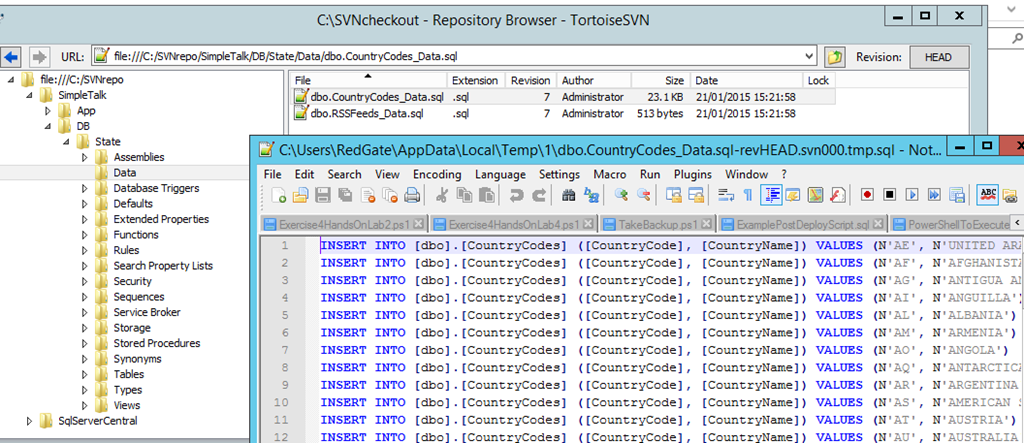
    We’ll show you how to get your database in a Version Control System (VCS). We use Redgate’s tools, but the idea of using version control can be done in other ways. I’m running the labs, and you’ll see how you can keep track of all of your database DDL code, including Lookup data!

    2015-07-23 18_45_53-DLM-Workshop-2015-02-19-1708-export-i-fg1k1eq0 - VMware Workstation

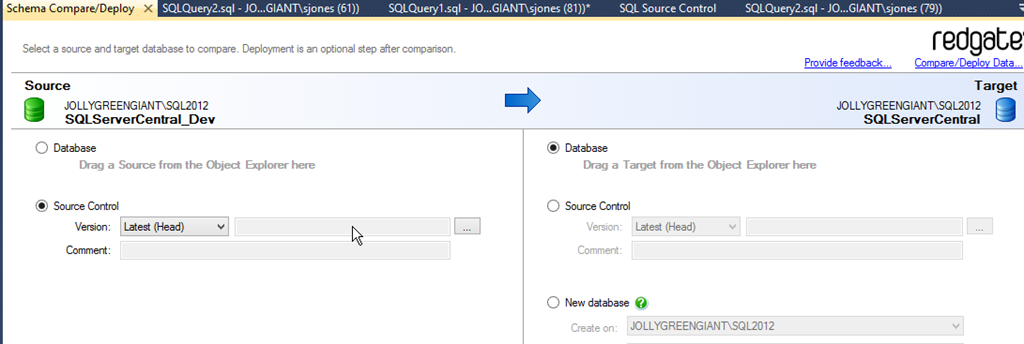
    We are also covering some advanced features that the Redgate tools make easier. Things like branching, merging, and deployments. How many of you would love to know that development is done and we can deploy our changes like this:

    2015-07-23 17_14_22-Schema Compare_Deploy - Microsoft SQL Server Management Studio

    I’ll show you how you can deploy your changes right from inside SSMS.

    This is an in-depth workshop, covering way more than I could ever do at a SQL Saturday or conference. What’s more, we provide you with a VM and let you actually work through the skills we teach you. You will get real practice during the day to give you the confidence and practice for your own environment back at the office.

    I hope to see you at either the workshop or SQL Saturday #423 in Baton Rouge.

  • My SQL Server Service Account Philosophy

    Recently someone sent me a question about service accounts. They weren’t sure how they should go about setting accounts up for various instances and services in their environments. Specifically they asked me about having domain accounts, or accounts separate for services.

    Note that I’ve managed SQL Server for years this way in environments up to hundreds of instances. I haven’t managed thousands, so there might be issues with this philosophy at scale.

    Here’s how I view service accounts. In a short list, I try to manage things like this:

    • Domain accounts for the SQL database engine and SQL Agent
    • Separate accounts for all instances and all Agent services
    • Long, complex, one-time passwords that aren’t stored.

    This has worked well for me, providing separation of services so that password changes or security issues on one instance don’t affect other instances.

    It’s also been scalable in that I rarely setup SQL Server instances. In most organizations I’ve worked in, we are adding a few instances a week at the most. The overhead to create two new accounts per instance (db engine and Agent) is minimal.

    Note that I would also have a separate domain account for SSAS or other items I install.

    With today’s rapid provisioning of machines through virtualized environments, I realize this isn’t necessarily a good hard and fast rule. If I expect an instance to be a production level instance and live for some period of time in the organization, I’d follow this philosophy.

    However if I am bringing online development and test instances that may not be kept around permanently, I think the local service accounts are fine. These will probably handle your needs and are worth scripting into your VM/instance creation process.

    I’ll add a few more thoughts on this across other posts, but there’s my idea in a nutshell.