Author: way0utwest

  • Presenting Data

    Many of us that develop or manage database systems are concerned with the actual bits and bytes that compromise data. However our clients and customers are more interested in the information, in gaining knowledge from the numbers, strings, and dates that are kept in our database tables.

    I really think that one of those things that can truly allow a developer or DBA to show their employer they are valuable to the organization. Employees prove this when they can retrieve information in a way that clients find valuable. Not that we, as the technical people value, but in the ways that clients find valuable.

    This doesn’t mean you need to learn PowerBI or PowerPivot or any other Power tools, but that you learn how to present the data you work with in the best way you can. Whether that’s in an SSRS report, an Excel worksheet you email around, or a complex visualization, all of these formats have one thing in common: a query. One of the best things you can do as a developer or DBA is ensure you can write efficient queries that assemble data from a variety of tables in different formats. Queries that retrieve data that can answer a question or reveal a pattern.

    Learning how to build a fancy visualization is great, but be flexible. If you get the opportunity, work with a new technology and develop some comfort, take it. However make sure that above everything else you can get the data sets to the end user. Clients can always use their own tools, but the efficiency and performance they experience will often come down to your query writing skills.

    Make sure you are constantly improving those skills.

    Steve Jones

    The Voice of the DBA Podcast

    Listen to the MP3 Audio ( 2.0MB) podcast or subscribe to the feed at iTunes and LibSyn.
  • Information on the Go

    I have been very interested in smart watches over the last couple years. I like wearing a watch that allows me to glance at it for the current time. While I can pull out my phone, and I’ve done that for little over a year, I preferred a watch. There are plenty of times that my phone isn’t easily pulled out.

    After considering lots of watches out there, I eventually settled on a Pebble, which I wrote about after living with it for a few weeks.

    Since that time, I’ve continued to use the watch and have enjoyed getting data on the go. Today I was traveling and getting a flight notification (priority email) through the watch as I was traveling through the airport was nice. I didn’t have to pull out the phone, and in fact, because it was in a low pocket, I didn’t feel it vibrate. Not that I would have had issues today, but there are times it would have been handy.

    One the plane, I saw someone with an Apple Watch. In fact, I’ve been seeing them more and more. My wife had asked me if I wanted one for my birthday this year. I like Apple products, and it was tempting. However the more I’ve looked at the product and read about it, the more I agree with Troy Hunt. It’s beautiful and awesome. And pointless.

    I want simple, quick information on the go. For me, that boils down to a few things I’m looking to learn without finding my phone while I’m walking, running, driving, or even talking with friends:

    • time
    • text messages – This is so I can decide if I want to, or need to, respond.
    • high priority emails – In the iPhone, these are my “VIP” people.
    • music – current song, play/pause, skip/restart
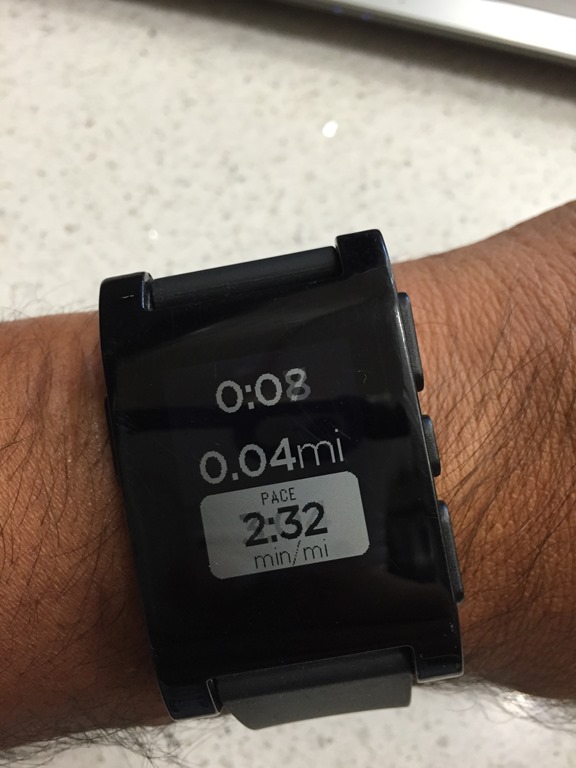
    • pace and exercise time

    The last item is really nice. If I start a workout on the Map My Run app, it starts the display on my wrist

    Photo Jul 17, 2 29 11 PM

    There’s not much more I want to appear on my wrist. Having this track my steps  would be nice, but I haven’t seen a way to track this in the background, which is what I would need to get rid of my flex.

    Responding to texts might be nice, but I can’t see how that would work smoothly, nor do I want to use speech. I don’t want to answer the phone on it, ala Dick Tracy, nor am I looking to play games.

    Really, I’m looking for a little bit of data. The Pebble seems to be the best choice for me, with a long battery life, flexibility to control notifications from the phone, and get a bit of information in an easy to consume fashion.

    Your needs might be different, and I’m sure some people would prefer a better device that does more, perhaps with GPS or other functions, but for now I haven’t seen a better device for me.

  • Continuous Delivery In Real Life

    I’ve been writing and presenting on Continuous Integration (CI) and Continuous Delivery (CD) for a few years now. In that time I’ve encountered a lot of excitement and a good deal of skepticism as well. Many people want to know more and more, who is actually using this stuff? It’s nice to talk about Spotify and Netflix, but their problem domain, resources, and above all, youth, are something few organizations deal with.

    What about Microsoft? They’re a large organization, fairly mature (now 40 years old), and have their own levels of bureaucracy to manage. However they’re fundamentally changed the way they perform development across the last decade and a half. Starting in the beginning of this century, they moved to make secure coding a priority. In the last few years, they’ve also started to truly speed up their development process with CI and CD, culminating (now) with an extremely quick Windows 10 development pipeline.

    I saw a piece noting Microsoft is releasing almost daily builds of the new OS. That’s an amazing feat of engineering, and certainly one that shows you can develop an efficient software pipeline. While I’m sure that individual engineers don’t necessarily have their code released daily, that’s not the point. The point is that changes can be checked into version control (please, please do this), tested, and then made available for release.

    You can build software this quickly, too, though not in a day. Probably not in a month. I would guess it will take a year or two for many organizations to assemble the processes, change a bit of culture, and get used to building your application daily. Above all, it will take time for you to build unit tests and get them automated. You’ll have issues along the way, and it will be painful, but isn’t releasing software painful for most groups right now?

    A year or two sounds like a long time, but really it isn’t. Look back a year at your company and job? How much have your process changed? If it isn’t a lot, doesn’t that feel like you could have done something to improve the way you release software? Is there the possibility of making a smoother process that makes it easier to get enhancements to customers? I’m sure there is, and I hope you think about starting to assemble your own software pipeline today with CI and CD. Take baby steps, and slowly make changes to automate and standardize your deployment process.

    Steve Jones

    The Voice of the DBA Podcast

    Listen to the MP3 Audio ( 2.6MB) podcast or subscribe to the feed at iTunes and LibSyn. feed

  • Jump In

    The SQL Server community is amazing. We help, share, bond, and care for each other in a way that is very rare for a large, disparate set of technical professionals. I see and hear validation of this constantly from people that participate in their first SQL Saturday and are amazed by the experience.

    I think one of the amazing things about the #SQLFamily is that we do jump in and help each other. I rarely see the RTFM answers to questions, or ganging up by multiple people to pick on someone’s ignorance. In fact, I see the opposite. Most often the SQL community calls out and refuses to tolerate unprofessional behavior.

    This seems to be the prevailing view of so many in the community, and I’m not surprised to see John Morehouse call for even more people to jump in and help out. I certainly see plenty of people offering to support or mentor others that are new to writing or speaking, and I think we can do even more.

    All of you can share your knowledge. Whether through speaking, writing, even just providing more comments and thoughts on what others do. Many of you have lots of experience and thoughts that can help your colleagues get better at their jobs. Whether inside of your company, at events, user groups, or just with a note posted to a random SQL Server blog on the internet. Jump in, be polite and professional, and make someone else a better SQL Server professional.

    Steve Jones

    The Voice of the DBA Podcast

    Listen to the MP3 Audio ( 2.1MB) podcast or subscribe to the feed at iTunes and LibSyn. feed