Author: way0utwest

  • Looking Back at a Sabbatical – One Year Later

    Last year at this time I was nearing the end of my sabbatical. I’ve been using the Timehop app on my phone to look back at the past and I’ve noticed the tweets and pictures that I had from last year popping up. I decided it was a good time to look back at a year in the past.

    Here was one of my projects, and the one I was most proud of: a flagpole made of wood.

    If you’re interested, you can read the journey I went on.

    Looking Back

    It’s been a year since I had six weeks off to do whatever. I think I had some memorable experiences from the time off, but I wanted to first look at how I feel this year, with no long set of time away from work scheduled.

    First, I don’t miss the sabbatical. I didn’t develop this craving to not work any longer, or work less. I didn’t think I needed to change my life around. In hindsight, it felt like a summer vacation between semesters in college. A fun time, and a break between the more serious work of building a career.

    That’s how I see it now. I’d like to do it again, and I’m not sure I’ll wait five years to do it again. I’ll have to see how our family finances go, and probably wouldn’t self-finance 6 weeks, but I am thinking to take a week or two again, separate from vacation, and just get away from work. However, like my sabbatical, I’ll want a plan of something I do that’s different than sitting around or vacationing. I’ll be looking for some self-improvement.

    Growth

    What did last year teach me, or how did I grow? Those are good questions. I’m a little torn on how to answer them. Let me tackle the teaching first, since that’s easier.

    I learned quite a few things about building, Habitat for Humanity, and woodworking by tackling projects. Those were easy skills, and things I picked up. I have more work to go and more to learn, but I’ve documented some of that stuff. The other thing I learned is that I can still learn and grow and make an effort to improve my life in numerous ways.

    I also learned some confidence. By stepping back, tackling some physical projects that might have intimidated me a bit prior to last summer, I know I can do more. This has helped me in having a bit more confidence to tackle other projects, both in an outside of, work in the last year.

    In terms of growth, I had the chance to reflect and appreciate what a great life I have, and what a great company I work for. Both of those definitely helped to recharge me and have made it a bit easier to manage life and travel in the last year. I’m a bit more mature in how I watch my schedule.

    Perhaps the biggest thing I learned is that time truly is my most precious asset. It is hard to set aside time for large projects, and I have a few half finished ones because I can’t get to them with a busy family life. In some sense I’m willing to let them go for now because I’m busy, but it made me appreciate the time I had last year to just methodically plod along. Even on weekends it’s hard to find that now.

    The Future

    Andy Warren has always said that we don’t get enough thinking time at work. Many of us are so busy moving from project to project, from work item to work item, that we fail to stop and consider the bigger picture. I doubted how much value there was in that, but the sabbatical helped me re-consider my thoughts.

    I have a clearer picture of the value of being able to step aside for a day or so and just think about things. I still find it hard to find the time, but when I can spare an hour or two and think about SQLServerCentral, or how Redgate works, or how some part of the world could be better, I appreciate that more.

    Finding this time also has me considering self-financing a shorter sabbatical sometime in the next year. At some point I want to be able to take a few days to myself, thinking about life, and career, and how to improve them for me.

  • No Defaults – T-SQL Tuesday #68

    tsqltuesday

    It’s the second Tuesday of the month, and time for T-SQL Tuesday. This month’s invitation is from Andy Yun, where he asks you to Just Say No to Defaults.

    This is the monthly blog party started by Adam Machanic, and it’s the chance for you to write on a particular topic every month. The hosts rotate, so you have to watch the #tsql2sday hashtag for the topic. Posts for the month need to go live during the day according to UTC time.

    I also keep a list of topics on the blog here, and you should feel free to write about any past topics and post something on your blog. It’s great practice, and a good way to get started as a #SQLNewBlogger.

    Default Changes

    There are all sorts of defaults in SQL Server. The setup program presents you with a number of choices, but in most cases a default exists for setting because SQL Server needs something.

    I used to have a setup script that I would run for every new install. In a few jobs, back when we used to have physical servers, a hardware person or sysadmin would install Windows and SQL Server onto a new computer and then send me the name for customization. My script, which was really a series of SQLCMD calls in a batch file that in turn called various other scripts, was designed to add an administrative database, create some jobs to track the system, setup backups, and more.

    The process really did part of what Policy Based Management can do, but was simpler and tailored to ensure that all of our SQL Servers worked in a similar manner. We could override settings, but this quick script gave us a starting point that all DBAs understood. We even ran this on development machines for instances we didn’t manage as it allowed us to troubleshoot other issues, it only took a few minutes, and it removed some of the management headaches from the developers’ minds.

    However, there is one thing I’ve almost always changed on my instances. I try to do it during setup, but at times I need to do it later. That setting is the default location for files. I do this as I want to usually have data files, log files, and backup files separate from each other.

    Even if I don’t have different drives, but setting up separate locations here now, I can easily move the files later and make one change here for the defaults and I know I’ll have things separate.

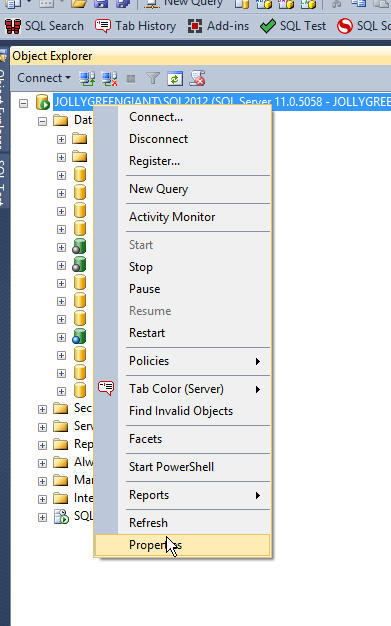
    I’m not running a new install this week, but I’ll show you how to change it on an instance that’s installed. First, right click the instance in Object Explorer and click Properties.

    2015-07-06 14_17_48-SQLQuery2.sql - not connected_ - Microsoft SQL Server Management Studio

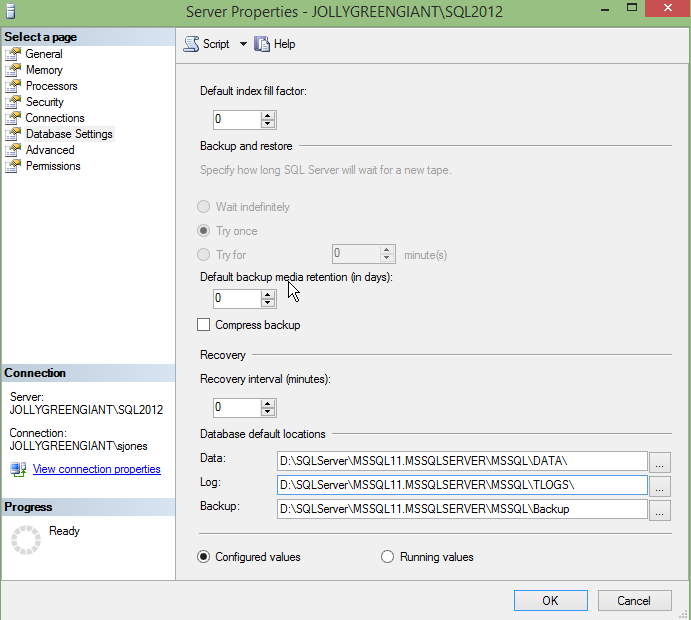
    Next, go to the Database Settings section.

    2015-07-06 14_24_07-Server Properties - JOLLYGREENGIANT_SQL2012

    At the bottom here you see locations for data, log, and backup. In this case, on my laptop, I only have two drives, so I can’t achieve great separation.

    However in any production system, I’d have the data and logs separated to different physical drives, or at least different LUNs. Backups might go with logs, but they’d ideally be separated to another location.

  • Data or Experience

    Data Driven

    Listen to the data.

    There are any number of phrases that implore us to use bits and bytes, pieces of information that lead us to better decisions. However, can the data ensure we make the best decisions? Do the models we use get better and better over time? It’s hard to tell.

    This has certainly been debated in the wake of Moneyball, the book that ocuses on the use of data over experience to drive decisions for baseball teams. The Oakland As were the first team to do this, without winning a championship, but the Boston Red Sox also followed the formula and won three championships in the last eleven years.

    However they’ve also had some abysmal years, including the current one. Does that mean that the principles of data driven decisions work, don’t work, or something in between? Personally, I think that the ideas of predictive analytics does work, but it’s not magic. It’s also not a guarantee of reaching some level of performance.

    In sports there’s a strong human element involved. While many players do perform at a similar level from one year to the next (slightly higher or lower), there are also times when a player dramatically diverges from the past. There’s also the notion that a sports team is a very small sample size for statistical analysis. Trends tend to be easier to predict when there are thousands of people’s behavior involved.

    There’s also some variance from transaction to transaction. Even in retail, where I might be able to predict today’s sales fairly accurately, I couldn’t necessarily determine the volume of sales for a particular product or the total on any transaction. Statistics are generated over time, and they’ll be accurate over time as well. Just understand that in the more a human is involved and the more detailed your granularity, the more actual results might deviate from your predictions.

    Even the card counters in Bringing Down the House, for all the millions they earned, still expected to lose some hands, and occasionally some big ones. Keep that in mind when making data driven decisions.

    Steve Jones


    The Voice of the DBA Podcast

    Listen to the MP3 Audio ( 2.5MB) podcast or subscribe to the feed at iTunes and LibSyn. feed

  • Database Version Control Workshops

    We’ve got more Workshops coming this fall from Redgate Software to help you get the most out of our tools and improve your database development processes. The list of our training schedule is out, and I’ll be at a few of these.

    The schedule does changes as we can add more dates and partners, so keep checking it, or let us know if you’d like to have a class near you.

    Baton Rouge, LA – Jul 31, 2015

    I’ll be traveling to Baton Rouge, LA for our July 31 class with Ike Ellis on Database Source Control. Ike’s teaching, and I’m there to help and manage the labs that we’ve put together for the class.

    This workshop is the day before SQL Saturday #423 in Baton Rouge, so if you’re attending that, consider coming a day early and getting some hands on knowledge of database and version control on Friday. It’s only $100 (a limited time sale), so register today.

    New York City – August 20, 2015

    We’ve also scheduled to give a Database Source Control workshop in New York City, in Manhattan on August 20, 2015. Once again, Ike and I will run the workshop, giving you a chance to learn how you can better manage the code in your databases with a VCS.

    Come Learn

    I hope to see some of you at one of these workshops, or one later in the year. We’ve really worked hard to pack a lot of information into a long day, helping you actually use the tools and technologies to control your database code. We’ll talk about how a VCS integrates with your code, what to include, how to handle branching and merging, and more.

    We’ve put the price of these workshops on sale for the remainder of the year, so take advantage and register today.