Author: way0utwest

  • Have you tried DLM Dashboard?

    DLM Dashboard is a new product from Redgate Software that’s free. Free as in beer, which should be attractive to many of you. The product is in Beta, but it’s fairly stable and has worked well for me. It’s still maturing, and we’re certainly looking for feedback on what works and what doesn’t.

    What Does DLM Dashboard Do?

    There are a couple of things DLM Dashboard does that I think many of you are interested in. Both of these promote DevOps collaboration, and I’d like to see these concepts take hold in most organizations.

    1. Track changes to Production
    2. See changes coming through Development

    There’s more to the dashboard, but essentially it works by tracking the version of the schema in all environments. If anything changes, then you get an alert on the dashboard (and email notification if you need it).

    That’s it. The versions are what you call them. You can set up versions as numbers (v4.2, 4.21, 4.22. 5.3, etc.) or you could do it by deployments (Mar 3 2015, Apr 6, 2015, etc). Whatever works for you.

    The Dashboard lets you know if it detects a change and the version is incorrect, or if it detects a known version that’s been deployed to a new environment.

    I’ll describe it more in other posts, but for now, check it out. It’s free, and it’s worth a few minutes of your time to try.

    Download DLM Dashboard

  • T-SQL Tuesday #65 – Learning Computed Columns for XML

    It’s T-SQL Tuesday time again, and this month the invite comes from Mike Donnelly (@sqlmd). The topic is Teach Something New and it’s a good one.

    I try to learn something all the time, and this post is about something I ran into recently with a submission from a user that I needed to check. I had to dig in a bit and see how XML worked in computed columns and I decided to write about it for this month’s entry.

    T-SQL Tuesday is a monthly event on the second Tuesday of each month. There’s a new invite each month, and you need to watch Twitter and the #tsql2sday tag to find the next one. I keep a running list of past topics, and feel free to write on any of them and post something.

    Learn Something New

    I haven’t done a lot of work with computed columns or XML in my career. At least not in SQL Server. I do remember using VB and traverse XML documents and pull out nodes, but that was years ago.

    Recently I had to verify how XML computed columns work and that required me to dig in a bit to the rules for both. This post looks at the way in which I learned how to return part of an XML column from a table.

    Imagine that we have a table storing some XML data inside it. For my demo, I have a table storing profile information for users. I’ve actually seen a table like this, grabbing information for a website and then shredding it later if there are changes needed in the database. Here’s the setup of the table with a row of data inserted.

    CREATE TABLE UserProfile ( UserID INT IDENTITY(1,1) , profile XML ); GO INSERT INTO dbo.UserProfile ( profile ) VALUES ( N'<user> <username>way0utwest</username> <history> <pageurl>/default</pageurl> <pageurl>/scripts/</pageurl> <pageurl>/scripts/id/2433</pageurl> </history> <points> <forums>32432</forums> <qotd>1123</qotd> </points> </user>' );

    If I want the username from this table, I can use this query:

    SELECT profile.value('(/user/username)[1]', 'varchar(max)') FROM dbo.UserProfile AS up;

    That will return this data:

    xmlshred_a

    However, suppose I don’t want to use that code in all my queries in the application. Certainly it’s not bad for stored procedures, but I don’t want to repeat that over and over either.

    Instead I want to use a computed column. I’d think that we could do something like this:

    ALTER TABLE dbo.UserProfile ADD Username AS (profile.value('(/user/username)[1]', 'varchar(max)'));

    However that doesn’t work. I get this error:

    Msg 435, Level 16, State 16, Line 1

    Xml data type methods are not supported in computed column definitions. Create a scalar user-defined function to wrap the method invocation. The error occurred at column "Username2", table "UserProfile", in the ALTER TABLE statement.

    I haven’t seen this documented in Books Online, but it’s a restriction. However, there is a specific document on using XML in computed columns, which gives a workaround. The way to do this is to use a user-defined function. I need to build a function with my query:

    CREATE FUNCTION UserProfile_XML_UserName(@xml xml) RETURNS varchar(200) AS BEGIN RETURN @xml.value('(/user/username)[1]', 'varchar(max)') END ; GO

    Now, I can use my function in the computed column

    ALTER TABLE dbo.UserProfile ADD Username AS (dbo.UserProfile_XML_UserName(profile));

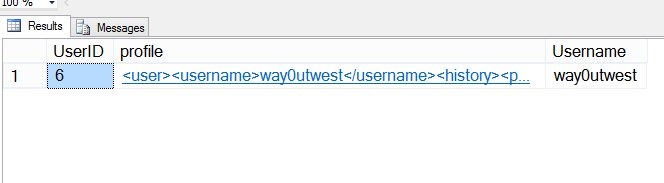
    Now when I query the table, I have a new column with the username:

    SELECT top 10 * FROM dbo.UserProfile AS up

    Here are my results

    xmlshred_b

    That’s what I learned in the last month in working with T-SQL. This came from a user submission, and it required me to dig into BOL and find out how I could make this work.

    References

    Here are the references I used to learn about this:

  • The Opportunistic Hacker

    You’re sitting in Starbucks, working. You need to use the restroom and you ask the hip, cool looking person sitting coding next to you, with whom you’ve chatted with for the last hour about C# and SQL, to watch your laptop. You leave and come back to an empty table.

    This was a hacker, coding away at their side job to pay a bills in between causing mayhem. They walked away with your laptop, not knowing if you work for a bank or a soy milk manufacturer. The hacker won’t know if you have a copy of the production database on your laptop or simple a few .ASPX files that are useless without a VPN connection to your office. Hopefully that can’t access other machines from yours.

    This is a crime of opportunity, and it happens regularly. Criminals steal laptops from coffee shops, airports, cars, and more. Often just because they can. Some may just wipe the device and sell it, but others may spend some time poking around to see if there is any value in the data on the machine. Or on a connected machine.

    Many of us have far too much data on our machines, with many, many saved passwords and connections. We have copies of code, databases, or backups, and losing our machine to a random criminal might be just as damaging to our organization as losing it to a hacker that targets us.

    Steve Jones

    The Voice of the DBA Podcast

    Listen to the MP3 Audio ( 1.9MB) podcast or subscribe to the feed at iTunes and LibSyn.

  • Pre-built or Ad Hoc

    One of the advantages of NoSQL databases id that the schema and organization of data is very flexible. The various types of databases usually allow the schema or organization of data to vary across entries. I hesitate to call them rows, but essentially each time you add data to a store, you can alter the format of the data inserted.

    For relational database professionals, this seems to be a recipe for disaster, with entirely too much data being captured in an un-organized fashion. At some point a user will want this data to be returned in a report format, which almost always seems to be rows and column related data, even behind the scenes of the incredible visualizations that appear in modern dashboards.

    I had someone recently note that their users don’t want to write ad hoc queries or try and discern the meaning of varying structures of information. They want pre-built structures they can count on and use reliably to answer questions. I suspect many users don’t want to decode the meaning of structures that change, despite the fact that so many users want to reformat and change the shape of data in Excel. Those of you that have to re-import some of these spreadsheets know just how unstructured a set of rows and columns can become.

    I really think that it is important that structures of data be decided upon and ordered in a known way so that users can easily understand the meaning behind the data. However we are gathering more and more data in new ways, from new sources, and we don’t have consistent ways of recording that information. That will continue in the future, and I do think that learning how to access new sources, like Hadoop, and present that data back to users in a familiar format will become a way to show you are a valuable resource for your organization.

    Steve Jones

    The Voice of the DBA Podcast

    Listen to the MP3 Audio ( 2.3MB) podcast or subscribe to the feed at iTunes and LibSyn. feed