Author: way0utwest

  • Starting with Azure

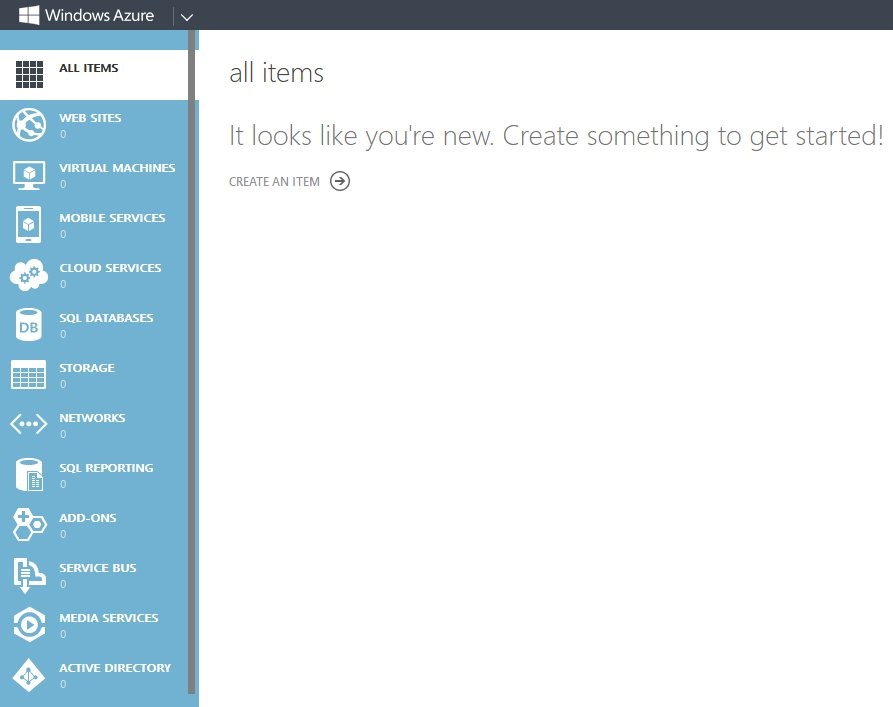
    I’ve been meaning to do this, and I finally had the chance recently to start working with Azure. Red Gate is investing in cloud tools, and more development tools, so it’s something I need to work on.

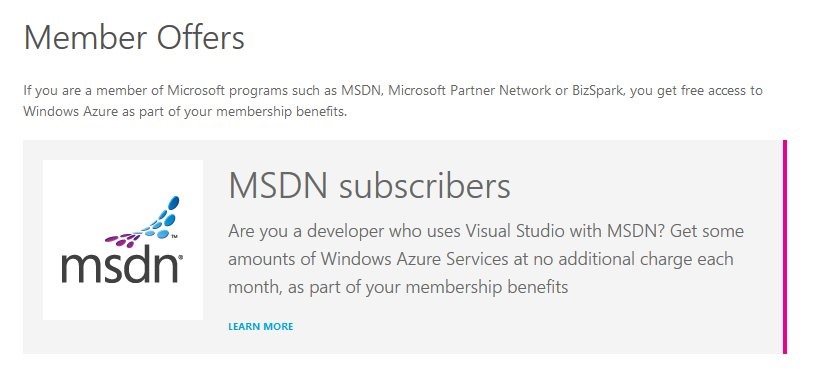
    I went to the Azure page, and noticed a “Member Offers” link.
    azure_a

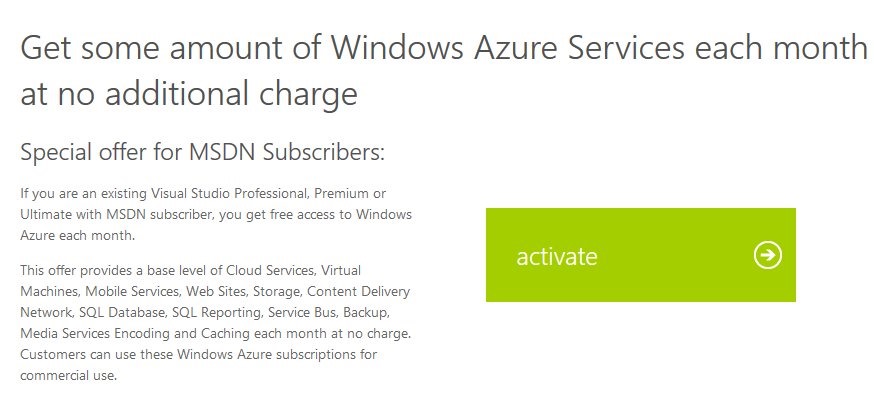
    When I clicked through, I could see the benefits. Below this screen shot is the list of stuff you get, depending on your MSDN subscription. You can see the exact benefits on the MSDN benefits page.
    azure_b

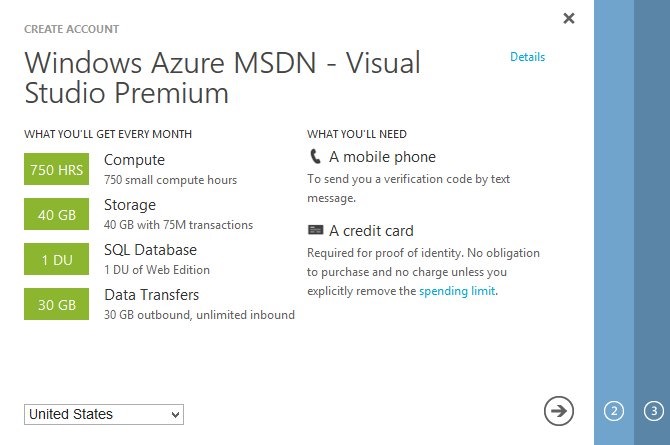
    I clicked the activate link and was taken to the Windows Live login page. After signing in, I got a page that asked me to create an account. It listed my specific benefits and the requirements for an Azure account.
    azure_c

    Since I have a mobile phone and a credit card, I clicked the arrow to proceed. The first thing is to verify your account with a mobile phone. I assume this gives me some sort of two factor authentication as well as a way for them to reach me for billing issues.
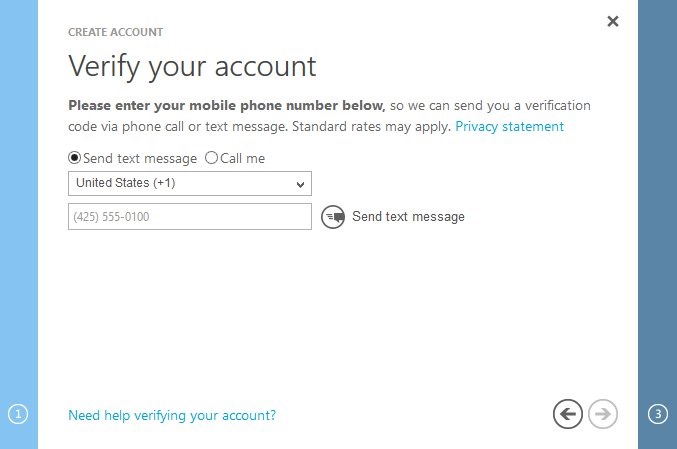
    azure_d

    After receiving a text and entering it, I was taken to the billing area. I know this freaks many people out, however I’ve had a number of friends use the MSDN subscription trial and not been billed after 5 or 6 months. I’ve had a few that have been billed, but it’s been low amounts, in the $5-10 range. Grant Fritchey (b | t) is one of them, and with all the writing he’s done on Azure, some presentations, and research for Red Gate, he hasn’t had issues.

    It’s your career, it’s worth $5 a month. If you find you’re spending more, shut stuff down. I’d give it a try, however, if there is any chance your career will include work in the cloud.
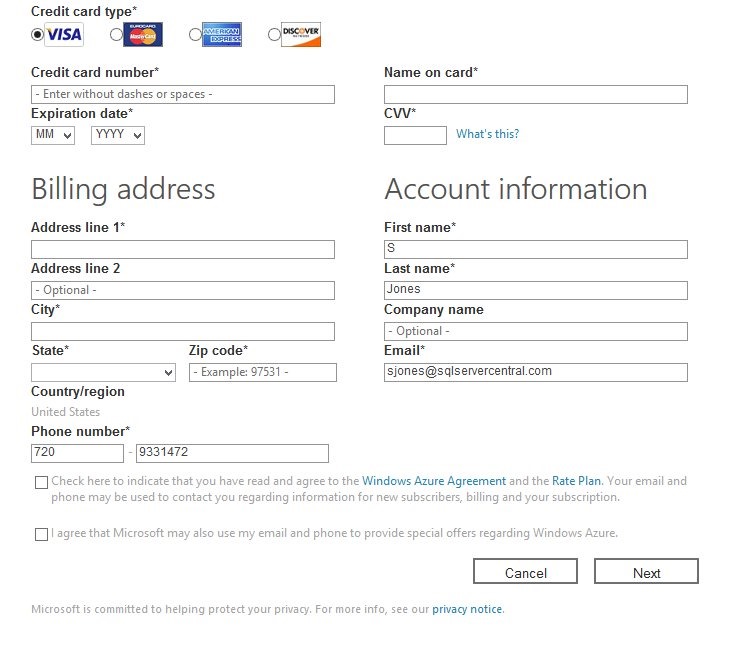
    azure_e

    Once you enter a credit card, they’ll get to work.
    azure_f

    The welcome screen gives you lots of options. I’m sure I’ll end up here quite often across the next few months as I try to be sure that I’m not running up my cost. I can expense it back to Red Gate, but I do try to spend wisely.
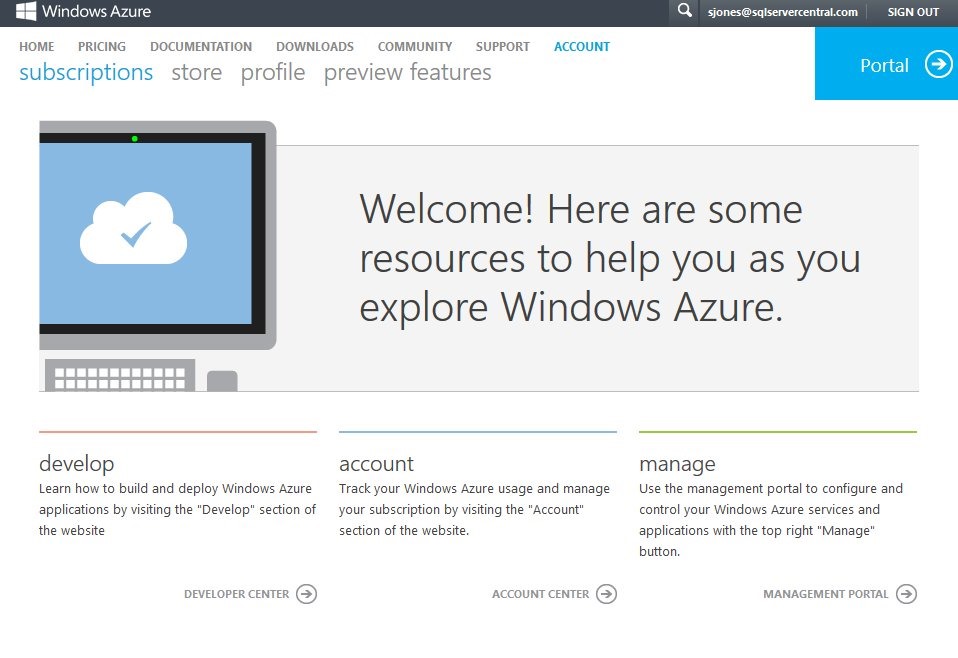
    azure_g

    What now? There’s lots of options.

    azure_h

    I have a few things in mind, but I’ll probably start with a few light experiments based on some presentations I’ve seen. Buck Woody has a nice set of resources to get me started, and I’ll likely give one of these a try.

  • The Bicentennial SQLSaturday–#200 Philadelphia

    When Andy Warren (b | t | Li)started SQL Saturday with #1 in Orlando, we weren’t sure it would succeed. After a few events, we dreamed and wondered if we’d ever get to 50 events. Despite our success in the past, we weren’t sure if a free event, supported by advertising (essentially) would survive over time. We also weren’t sure if we could replicate and grow this event in other locations.

    It grew, and prospered, and then exploded, thanks to Karla Landrum (b | t). Under Karla’s guidance and nurturing, we’ve seen a tremendous number of events taking place all over the world. Not only did we get to 50 events, the SQL community blew past 100 a few years ago and earlier this year event #200 was posted.

    It’s somewhat fitting that in one of the cities that helped birth my country, and houses the Liberty Bell, will host SQL Saturday #200 in a little over a week. I’ll be traveling next week, along with Andy for the event. There’s an exciting lineup of speakers, bringing you a wide variety of SQL Server learning sessions.

    I’m looking forward to seeing friends and meeting new people, as we celebrate the bicentennial SQL Saturday. If you can’t attend this event, there are lots of SQL Saturday’s scheduled for the rest of the year. They’re free (other than lunch at a few events) and it’s worth your time to learn something new about SQL Server and network with some of the people in your local area.

    If you’re attending an event, you might even think about bringing kids and perhaps organizing a session for them.

  • Understanding HA

    51JU2kM8vHL._SL160_PIsitb-sticker-arrow-dp,TopRight,12,-18_SH30_OU01_AA160_I’ve learned a lot about high availability (HA) and disaster recovery (DR) over the last two decades. Some of the things I’ve learned were from studying, some from experimentation and practice, and a few from hard lessons when some part of a system failed. The latter were how I learned the quickest and most effectively, but those were also the most stressful times in my career. Getting called by senior management because a system is down is not the way that I want to improve my skills.

    I know many people struggle with HA and DR, which are two different concepts. They are designed to solve different problems for different situations. SQL Server includes a number of options for how you might handle either HA or DR situations (or both), and the list of options continues to grow over time. We have the AlwaysOn suite of technologies, database mirroring, replication, log shipping, and more.

    All of the technologies that you might use to solve HA and/or DR problems may provide other benefits. The ability scale out, or spread load are a possibility with a few of these features. What I find, however, is that many accidental, junior, or otherwise inexperienced technology professionals that need to manage SQL Servers get confused. They seem to think HA and DR are the same thing, and one technology is somehow better than others.

    Whether you need HR or DR, or some other solution, it’s important the you research, understand, and practice working with the technologies that you will implement. Books Online gives you a good starting point, and there are plenty of online resources where you can ask additional questions or debate the particulars of your situation.

    Disasters rarely occur, but you should take the opportunities to hone your skills at working with the various technologies you may implement before things fail. Schedule failures of systems in your test environment. See if your HA technology keeps the system running if you remove a system, or test that you can recover using your DR techniques. When something actually goes wrong, you’ll be glad you prepared.

    Steve Jones


    The Voice of the DBA Podcasts

    We publish three versions of the podcast each day for you to enjoy.

  • How do you solve T-SQL problems?

    solvetsql

    Six scans, six logical reads. What could be the problem? There’s no problem if you’re always dealing with six rows of data. If you’re dealing with 6mm, however, this is likely to be a performance problem on your server. Many developers might write a query, check the statistics, and see something like that shown above, and think that it’s a good day’s work.

    Solving the problem is only half the job you should do. Solving things in an efficient way is the other half. When you tackle a new T-SQL challenge, what’s your methodology? Do you have one? I don’t need to know, though if you think you have a good one, post a note in the discussion, or perhaps write an article. If you aren’t sure how you begin, other than randomly trying ideas you vaguely understand or have seen others try, perhaps you want to start by reading Kathi Kellenberger’s Step by Step method.

    The image above comes from Kathi’s article, and is indeed the result of her first solution to a complex T-SQL problem. She lists out the basic steps she used to derive the solution, along with the business rules used. All too often I’ve found developers (including myself), start writing code without taking a few minutes to specifically state the business rules. Following that one step might eliminate lots of bugs in coding.

    Her solution worked, but with 6 scans occurring on her 11 rows of data, she knew this would be an issue. Moving forward she asked for help, which is perfectly acceptable way of working in your career. Try to solve it yourself, get a solution working, and then ask if it can be improved. Not only did she end up with a better performing solution, but she learned a bit more along the way. Something we all can do.

    Steve Jones


    The Voice of the DBA Podcasts

    We publish three versions of the podcast each day for you to enjoy.