Author: way0utwest

  • Honeywords in SQL Server

    honeypotAs we become more and more security conscious, it becomes more important not only to configure systems for better security, but also to add more monitoring and auditing to detect when problems occur. We know that at some point someone will attempt to hack our systems. Many of us have auditing set up to detect failed logins, but is that good enough?

    If a hacker manages to gain access to your password hashes, and it’s not a stretch these days to think that they might, wouldn’t you like to know if they manage to find the plain text that corresponds to the hash? There’s an idea that systems could be written to store multiple passwords for user accounts, but only one of which is valid. A separate system detects attempts to log in with the false passwords and alerts administrators to a hacking attempt.

    This is an interesting idea, and while it won’t solve all our problems, it will solve some. If a brute force attack occurs on an account, and multiple passwords are being tried, all of which are known to be false (the honeyword passwords), administrators can be notified, and warnings passed on to users. It doesn’t help if the hacker chooses the correct password to enter first, but with enough honeywords, you reduce the chances that they will.

    I don’t know that I’d like to see this for SQL Server, but I certainly would like to see additional security features. Two factor authentication would be nice, perhaps even some sort of  approval process enabled that required multiple approvals for some changes. The latter would help us prevent the cowboy DBA from making changes without anyone else being aware of them.

    Detection of breaches, using something like honeywords, provide another layer of security. They don’t prevent hacks, but they can help us deal with them.

    Steve Jones


    The Voice of the DBA Podcasts

    We publish three versions of the podcast each day for you to enjoy.

  • The Challenger

    Are any of the other database challengers really competitors to SQL Server?
    Are any of the other database challengers really competitors to SQL Server?

    There’s a lot of competition among database platform vendors. Once a platform is chosen, companies rarely change, and with good reason. The cost of the people building your application accounts for most of the resources you expend on a database system. Re-training, or replacing, is often cost-prohibitive. That hasn’t stopped many companies from looking to less expensive alternatives to SQL Server, like MySQL, but I’m not sure the license savings offset all the other costs, including potential performance declines from mis-configured systems.

    SQL Server has had a few competitors over the years that tried to provide compatibility and enable easy or seemless migration from SQL Server to a new database engine, but none of them seem to have been very popular.

    NuoDB is the latest, providing a NewSQL, distributed cloud database that has many of the features that developers look for, but is built to integrate easily with .NET technologies, including Visual Studio, has LINQ and Entity Framwork compatibility, and runs on the Azure and AWS platforms. The company hopes it will replace SQL Server as the preferred database in the Azure IaaS cloud.

    I don’t know that many companies want to migrate their applications to a new platform, but I do know that there might be situations and problem domains where platforms other than SQL Server make sense. If the compatibility is close enough to limit the amount of code that has to change, it’s worth looking at. The problem for this challenger, and many others, is that SQL Server has grown to include many other features, like SSIS, that companies find compelling.

    Ultimately I think it’s easier to stick to as few platforms as possible to allow your staff to build expertise in optimizing their code and configurations for a platform. Developers and administrators don’t often become experts, but I’m not sure the situation is any better if you give them an additional platform to work with.

    Steve Jones


    The Voice of the DBA Podcasts

    We publish three versions of the podcast each day for you to enjoy.

  • Not My Google Reader Replacement

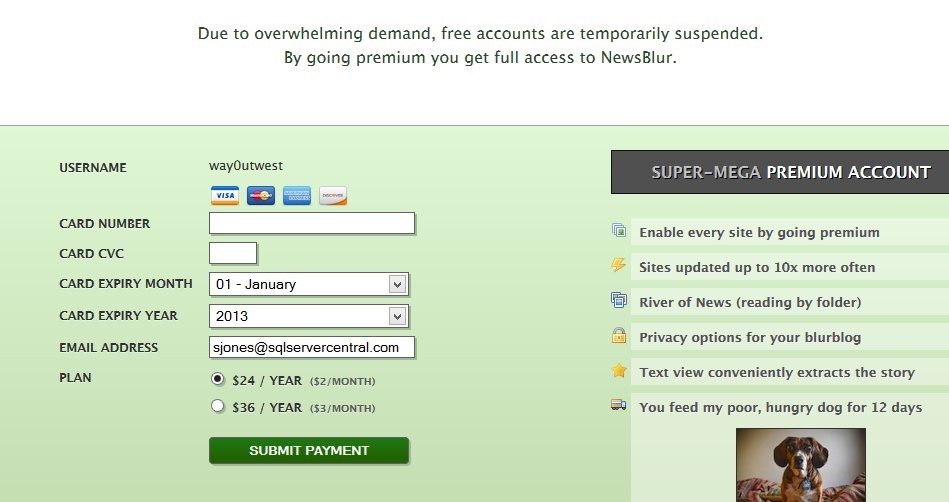
    Someone suggested Newsblur to me, and I went to their home page. Like many sites, it asks you to sign up, so I decided to give it a try.

    newsblur2

    The import from Google Reader caught my attention, so I clicked it. It asked for an authorization from Google, and then I got this page:

    newsblur

    I have to say. Not only do I now see anyway to understand the difference between $2 a month and $3 a month, but I also feel like this is a bait and switch, given the top banner. This could have been called out on the home page, though I suspect not as many people will click through.

    I’d gladly pay Google Reader $2 a month, but I know what I’m getting. Here I’m not sure, and I’m already annoyed.

    The search continues.

  • The Platform Problem

    A fantastic platform. If I had a choice of where to run it.
    A fantastic platform. If I had a choice of where to run it.

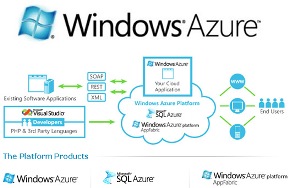
    I really like the idea of Azure providing a Platform-as-a-Service (PaaS) for applications to be built on. As I’ve evolved in my career, I’ve learned I prefer not to manage individual machines or deal with the complexities of configuring anything outside of SSMS for SQL Server. Working with Hyper-V recently has cemented the idea that I don’t become more productive by dealing with the complexity of the Windows host.

    However I can’t see many customers migrating the majority of their applications to the PaaS Azure service for one reason: there’s no competition.

    Moving to Azure means placing a big bet that Microsoft will continue to offer the same or more features, more powerful machines, and stability at a reasonable price. Moving to Azure also assumes that you are comfortable working with only Microsoft for the foreseeable future, using their data centers, staff, and products. Any code you write will be specific to Azure.

    If you were to use the IaaS services from another vendor, like AWS and their virtual machines, a migration might still require some code changes. However, I’m sure if I contracted for virtual machines from Rackspace or some other provider, I could easily redeploy my application elsewhere. Well, perhaps not easily, but certainly easier than if all my code depended on a platform I can’t run inside my own data center. A platform nobody outside of Microsoft can run.

    My view is that Azure is a great platform, and one that could explode in usage. If we have choice.

    Microsoft should sell us the code to run inside our own data centers, or at least license it for a number of large providers that might want to offer Azure services. Ultimately the success of the platform depends on people choosing Microsoft because it’s the best choice, not because it’s the only one.

    Steve Jones


    The Voice of the DBA Podcasts

    We publish three versions of the podcast each day for you to enjoy.