Author: way0utwest

  • #GetHawt – The Summer 2012 Edition

    Jen McCown started a #GetHawt set of posts last year and I think it went well. It must have, so she started an invitation for a summer competition. Silly me hadn’t been paying much attention, even though I’d seen the tweets. I finally caught up this last week, and decided to unofficially join in.

    Update, I meant to publish this on Friday, but didn’t get it completed in time, so I’m sending it out today.

    I’ve been running for some time. I keep a log (if you care), and today is day 1427 for me of running at least a mile every day. On the US Running Streak Association site, I’m #228 on the active list.

    In all the time, however, I haven’t gotten in great shape. I’m fit, and I feel wonderful, but I haven’t been what you’d call Hawt-shape. Years ago I did the Body for Life diet/challenge with my wife and we got in great shape together. She wanted to try it again, and we started it back up a little over 3 weeks ago. I weighed 224 late last year, which was a bit heavy. I’d like to get lower, but I’m not overly driven by weight.

    I weighed myself this week on my scale and it said 205. Note that 205lbs on my scale does not necessarily bear any relation to 205 on any other scale in the universe. We’ve had this old, analog scale since 1992 or so and I can only use relative measurements. I know I was north of 220 earlier this year, so I have slimmed a bit.

    It’s going well, and I like it. In terms of the #GetHawt competition, it lines up OK. I drink a ton of water, exercise every day, eat 6 meals a day, get one day off each week to do anything. In terms of the points for last week for me:

    Friday – Good day exercising with my son and running for 20. Good meals, with grilled, low fat foods for 30 points, lots of water, lots of sleep (I love summer), sticking with the habits of the new routine, but had a soda. 85 points

    Saturday – Free day for me. Ate decent, but enjoyed myself with pizza, tortilla chips and a brownie desert. 20 points for running 3.5 miles, 6 points for one decent meal (it’s free day), 10 pts for water, 15 pts for sleep, for a total of 51.

    Sunday – baseball and a 2mi run, water, good meals (6 small meals, no snacks), sleep, got back into the habit of chores. 95 pts since I have no teammates.

    Monday – lift, run, water, eating all good. Talked my wife into lifting with my son and I, slept. Sticking to the good habits of the diet, and no soda (trying to cut down), so 100 pts.

    Tuesday – Great run, more of the same, but no communication today since my wife was gone. 95 points.

    Wednesday – Run, bike, etc. 20 points. Ate well, even threw some candy in the trash without eating it 30 points. water, sleep, 25pts. Communication with my wife and kid 5 pts. Special trip to get a diet coke, -10 points. 70pts.

    Thursday – Not a bad day, but I missed the lifting today. I got busy, and ran but my exercise is a getting a bit off track. 20 points. I’ll call it only 18 points for food since the kids got me to stop after volleyball and have part of a burrito. 10 for water, and -10 for a large coke zero. My wife avoided me and I didn’t chase her down. 38 points.

    Friday? Up early to fly to Sacramento for SQL Saturday #144. I’ll mostly stuck to the diet. I didn’t have any alcohol at the party, but couldn’t resist Will Meier’s pulled pork. I did mostly have vegetables, and had a good eating day. Call it 20 points for a run in the park, 24 points eating, 10 with lots of water, and 10 for avoiding diet drinks and beer. 64 points.

    In a week, that’s 534 points. Not sure if that’s good or bad, but I managed that on Fri-Thur. I wasn’t a strict dieter on the Body for Life diet on Sat/Sun, but I was pretty good.

    Even with a double double from In-N-Out on Saturday on the way to the airport.
  • Better Bosses Needed

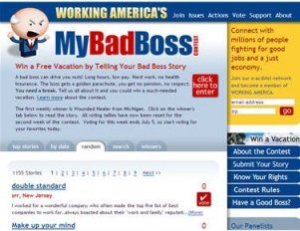
    Bad Boss Contest
    Hopefully your boss wouldn’t end up in this contest.

    Raise your hand if you have a bad boss. Now raise your hand if you’ve ever had a bad boss. I can’t quite make a count, but I’m hoping that those of you with raised hands constitute a minority of my readers. I’m somewhat afraid that you probably constitute a majority.

    That’s not such a bad thing, right? After all, many of us have had lots of bosses, starting at age 16 or 17, and continuing on through today. There’s a good chance that somewhere along the line we had a really, really bad boss. The people that used to manage paper boys, or clerks, or fast food cooks aren’t known for their superior leadership skills, are they?

    However you would think that in business that developing good managers would be a priority, wouldn’t you? So many people seem to lavish much of the success in business on management, so one would think that companies actually do spend time and money to train managers to be excellent at their jobs. Please stop laughing, you’re distracting me from continuing.

    Those of you that have been managers know that all too often there is no training. People are thrown into the job, expected to manage while learning on the job. Those that survive, or perhaps thrive, get promoted. Unfortunately that’s the theory. All too often I find those that please their boss are promoted.

    A bad boss can be rather damaging, and in these days of complex systems, short deadlines, and a struggle to to find good employees, wouldn’t you want to keep as many good employees as you can? If you can’t train great managers, can you at least train them to not be bad ones?

    Steve Jones


    The Voice of the DBA Podcasts

    We publish three versions of the podcast each day for you to enjoy.

  • Performance Data

    monitoring in the cloud
    Are you worried about security for your performance metrics?

    A good DBA is monitoring their system, looking for problems on a regular basis. The best DBAs are pro-actively heading off future issues by tuning or adding resources to their systems before a problem surfaces. It seems, however, that it’s the rare DBA that is really on top of their environment all the time, examining performance metrics to look for indications of any abnormality. I guess the best DBAs have routines that look for deviations from baselines, alerting them of potential issues.

    SQL Server has grown over the years to add new features that make the administrator’s job easier. The addition of SQL Agent and its alerting capabilities have helped for a long time, and in recent versions we’ve gotten eventing as well as the development of tools like the Policy Based Management (PBM) framework to allow the instance to do work for the administrator.

    More recently we’ve seen Project Atlanta at Microsoft became the System Center Advisor. This is service that uploads metrics from your instances for evaluation by specialists, and presumably some expert systems, at Microsoft. I don’t know how well it works or how effective people feel it is, but it’s an interesting idea. Ignoring the effectiveness of the service for now, I’m wondering about something related this Friday.

    Do you feel your performance metrics need to be secured?

    I’m wondering how you would classify the data from System Monitor, from alerts, events, PBM, and more. Does it require a high level of security for your organization? Are you concerned about contracting with someone to analyze the data and report back to you about things that might improve performance? Many people contract with consultants like SQLskills for Health Checks, but that’s at an individual level.

    Let me know this Friday how you feel.

    Steve Jones

    If you’re interested in trying out a hosted monitoring service, sign up for updates on the new SQL Monitor SaaS Edition.

    The Voice of the DBA Podcasts

    We publish three versions of the podcast each day for you to enjoy.

  • Leaving Some Headroom

    Max Headroom
    You want to leave some headroom on your server, though perhaps not this kind of headroom.

    I was reading this piece on scaling Dropbox and something caught my eye. It’s a very interesting read, especially if you deal with scaling, and I’d encourage everyone that works with technology to read it. The one thing that really caught my eye, however, was the idea of running with extra load. In the piece, the author notes that they had a process running on their systems that consumed memory and CPU. If they ever reached their limit on the systems, they could stop the process, giving them a little more horsepower for the application.

    That’s interesting. It’s a take on similar techniques that we used on our SQL Servers in the past. We could keep a few 1GB files (in the days of 50GB disks) on each logical drive. If the drive somehow filled up, we could delete the file, giving us a little more space.

    Steve, that’s silly. You’d still need the same amount of space, so why does this help? It helps because it buys you time. If a process fills your log file, which fills the disk, the database stops. If you kill the process, and then delete the file, you’ve got space to clear your log, and keep your system running while you find out what went wrong. That’s the idea of artificial headroom. It allows you more time to respond in a crisis.

    I’m not sure how I’d want this to work on my SQL Servers. After all, any load I placed on them wouldn’t necessarily just occupy CPU. It would also impact the buffer pool, as the type of process I chose would influence what would stay (or go) in that bit of memory. However the idea of limiting my system slightly, maybe 5%, in a growth situation is interesting.

    At the very least it might appease my users while I get a purchase order for more resources approved.

    Steve Jones


    The Voice of the DBA Podcasts

    We publish three versions of the podcast each day for you to enjoy.