Author: way0utwest

  • Change your Windows path

    When you run something from the start menu or in a Windows command prompt, you type the program name to run the executable file. There are three ways in which you can execute something:

    1. the executable is in your current directory/folder
    2. you type the entire path to the executable.
    3. the PATH environment variable contains a value that points to the folder containing the executable.

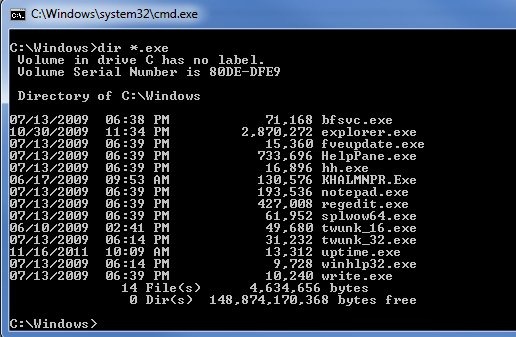
    The first and second items are fairly self explanatory. In a command prompt, if I change to the \Windows folder in Windows 7, I see these executables:
    path1

    If I type notepad (the .exe isn’t required), Windows searches the folder, finds notepad.exe, and runs it.

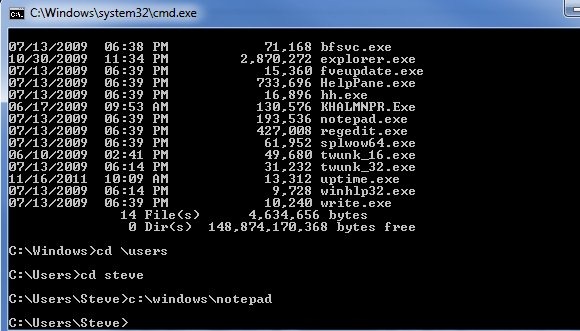
    If I am in c:\Users\Steve, however, I can run notepad in one of two ways. I can do this:
    path2

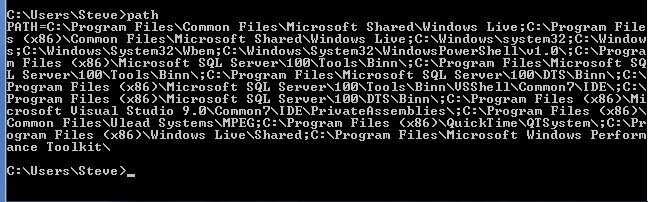
    The other way is that I just type notepad, and it runs. How does this happen? It’s a holdover from DOS (and Unix) for an environment variable called PATH. My current path is returned by typing PATH in a command prompt.
    path3


    There are a lot of folders listed here, all separated by a semi colon.  Most of these are for various programs, and lots of installers alter the path to add their own folder. For example, the Live suite of products added this path

    C:\Program Files (x86)\Windows Live\Shared

    I would have thought most technical people knew how to change the path, but I found a developer recently that did not. I suspect most people don’t need to deal with this in most cases, so they aren’t aware.

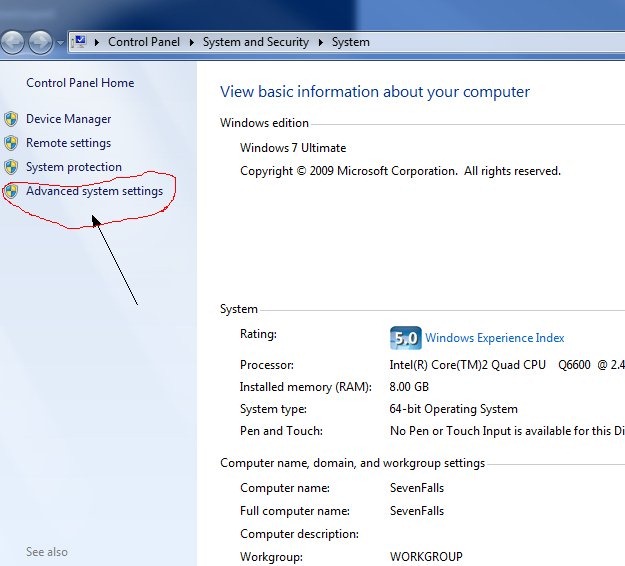
    The way you should change this manually in Windows is this. Go to the properties of your system by right clicking the “Computer” item in the Start Menu and select Properties. You’ll get this screen (in Windows 7)
    path4 

    Select the “Advanced System Settings” in the left side. This is an admin function, so you need the UAC permission. This will open a new dialog
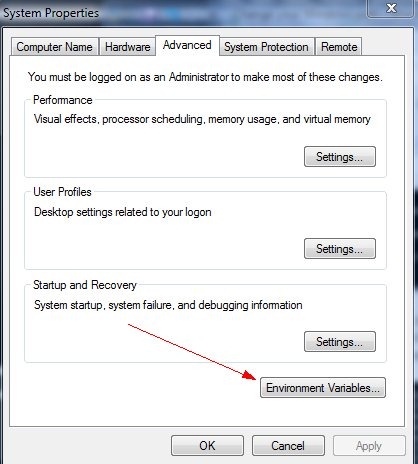
    path5

    The Environment variables are accessed through a button on the Advanced tab. Once you press that, it will give you the variables dialog.
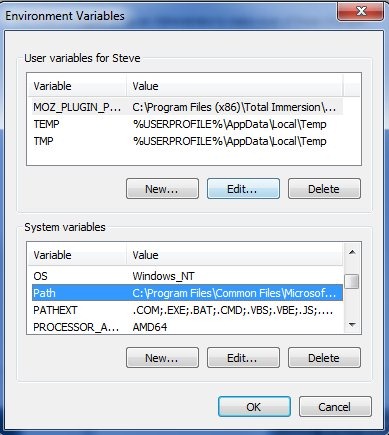
    path6

    If you scroll down in the System Variables, you’ll see PATH as an item. Select “Edit” and you can change the path.
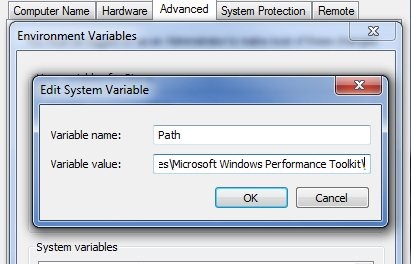
    path7

    The path is selected when this opens.

    DO NOT START TYPING.

    Instead hit the right arrow to de-select all the txt and move to the end (as shown in the image above). Add a semi-colon and your path, and OK back out of all dialogs. You’ll have a new path that you can use in your system.

  • Data Growth

    Data Growth
    Data is growing at many organizations at an unbelievable pace.

    I attended the Special Ops Tour for SQL Server 2012 in Denver recently. It was an event that was showcasing some of the changes in SQL Server, with presentations and networking for the local SQL Server pros. It was fun to get out for a half day and see some friends from the area and extra exciting as the RTM was announced the day before our event.

    During the opening talk, there was a slide with a very interesting statistic. It talks about the last few years had seen 40% data growth for many organizations, but IT budgets had only grown by about 5%. Those two numbers don’t really relate well to each other since the cost of IT operations can dwarf the cost of storage, but for how long? At some point 40% growth will catch up and become a significant cost in your organization.

    The 40% growth does show that data professionals become increasingly important to companies. As “Big Data” becomes something that more companies need to deal with, the skills that we have as data professionals will become more valuable. We have to learn to separating out the information from the noise, enforce data quality, and learn to manipulate large volumes of data more efficiently. SQL Server is growing to help us with enhancements to SSIS, DQS tools, and even Hadoop processing capabilities, but we need to learn how to better use these tools. Storage is also an issue, and so many products and tools are available to help here. We have lots of compression tools, some de-duplication tools for backups, and more, but we need to learn how these tools fit in our environments, and what the ROI is for our organization.

    Budgets are not going to keep pace with the requirements we face. We need to learn to work smarter, more efficiently, and more effectively to get the most out of the limited funds available.

    Steve Jones


    The Voice of the DBA Podcasts

    We publish three versions of the podcast each day for you to enjoy.

  • Attracting Talent

    Red Gate Software
    Red Gate is hiring

    Finding good employees is hard. If you read the blogs and tweets from people trying to interview developers or DBAs, it seems there’s no shortage of unqualified candidates looking for jobs every day. The answers given to fairly simple questions, the lack of knowledge in areas list on the job description, and the inability to back up the words written on resumes are jaw-dropping. It’s a problem that seems to have no solution in sight, which is distressing.

    When a company needs help, what can they do? Hopefully they’re a good company, one where people want to work. If that’s the case, then be real, be honest, and show employees that you are a place people want to work. My own employer, Red Gate Software, made a great video for a UX specialist. It almost makes me want to apply for that job. Unfortunately I’m much better at breaking visually appealing things than designing them.

    The best way to find good employees is really through networking and word of mouth. Employees tend to know who can do a good job, and it’s not often I find someone looking to recommend an incompetent individual to help share the load. Empoyees know that recommending a slacker is likely to result in more work for them, not less. This might help you build better teams, but if your culture stinks, you might get no recommendations at all.

    Steve Jones

    PS – We are hiring a few people at Red Gate. It’s a great company, and if you want to live in Cambridge, apply for one of the positions.


    The Voice of the DBA Podcasts

    We publish three versions of the podcast each day for you to enjoy.

  • Tabs or Spaces

    Obfuscated Code
    Hopefully your code doesn’t get formatted like this.

    An argument among developers that might rival the NULLs/No NULLs debate, or even the comma appending/prepending items in T-SQL might be tabs versus spaces. I was engaged in a debate recently with a developer on this very topic, with this person insisting that tabs were the proper way to handle indentation in code, and my insisting just as hard that spaces were the way to go.

    Actually, I should clarify, I think that tabs should be inserted into code as spaces, so that a consistent layout can be maintained. Most tools allow for this, and while I have never worked in a place where the tab/space ratio was entirely consistent among all those writing code, I have found that using ASCII 32 is preferable to ASCII 9 when files are shared among different people.

    Am I right? I don’t know that I’m right, but I have found that spaces result in less issues, and easier to read code over time as more and more developers work on a project. Invariably spaces creep into code, and when they mix with tabs, the visual layout of the code can vary wildly, depending on the configuration of the developer. I understand that indents and alignment differ, and using a mix of tabs for indentation and spaces for alignment can work. I just feel that this is an additional level of conformity that will never work well for most team projects.

    There are all sorts of arguments for tabsfor spaces, even for saving the planet. The one thing I know is true: the only programming project with no disagreement whatsoever on code formatting is the one you work on alone (from Coding Horror). I also love the concluding sentence in that post (since I agree with it).

    With that in mind, I do think having a standard makes sense, and while the standard might annoy a portion of your developers, overall they will get used to it and be more productive than having no formatting standard at all.

    Steve Jones


    The Voice of the DBA Podcasts

    We publish three versions of the podcast each day for you to enjoy.