Author: way0utwest

  • RECONFIGURE can flush the procedure cache

    I ran across this KB article the other day, which lists a few ways in which performance is affected by various maintenance or administrative type operations.

    In KB article 917818, it notes that some operations cause a performance issue. Some of the operations make sense (offline/online, restores, etc), but there were a few that surprised me. For example, did you know that Autoclose flushes the cache? Might not be a big deal, but it also might mean that your apps based on Express might end up running slowly each time the user accesses the databases.

    There are also a number of items which are implemented by a RECONFIGURE that will flush the cache. These are listed in the KB and are:

    • cross db ownership chaining
    • index create memory (KB)
    • remote query timeout (s)
    • user options
    • max text repl size (B)
    • cost threshold for parallelism
    • max degree of parallelism
    • min memory per query (KB)
    • query wait (s)
    • min server memory (MB)
    • max server memory (MB)
    • query governor cost limit

    Also, changing a filegroup to read-only will flush the cache.

    This is by design, and I wouldn’t expect it to change anytime soon. Since these options can affect query plans, it might make sense to flush the cache, but if you don’t agree, file a CONNECT item and stump for votes.

  • BYOD

    Would you want to provide your own device, like this one?

    As laptop prices have plummeted over the last few years to the point where most technical people can afford to purchase their own machine for around $500. Unless you want an Apple machine, then you’ll be looking at something over $1000. There are quite a few people working with SQL Server on OSX, however, so if you want one for work, you can make the switch, and here are a few blogs for you (Aaron BertrandBrent OzarJoe Webb)

    As computers become a commodity, and we use them more and more to live our lives as well as work, does it make sense for workers to purchase their own machines and use them in a corporate setting? I know some companies give workers a computer allowance and the workers can take the machine with them if they quit, presumably if they work at the company for longer than a few months. Other companies give their employees money for technology, which can be exciting for technical people that might want to upgrade their monitors or other accessories regularly.

    There are definite security and data concerns, but with cheap memory, disks, and hypervisors, it’s possible to get around those issues, and allow employees to work with the tools they are familiar with. I ran across this blog that talks about workers owning their own devices in the future, even being required to provide them. Just like many other professions where the workers must own their own set of tools.

    On one hand this seems crazy. Employers should provide computers, and as a young worker in this business, I would have struggled to purchase a $1500-2000 laptop. Or maybe I wouldn’t have. Maybe I would have seen it as an investment in my career, just like college was. These days, we have even more devices, and while IT departments struggle to secure them, that doesn’t stop people from using them, or wanting them. I think I’d like to provide my own smartphone and laptop, and get some sort of allowance from my employer each year to offset the cost.

    I don’t know how we’d handle the data/security pieces of this scenario, but I’m there would be no shortage of ideas from the various software vendors.

    Steve Jones


    The Voice of the DBA Podcasts

  • Blackout

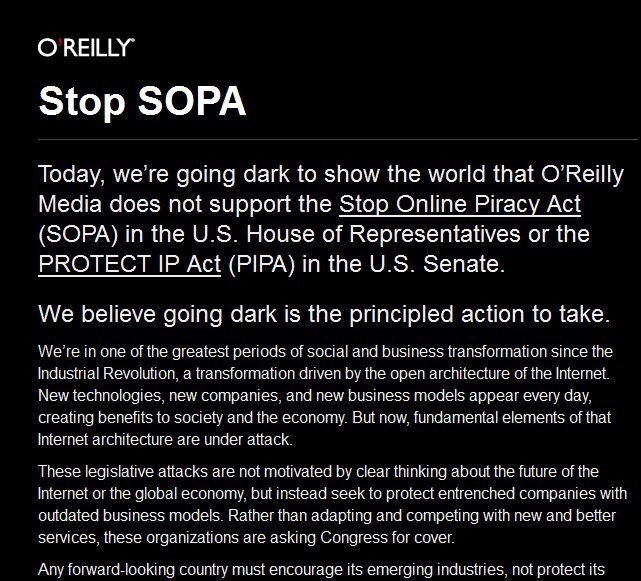
    It’s anti-SOPA/PIPA day, and a number of sites have shut down for the day. O’Reilly closed their page, and of course, Wikipedia shut down.

    oeillysopa

    Google didn’t do the blackout I was hoping for, but they have hidden their logo:

    blackout

    I like the Wikipedia closure, which appeared seconds after hitting a page. It has a great effect on me.

    wikipedia

    I debated about shutting down this site, but for a WordPress hosted site, I didn’t see an easy way to do it.

    To be clear

    I am not against copyright legislation, nor IP protections. We should ensure that content creators have some recourse and ability to control the way their content is used.

    I think SOPA / PIPA are gross, overreaching ways of doing this that are designed to help a few large companies, and potentially hurt many small ones, and will have no impact on foreign sites. These laws simple cut the US off; they do not affect the operation of the foreign site.

    We can come up with better ways to protect content, while also preserving fair use and personal liberties, and limiting copyright.

    My personal stance is that the original 14 years + 14 year extension for copyright is plenty. If you cannot earn money in those 28 years, let someone else build on your work.

  • SQLServerCentral Webinar #15

    Once again, I’m the moderator for a webinar coming up at the end of the month, on Jan 31, 2012. It starts at 11am EST, and features Brad McGehee (blog | @BradMcGehee and Grant Fritchey (blog | @gfritchey)talking about DBA administrative tasks.

    Come register and save the date if you want a little basic DBA admin knowledge from some experts. It should be an informative hour for you, and this webinar is sponsored by  Red Gate Software.

    I like being the MC rather than the presenter because talking into my computer, in the basement, drives me slightly crazy.