Author: way0utwest

  • SQL Slammer

    Seven years ago I was in the mountains of Colorado, taking advantage of the a school break to get away for a long weekend. There wasn’t good cell phone coverage up there, and I was surprised as we drove back Sunday evening with a voice mail indicator on my phone. I dialed in and found a message from work to call ASAP. SQL Slammer had struck.

    I wasn’t expecting to get back to work so soon, but as soon as I got kids out of the car and into bed, I headed into work to deal with the issues. A crisis team was assembled, with the other production DBA already having spent much of Sunday at work. We worked late into the night, patching servers and trying to eradicate the worm.

    However we had literally thousands of infected MSDE instances that had been installed with custom paths and the patch Microsoft had released would not fix them. We had an engineer fly out from Seattle and help work through the issues, finding workarounds and understanding our environment. A combination of creativity and scripting allowed us to finally develop a solution late Monday night that we deployed into the wee hours of Tuesday morning.

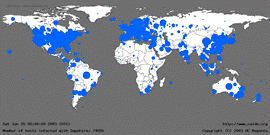
    That was seven years ago and it was a memorable time for me. I had thought that the Slammer worm was dead, but apparently that’s not the case. Traces are still detected at times and this month the SANS Institute is trying to work with ISPs and companies to eradicate the worm once and for all. They are asking system administrators to spread the word and help them try and remove SQL Slammer as a threat. They are not confident that they’ll succeed, but I think it’s worth a try.

    I’m sure many of you encountered the Slammer worm if you were working with SQL Server at that time. Any great memories? Any stories to share? Let us know in the discussion below and if you can help eradicate the worm, make sure you pass the word to the administrators of SQL Server 2000 instances.

  • Efficiency

    There was a debate recently about older IT workers and the fact that there is some age discrimination going on in this industry. While that’s probably true, it happens in other fields as well. Especially blue collar fields where the amount of work done often relates to some physical activity. Older workers might make less, or be paid less, because they do the job differently.

    Without getting into the debate about age discrimination, I wanted to get a feel for how you feel about your career progressing. I’m sure those of you in your 20s can’t conceive of being 60 and programming any differently than you do now, but times will change for you.

    One of my feelings is that there is a lot of value in experience. The latest .NET changes aren’t harder to use or understand than the previous ones, and the changes to T-SQL bring about new things to learn, but they aren’t really any more complex than previous features, commands, and constructs. For this Friday, I wanted to ask this:

    Are you becoming more efficient as you progress in you career?

    Maybe you can answer how you are getting more efficient. Are you developing skills that allow you to produce higher quality code in less time?

    I hope that most of you are, and the explosion of blogs, books, and events like SQLSaturday mean that you have more chances than ever to learn how to become more efficient in whatever type of technology you work with in your career.

    Steve Jones

  • New Looks

    It’s been quite a few years since I updated the Hawaiian shirt wardrobe. I bought a series of 5 shirts for TechEd years ago, having “SQLServerCentral.com” embroidered on each of them. I had 3 copies of each shirt, with Andy, Brian, and myself having a selection of shirts to wear.

    In the in between years I’ve purchased a couple more, but no customization. However this year I needed to outfit my “Scary DBA bouncer” for the SQLServerCentral party. He made a joke about getting a shirt like the one I wore for the Baton Rouge SQL Saturday keynote, and I decided it was time to get a few more for myself, so I started searching around.

    The last time I was looking for someone that would customize the shirts. I didn’t find a lot of places in 2004, but there are more now. However I was a little worried about turnaround. So I looked locally. After pinging 3 or 4 places in the Denver area, Burbank Embroidery said they’d be able to handle a few pieces (I was thinking 6 or 7 shirts) at a reasonable rate and have them done by Oct 29th.

    So then I was searching for shirts. For some reason I wandered onto Beanteacher Hawaiian Wear and found some great shirts. They had a nice online store, and when one of my shirts was out of stock, they promptly emailed me with a few choices and I picked one. My order arrived within a week, and I was happy with the qualify and service from them.

    The shirts are at the shop, and I should pick them up next week sometime, just in time for them to accompany me to SQL Connections in November. And in time to get the Scary DBA properly dressed.

  • SQL Saturday Advice – Extra Food

    No matter whether you provide the food or have people pay for it, it seems that at every SQL Saturday I’ve attended, there is extra food left over. Sometimes it’s a very significant quantity. At one of the events I think there were over 50 boxes lunches left over.

    You need a disposal plan.

    Now it’s easy to toss the food, or give some to volunteers if they want it, however I’d encourage you to think a little wider, or maybe even more socially. Think about how you put that food to good use.

    At the Rocky Mountain Tech Trifecta that we’ve run for a few years we typically have no issues with leftover pizza. Plenty of students are wandering the halls on a Saturday and are more than happy to help us dispose of a few slices. I like to think we’re doing a good thing by allowing students a free meal after the attendees have eaten.

    In many events, however, there isn’t a large group of people walking around the area that would appreciate the food. After both the Denver and Kansas City SQL Saturdays, the leftover food was donated to local missions that used it to feed those people who are down on their luck. I know a few other events have done this as well, and I’d encourage everyone to consider a local mission in your area. If you are having trouble finding one, contact a few churches nearby your event and I’m sure they can help.

    I’d like to think that those of us in IT are fairly well off compared to many people in the world. And I think that we can do a bit more to give back to others that might not be as fortunate. Have a disposal plan for extra food and don’t let it go to waste.