Author: way0utwest

  • Hire Well

    In the last few years, I’ve noticed that the quality of technical workers can vary quite a bit in many organizations. I think most people get things done, but often not at a high-quality level. It’s one reason that I write, speak, and try to motivate more of you to work on your skills and your career. I want to see better software being built.

    I tend to work with more database developers than application developers and I tend to see more SQL code than C#/Java/etc. And I see a lot of poorly written SQL Code and poor data models that seem to have been built without a lot of thought put into them. Whether this is because of ignorance or just poor skills is hard to know, but I see a lot of code that makes me slightly cringe.

    Over time, many of us see that this technical debt limits our ability to improve things or make changes. Often these systemic issues linger because the development staff a) doesn’t know how to fix them, b) has other, higher priorities, or c) is afraid to try and make changes. Often it’s a combination of all three, which further limits the agility of the database and application teams. We end up struggling to keep up with customer demands, or we may pile on more and more technical debt. Often this leads to increased performance problems in the database.

    I was reading about development and staffing in this piece, which had an interesting quote: “I currently believe that there’s only one way to buy yourself out of technical issues and bad data models, and that’s buying a really talented engineer whose sole focus is fixing the problem.” Essentially, you need to do two things here. First, hire a smart engineer, and second, empower them to effect change. In many cases, I think you actually need two smart engineers: one database engineer and one application software engineer. Those people have to focus on improvements, refactoring bad data models and the code that depends on them, and slowly raising the level of quality.

    The piece gets a little sidetracked with the way vendors promise their products will fix your problems. In general, that’s not true, at least not without you adapting your process to their software. In my role, I’m careful not to promise more than I can deliver, and not try to minimize the effort required to change. I know it’s somewhere between using 10% time and a major overhaul, and I hope I convey that to clients.

    Ultimately, I think that we haven’t commoditized lots of software development, which is the point of the piece and the quote above. We need to get talented people, or we need to train them, or both. We need people that enjoy their jobs and find some purpose or satisfaction. Part of that is making their jobs more interesting and enjoyable.

    That also means there are many opportunities if you learn to be good at your job. Learn to build good data models. Keep up your skills that write efficient code, learn how to troubleshoot, and learn how to work well with others. None of those are easy skills to develop, nor are they quick to learn, but they can be learned with some effort. Document your progress, blog/write/speak, and I bet you’ll find your career prospects improving.

    Listen to the podcast at Libsyn, Spotify, or iTunes.
  • Friday Flyway Tips–Linking a GitHub Issue to a Code Commit

    Recently I was doing a demo and a customer asked how I had linked my commit in Azure DevOps to the work item that existed. It’s easy, and tldr; it’s with the commit comment. This post shows how that works.

    I’ve been working with Flyway Desktop for work more and more as we transition from older SSMS plugins to the standalone tool. This series looks at some tips I’ve gotten along the way.

    Creating an Issue

    Many people use GitHub and adding issues is easy. You go to the Issues tab, click “New” and enter details. What is required might vary by project. I have a public demo project here: https://github.com/way0utwest/FlywayNorthwind

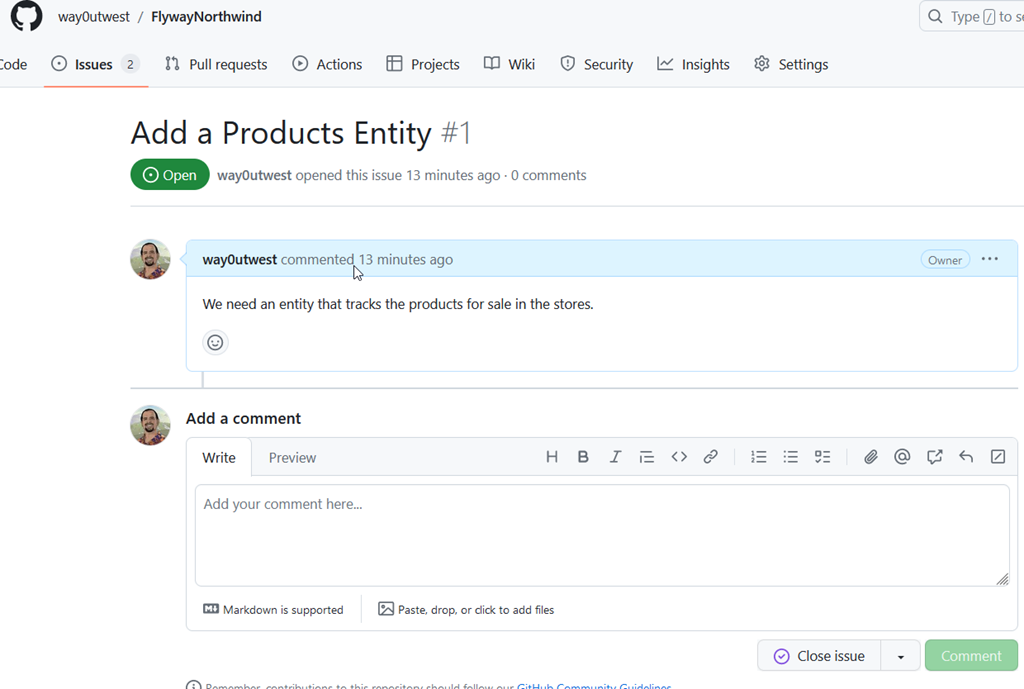
    My issues tab has a few items, but you can see one of the issues below. Note, I’m not proud of this, as I just added this for a demo. I didn’t really add enough detail for anyone to work off this. I’ll do better with other issues.

    2024-01-05 17_01_26-Add a Products Entity · Issue #1 · way0utwest_FlywayNorthwind — Mozilla Firefox

    In any case, the thing to note is I have a #1 at the top, meaning this is issue #1. If I type a comment or note anywhere in this project and include #1, a link is created to this issue.

    Linking A Commit in FWD

    This is very similar to the technique I showed in Azure DevOps. Actually, it’s the same. I’ll make some changes for a products table and generate a migration script. When I go to the Version Control blade, I see the changes and I commit them with a message that includes #1.

    2024-01-05 17_05_11-

    In the GitHub code tab, I see my commit message, and the #1 is hyperlinked. If I hover over it, I see the issue.

    2024-01-05 17_06_13-way0utwest_FlywayNorthwind_ Test project using Northwind and Flyway — Mozilla Fi

    In the Issue itself, I see a flow with the commit listed.

    2024-01-05 17_06_51-Add a Products Entity · Issue #1 · way0utwest_FlywayNorthwind — Mozilla Firefox

    Now I’m not only tracking discussion and comments of the issue, I’m linking commits as well.

    This is less a Flyway Desktop feature than a GitHub one, but you can access this from Flyway Desktop by writing good commit messages with Issue numbers.

    Try Flyway Desktop out today. If you haven’t worked with Flyway Desktop, download it today. There is a free version that organizes migrations and paid versions with many more features.

    Video Walkthrough

    I made a quick video showing this as well. You can watch it below, or check out all the Flyway videos I’ve added:

  • A New Word: Altschemerz

    altschmerz – n. a sense of weariness with the same old problems that you’ve always had, the same boring issues and anxieties you’ve been gnawing on for decades, which makes you want to spit them out and dig up some fresher pain you might have buried in your mental backyard.

    Many of us deal with problems over and over in our lives. Sometimes we just don’t have the energy or power to change them. Sometime we don’t know what to do with them.

    Over time, this can wear you down. For me, I have all sorts of problems, fortunately overshadowed by the amazing things I experience.

    As an example, I struggle with anxiety when starting some projects. Not all, but there are some that I don’t complete well enough, or need repeated repairing, and I get challenged to find a new approach or even re-repair something. Sometimes these are things I’ve delayed fixing, sometimes they’re maintenance that creeps up again, sometimes a thing broke. I get anxious and feel challenged, I worry I don’t do well, I don’t want to start and get stuck or stop.

    Rebuilding trailer hubs is one of those things. I can’t decide if maybe the trailer is bent too much, but these keep happening and I wish they didn’t.

    I certainly have other problems, but relatively few. I deal with altschmerz well some days, and not well others.

    From the Dictionary of Obscure Sorrows

  • Learning NoSQL

    It’s a good idea to learn more about different technologies. I’ve been amazed throughout my career, and even now as someone working for a software vendor, how many different technologies I run into. I’m also amazed at how little bits of knowledge comes in handy, either to help me understand a problem or to help guide others with a recommendation of how to proceed.

    Many of us have experience with relational databases and tabular data. We are comfortable with it, even if we might struggle with a packing problem or using a tally table. However, do you understand how a NoSQL database might be different? Can you even name a few types of NoSQL databases?

    I find it valuable to know a bit and experiment a bit, as your devs may ask you if it’s suitable, or even how to work with one of these databases. They might even start using one and expect you can take responsibility for managing it, backing it up, securing it, and more.

    I wonder how many of you know MongoDB? What type of database it is or how it stores data?  What about Cassandra? Neo-4J? CosmosDB? I haven’t done much work with any of these, but I’ve learned a bit about them. I even spent six months digging into graph databases and learning how they work, how to model data, and how to query them. Part of this was SQL Server’s inclusion of graph structures, but part of this was a customer looking to add graph capabilities to their application. I learned a lot, and even delivered a few presentations on how they work.

    I’m not an expert, but I can have a rational, reasonable, informed debate about the good and bad things with graph databases. Enough to help provide an opinion on whether they might suit a problem. They solve some complex things well and I think they might be a good platform to add to some applications. I wouldn’t get rid of the RDBMS, but supplement it.

    This year I’m going to dig more into MongoDB and Cassandra. We have more customers asking about these platforms and we’re working on Flyway support for both of them.

    If you have any thoughts on NoSQL, or experiences, or even want to write a bit about them, let me know. I’m always looking to learn more, and I always need good authors.

    Steve Jones

    Listen to the podcast at Libsyn, Spotify, or iTunes.