Author: way0utwest

  • Consolidating Cloud Backups

    I am a big fan of the cloud. While I appreciate local storage and privacy/control/security, etc., that stuff can also go away locally. Plus, I like the convenience, and I think that many cloud services do a good job of making my life easier.

    That being said, I’ve had a few things in place for the last few years.

    • Dropbox – files, sharing photos/video, presentations
    • Google Workspace – personal email, photos, docs/sheets
    • Amazon Photos – extra photo backup (free with Prime)
    • OneDrive – personal and business, syncing files
    • GitHub – repos of misc stuff.
    • BackBlaze – laptop/desktop backup
    • Notes – Joplin through DropBox
    • Passwords – Password Safe through OneDrive.

    I have a few other minor things, but this is where I have a lot of stuff.

    Recently I’ve been thinking that I need to consolidate a few things. Partially because of cost. Like 37 Signals, I realized that I was spending more than I’d like on a few things, and I’ve decided to try and reduce costs, but not reduce service.

    Leaving DropBox

    I’ve been paying for 1TB of space in Dropbox. I’ve also had 1TB in OneDrive. I essentially flipped a mental coin and decided to stick with Microsoft, partially because a lot of my work involves MS, and I have a number of things linked to a personal MS account where I use my OneDrive.

    I was only using about 20GB of space in DropBox, so this was an easy move  for me. I dragged/dropped a bunch of things from one folder to another and let them sync. I cancelled the $10/mo for DropBox and I’ve reduced some cloud spend.

    As a second backup, I’m going to start moving more of my talks to GitHub, keeping presentations there, along with copies in OneDrive, as this will ensure I have a couple backups in the event of some disaster.

    Photos

    I ran out of space in my Google Workspace for photos. I share this with my kids, and the plans to expand space are poor for an individual. They are geared to businesses, and adding more space would take my $18/mo plan to $60, which seems like a crazy indulgence.

    For now, I’ve started using OneDrive as my backup for photos, still with Amazon, and I’ve kicked the can on this as my daughter is in her final year of Uni and doesn’t want to deal with any migrations.

    Notes

    I wrote about moving to Joplin from Evernote awhile back. It’s worked well, but I was synching things through DropBox. I had to move that to OneNote and it works well.

    I saw a few people at work using other services, and I might investigate them, but for now, Joplin has worked well.

    I still don’t like OneNote and prefer text or MD formats.

    Email/Docs

    Like the photos above, I’ve got a lot of stuff in Google, but they haven’t made it easy to manage. A lot of Google services are either personal or business, and there’s no crossover. For example, I can’t use Google Pay with my workspace account because, well Google has different divisions and they don’t talk.

    I want to migrate my personal domain away, but for now, I don’t have a good plan, I’m sticking with Google and I’ll decide in the summer what to do.

    Backup

    Backblaze has been great for me. They’ve raised prices a few times, but I’m OK with that. I want a raise most years, so I’m fine with reasonable price increases.

    Passwords

    We have a service at work for passwords, but I’ve been hesitant to move to it. It syncs to the cloud and provides automatic entry into browsers and things, but I’ve been used to Password Safe and I am hesitant to change. I like having my own safes for passwords that I can manage the synching of through a choices of file sharing. Too many third parties have had breaches, and I worry that my personal file storage is less likely to be targeted than a third party managing passwords for corporations.

    I’m sticking with Password Safe, syncing through OneDrive.

    Summary

    I love the cloud, but I’d be curious if any of you use/recommend/hate different services.

  • Take A Vote and Accept Your Loss

    I feel differently today than in the past about many of the things I’ve seen technical people argue about. I’ve written about Tabs vs. Spaces and Singular vs. Plural, and others have debated commas before or after among other topics. While these might be interesting sidebars at lunch, I see them sometimes devolve into time sinks with teams revisiting the issues over and over during their daily work.

    These types of religious wars stifle a lot of productivity and often can linger for years. However, in many cases what I see is debate across weeks or months and then time spent to shift the way that large groups of people work inside of a company. In the last few years, I’ve seen customers argue about which VCS to use, which new CI tool to choose, or even about which secret store to use for their database credentials. Often these debates happen when there is already a technology in use.

    In most cases, the differences between many of these arguments are negligible. Lots of teams fall down on either side of a debate and find themselves very productive. Or not productive, but it often seems the difference is the staff, not the tool, platform, language, or style. Good people are productive no matter which way we choose to work.

    My view is that for most of these items, we ought to have a (relatively) short meeting. Give each side a few days to prepare, but then one spokesperson for each side gets 5 minutes to present their case on why the group should adopt their idea. Once everyone has presented, we debate for a limited time, maybe 15-20 minutes, vote, and then move in that direction. Ultimately, we’re trying to get software written (or deployed or managed or something) and not trying to decide the best way to format that code or choose a tool for CI/CD.

    This teaches people to communicate and learn to present a rational, coherent, succinct idea, which is a valuable skill. This also teaches us to work as a team and learn to accept decisions that don’t go our way. None of us wins 100% of the time in life, so make a good effort to lead others in your direction, but accept that they might choose a different path. In that case, learn to support the team in their efforts.

    The caveat to all of this is that inside of an organization, we often want a standard, so if something is already heavily used, just adopt that pattern or technology.

    Steve Jones

    Listen to the podcast at Libsyn, Spotify, or iTunes.

  • Moving SQL Prompt History to Another Machine

    A customer was asking about SQL Prompt recently and how their history is stored and if it can be moved to another machine. This post shows how this works, and how you could move it. There is also a video walk through at the bottom.

    Caution: This is history for your specific queries, and moving the database means you overwrite history on the new machine. Don’t do this to share code. Do this only if you are upgrading your own machine.

    This is part of a series of posts on SQL Prompt. You can see all my posts on SQL Prompt under that tag.

    SQL Prompt History

    History in SQL Prompt is a slightly hidden, but amazing piece of technology. A number of customers find it incredibly valuable to see the history of their queries, especially when they’ve gotten busy with a number of different pieces of code.

    In SSMS, when SQL Prompt is installed, it is keeping track of what you write in queries. Don’t worry, this is local, and it’s on your machine. Let’s look at this.

    Say I have a query window, like this:

    2024-01-09 12_59_53-SQLQuery10.sql - ARISTOTLE_SQL2022.compare2 (ARISTOTLE_Steve (121)) - Microsoft

    I can’t remember who the users are, but I add a new query to this window, as shown here.

    2024-01-09 13_00_25-SQLQuery10.sql - ARISTOTLE_SQL2022.compare2 (ARISTOTLE_Steve (121))_ - Microsoft

    All that is captured in SQL History. In one of the menu bars in SSMS, you can see this listed with other Redgate products.

    2024-01-09 13_00_35-SQLQuery10.sql - ARISTOTLE_SQL2022.compare2 (ARISTOTLE_Steve (121))_ - Microsoft

    When I click this and open it, I see my query windows in the upper left, with the window text in the right, and below on the left, a timeline.

    2024-01-09 13_00_45-Moving SQL Prompt History to Another Machine - Open Live Writer

    This is the latest version, but if I click down, I see the previous version without the SELECT.

    2024-01-09 13_00_54-

    I can go back further and see before I added the ALTER ROLE statement.

    2024-01-09 13_01_00-SQL History - Microsoft SQL Server Management Studio

    Finding History

    All of my data is stored in my local profile. I can browse the path under AppData \ Local for my user, and inside there is a Redgate folder. Under that is SQL Prompt 10 (or your version). If I sort by date modified, I see my SqlHistory.db file, which is the database of my SQL History in Prompt.

    2024-01-09 13_10_37-SQL Prompt 10

    If I were changing to a new machine and wanted history to move with me, I’d copy this file to the new machine. Unfortunately, I can’t put this in a VCS, as the path is set.

    As I cautioned above, this isn’t something you send to colleagues. This is an individual file of your work and only copy this to a new machine when you are upgrading, not trying to sync work. Use a VCS for proper code control.

    Browsing the Database

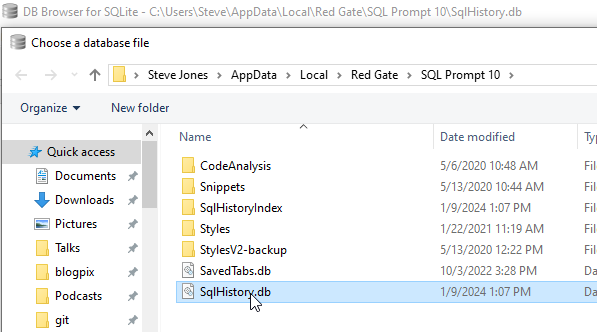
    This is a SQLLite database, and any tools that let you look at the data work. I have the sqllitebrowser tool on Windows, which works great. I can click “Open Database in this tool and browse to my file.

    2024-01-09 13_13_43-Choose a database file

    Inside here, I see my schema and tables and if I scroll down to the bottom of the QueryVersions table, I can see my query in the last entry in the Contents field. Note the query on the right looks like the one in SSMS.

    2024-01-09 13_14_32-DB Browser for SQLite - C__Users_Steve_AppData_Local_Red Gate_SQL Prompt 10_SqlH

    If I click up a few, I see the other version.

    2024-01-09 13_14_40-DB Browser for SQLite - C__Users_Steve_AppData_Local_Red Gate_SQL Prompt 10_SqlH

    No magic here, just good solid programming that saves you a lot of time and helps you deal with the chaos of software development and the frailty of the human mind.

    If you haven’t tried SQL Prompt, download the eval and give it a try. I think you’ll find this is one of the best tools to increase your productivity writing SQL.

    Video Walkthrough

    I made a video of how this works if you’d prefer to watch this. You can also see all my SQL Prompt Tips.


  • Webinar Tomorrow: Navigating the Database Landscape in 2024

    You can still register and join me tomorrow. I’ll actually be in Austin at the Redgate office doing the webinar, which should be interesting.

    Send your questions, comments, and have some fun as we look at the results from our survey of 3500+ database professionals.