Author: way0utwest

  • A New Word: Ghough

    ghough – n. a hollow place in your psyche that can never be filled; a bottomless hunger for more food, more praise, more attention, more affection, more job, more sex, more money, more hours of sunshine, more years of your life; a state of panic that everything good will be taken from you too early, which makes you want to swallow the world before it ends up swallowing you.

    I think most people have some sort of ghough, longing for more. It’s a human, and a very America, thing. There’s never enough. You wish you had something more.

    As I age, I have less of this, though I do feel the passage of time. No panic about passing away yet, but I can imagine I will at some point. It’s why I find myself more willing to have adventures in life, even at a slightly uncomfortable financial cost. I never know how long I’ll be here.

    Of the list above, I think money sometimes intrudes. I think about travel with my wife, or things that have to be fixed on the ranch, and I think “more money” would solve things. However, I know that’s not really the case, and I try to calm my psyche down, reminding it that I need to manage and live within constraints, enjoying and appreciating what I have.

    From the Dictionary of Obscure Sorrows
  • Quick Filtering in SSMS–#SQLNewBlogger

    I saw someone limit the databases they see in SSMS, which isn’t something I often do, but I thought this was great.

    A Long List

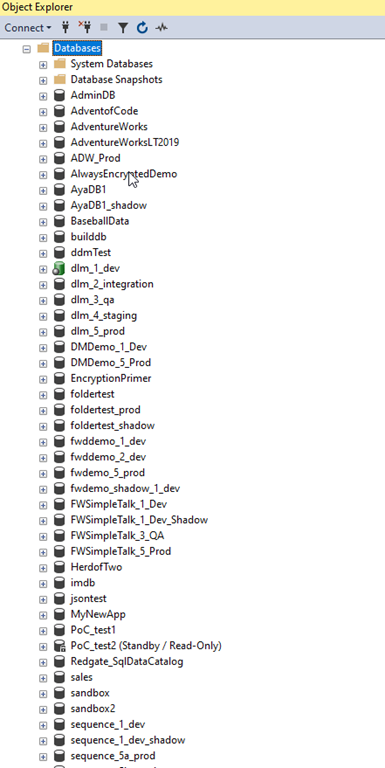
    This is the list of databases on a demo instance I have. While it’s a lot since I do a lot of testing with customers and colleagues, I see plenty of people will lists of databases longer than this.

    2023-09-18 09_39_38-Window

    I also watch them scroll like I do when trying to find an object in a database.

    However, for demos, this is a lot, so I like to slim things down. I used to have a script to detach all the databases and then attach the ones I need, but that’s time consuming and once in awhile, I need a different database, so that’s an issue.

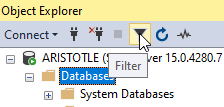
    I saw the someone filter their list by clicking the filter button in the Object Explorer. This is the funnel button shown here:

    2023-09-18 13_57_35-Window

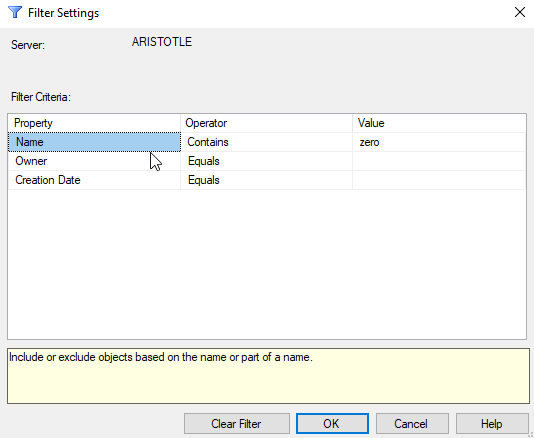
    Once you click this, a dialog appears that let’s you enter your filter criteria. I’ll use a simple filter of “zero” to limit to those databases in my zerodowntime demo.

    2023-09-18 09_39_25-Window

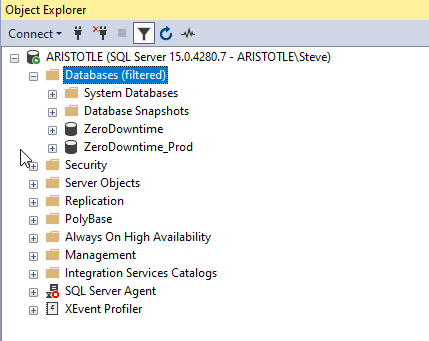
    Once I click “OK”, I see only those databases listed.

    2023-09-18 09_39_18-Window

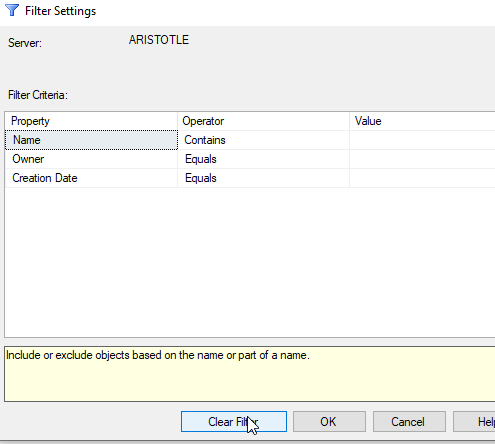
    If I want to get everything back, I can click filter again and then delete my criteria, or click “Clear” filter. That gets me the entire list back.

    2023-09-18 09_39_32-Window

    Easy.

    SQLNewBlogger

    This post was something I jotted a note about when I saw someone do this. The note was literally “write about filtering in SSMS object explorer”. I took that and wrote this post in 10 minutes, including time to grab screen shots.

    You could do this as well, showcasing the knowledge that you’re learning to use tools better, which make you more productive. Employers love that.

    Write your own post with more advanced filtering.

  • Running a Service

    Many of us work for some organization and we’re responsible for managing a database or coding some application or some other data related position. Perhaps we ensure reports work for our users or move data around. In many cases, we have customers, whether they are internal to our organization or perhaps external from another business or even the wider public.

    However, many of us see our jobs as a part of the org/business and not that we are actually providing some service to others that we are responsible for. While I’ve certainly felt that way, I learned at some point that if I were an app dev, I ought to treat people using my app as customers, even though they don’t pay me in currency. They often pay me in praise, or better yet, with praise to my boss. As a DBA, I treated both app devs and users as customers. That helped me take pride in my work and learn to view my position from other points of view.

    There was a post on learnings from running a SaaS service for a year. While few of us maintain a SaaS service, we could think of the app we build as Software-as-a-service, albeit without any revenue. We could see databases we manage as DBaaS (databases as a service) or PaaS (platform as a service) items.

    I think that the way we view the world, or view our situations, can be helpful to us in managing our workloads. We can better triage what is critical, what’s important, and what’s nice to have. We can decide when an issue deserves some to cause some stress and we might give an extra effort, and when something can wait until tomorrow. We can decide when we push back on demands and when we accommodate them.

    This approach has also helped me to think about ways to improve the service/software/platform I provide to others in ways that helps my customers, or makes my job easier. This way of thinking leads me to make the situation better when I can. It also helps me to discuss the decisions with others, especially management, in terms that can matter to them. Are we finding ways to improve the overall system?

    It doesn’t always work, but it often has for me.

    And if you’re interested in your own side project, the journey continues in part two. Perhaps you can spend an hour or two a day and build something that becomes your own business. That’s what happened to me with SQL Server Central.

    Steve Jones

    Listen to the podcast at Libsyn, Spotify, or iTunes.

  • SQL Saturday Denver 2023–VCS Primer for the Database slides

    My slides are here: VCS Primer Denver 2023

    This was an overview of what version control is, and the basics of Git.

    Not too many questions, but if you have some, ask.