Author: way0utwest

  • Are You Worried About AI?

    The AI revolution is happening. I don’t know how successful it will be, but regardless, people are trying to get AI into everything. That might be good or bad in various situations, but it has people worried about AI. This piece looks at a survey from the American Staffing Association that says 47% of people somewhat or strongly agree that their job is replaceable by automation with an AI. There is more data to dig into, but that’s a lot of people who worry about their jobs.

    Most people do think that tech is generally a good thing. I do find that many of us in tech, and some other industries, are buried in work. There’s never a shortage and we could easily work 60, 70, or more hours a week and not complete everything. The flip side of that is a lot of work doesn’t necessarily need to be done now and could be delayed, so I think it’s hard to decide whether we need more help or more patience.

    The various places I’ve seen AI used are often helping people get started or unblock their creativity struggles. Recently someone posted this link on some prompts a person had used to get moving. I found a few of these possibly helpful. Not writing, but maybe having an AI proof something, or even get me started in some new area. I worry about book summaries, or even text summaries, as I’m not always confident the AI understands which pieces I might find important. However, that’s also a danger with humans. I’ve seen no shortage of people asked to summarize something for others. When I understand the subject well, I sometimes disagree with another’s summary (or think it’s just plain wrong).

    I don’t think AIs are a big danger to many people’s employment. I do think that as people learn to use AIs are assistants we might find that we grow or enhance staff less. We might also find that the 10x engineer knows how to engage 10 AIs to help them get things done, especially simple, busy work. The low performers will likely be those working in the same way in the future as they do today. That might not threaten your job, but it might mean lower bonuses and less opportunities in the future if you can’t adapt your skills to this new world.

    Steve Jones

    Listen to the podcast at Libsyn, Spotify, or iTunes.
  • Future Data Driven 2023 is This Week

    The Future Data Driven 2023 virtual conference is coming on Wednesday, September 27. Register today and save a note in your calendar.

    The event has  a great schedule (scroll down) with quite a few sessions that I will try to watch. Take a minute and flip through the list. If anything catches your eye, block your calendar and register today.

  • Opening the SQL Prompt Command Palette

    A few years ago SQL Prompt added a command palette to let you search the commands available. This is similar to the same concept in Visual Studio Code, ADS, and various other tools. This post looks at how to get to this tool in SSMS.

    This is part of a series of posts on SQL Prompt, which is an amazing productivity tool from Redgate Software.

    Opening the Palette

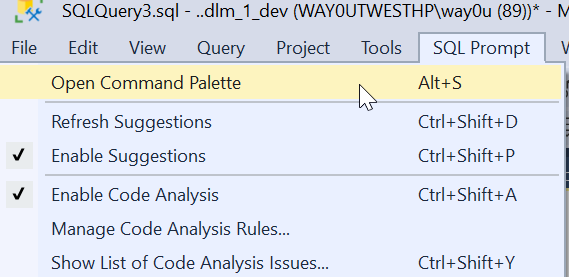
    You can also open the Command Palette from the menu. In the SQL Prompt menu, it is the first item. You can also see there is a shortcut of ALT+S below here.

    2023-09-04 04_44_26-

    When I click this, I’ll see the full list of palette commands. This is a large window, and across the top I can filter things. In the complete list, you see various things: objects, snippets, and refactoring commands. We also have the Prompt behavior settings as well.

    2023-09-04 04_44_43-SQL Prompt_ Command Palette

    For example, I could look for things with “brackets”. I see a few things that are relevant. I can pick any of them if I want that apply to my code or change the behavior of the tool

    2023-09-04 04_52_25-SQL Prompt_ Command Palette

    Adding to the Menu

    If you can’t remember the shortcut. or don’t want to use the menu, you can add this as a button in the toolbar. Here’s the easy way. When you installed SQL Prompt (or the Toolbelt), there is a Redgate toolbar added. Mine looks like this:

    2023-09-04 07_29_16-SQLQuery3.sql - ..dlm_1_dev (WAY0UTWESTHP_way0u (92)) - Microsoft SQL Server Man

    I clicked the “Add or Remote buttons ” and got a list of buttons on this toolbar. I can click “Customize if I like. That opens the dialog below.

    2023-09-04 07_51_53-Customize

    Now click “Add Command”. That gives you a list of items in all the menus in SSMS. Pick the SQL Prompt menu on the left (first one). Then scroll down and find “Open command palette” in the right side. Select it and click OK.

    2023-09-04 07_52_16-SQLQuery3.sql - ..dlm_1_dev (WAY0UTWESTHP_way0u (92)) - Microsoft SQL Server Man

    Now you have this in your toolbar.

    2023-09-04 07_52_25-SQLQuery3.sql - ..dlm_1_dev (WAY0UTWESTHP_way0u (92)) - Microsoft SQL Server Man

    Now one click, and you have the palette.

    FWIW, you can use this trick to add any menu item to a toolbar that you want.

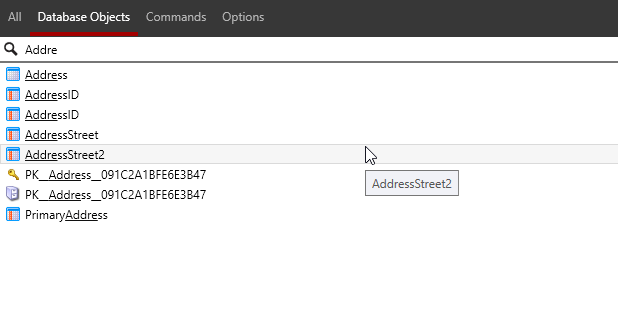
    UPDATE: A comment asked about partial matches, and you can see I see partial matches for “Addre”.

    Partial match of a word in the command palette

  • Friday Flyway Tips–Flyway Parameters

    Flyway is a command line tool with lots of options and parameters. Working with those is a pain, but we’ve made this easier in Flyway Desktop 6.5+. In this tip, see how you can add parameters to your Flyway command.

    I’ve been working with Flyway Desktop for work more and more as we transition from older SSMS plugins to the standalone tool. This series looks at some tips I’ve gotten along the way.

    Flyway Options

    There are a lot of options in Flyway that you can use, and we added a dialog in Flyway Desktop to make it easy to construct a command line call. However, we also made the FWD tool work better recently, removing the need to save your changes.

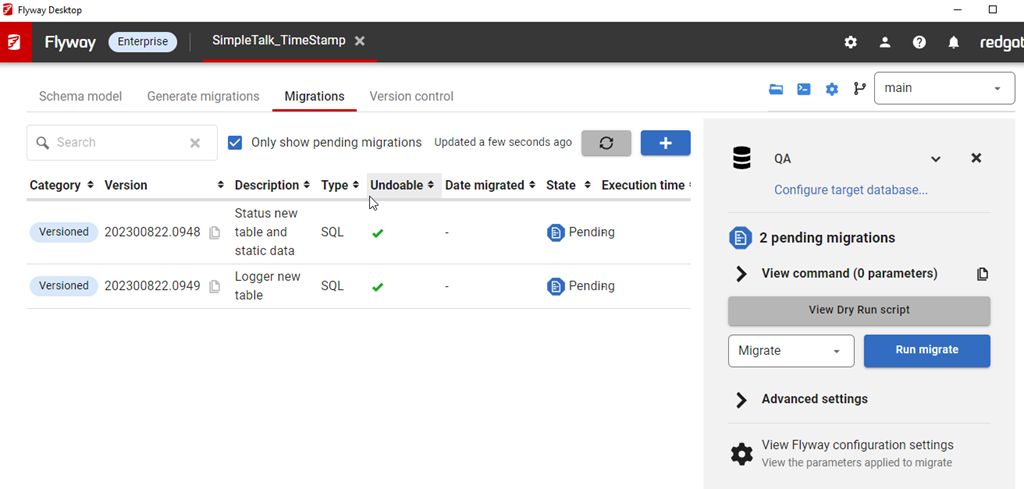
    In the migrations tab, I have all my migrations listed, and on the right side, I can see the command that would be run with the Flyway CLI.

    2023-09-18 14_11_01-Window

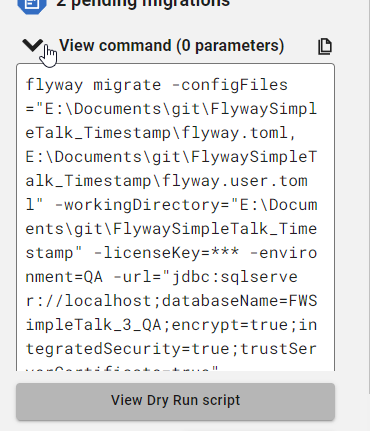
    If I click “View command”, I can see this command, which has a number of parameters by default.

    2023-09-18 14_11_08-Window

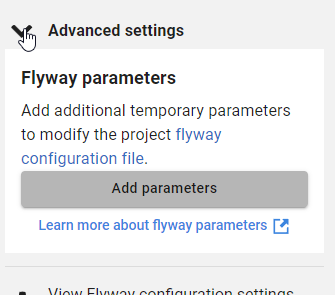
    However, often I want to add other parameters. Below this dialog is the Advanced settings area, which is where we add parameters.

    2023-09-18 14_11_19-Window

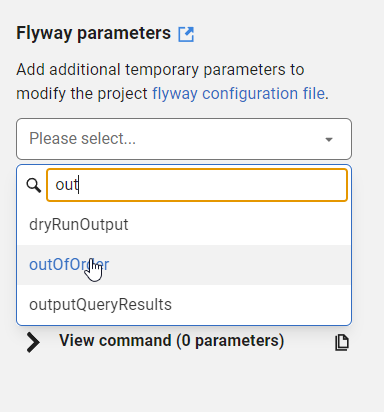
    If I click Add parameters, I get a list of all the parameters, and I can type in the list to filter them down. For example, I often want outOfOrder, so if I type “out” I see this listed.

    2023-09-18 14_11_42-Window

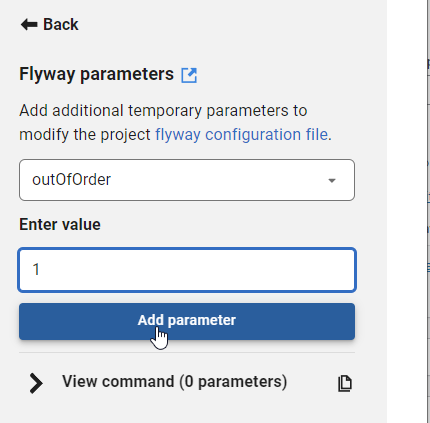
    I can select this and then enter a value for the parameter. I showed in a previous tip how you can easily copy migration numbers, which is handy for using in some of these parameter values.

    2023-09-18 14_11_49-Window

    Once I enter a value, I can click “Add parameter”. Of course, if I’ve done something silly, like enter an integer for a true/false value, the GUI tells me.

    2023-09-18 14_11_57-Window

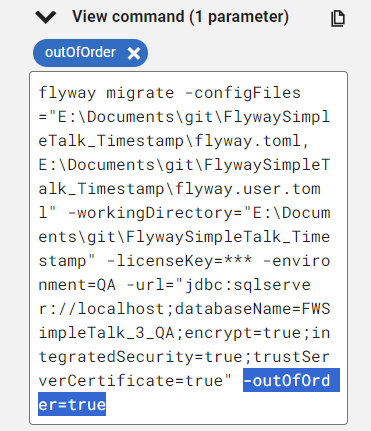
    If I add this, then it’s reflected in the command, which is what I’d copy and paste into some deployment tool like Azure DevOps, GitHub Actions, Octopus Deploy, etc.

    2023-09-18 14_12_05-Window

    Try it out today. If you haven’t worked with Flyway Desktop, download it today. There is a free version that organizes migrations and paid versions with many more features.

    Video Walkthrough

    I made a quick video showing this as well. You can watch it below, or check out all the Flyway videos I’ve added: