Author: way0utwest

  • If You Build It, Will They Use Linux?

    There’s a great scene in Field of Dreams where James Earl Jones says that people will come. It’s in response to the voices Kevin Costner hears early in the movie. This is the climax of the movie, where Costner makes a financial decision to trust his instincts and hope his farm will be saved.

    In many cases, organizations do just this. They build something, assuming people will come. They may have some data, research, or other reasoning as to why why people will use what they build. However, that’s not always the case. Sometimes they build something and hope people will come, much like Field of Dreams.

    I wondered about this recently with some friends when discussing SQL Server on Linux. Quite a few people I know haven’t seen any Linux installations inside their organizations. Others are consultants and haven’t experienced any work on Linux, which is interesting. I’ve heard people at Microsoft state there are plenty of installations out there, but I’ve found few people who have moved from Windows.

    I know a lot of people who work in the Microsoft data stack aren’t familiar with Linux. This is despite all the articles and writings the last few years trying to teach people about Linux and how SQL Server runs well. I also see articles like this one, which claims Linux uses more CPU. This is despite Red Hat saying Linux runs SQL Server well and leads in benchmarks from TPC, at least the TPC-H results.

    I learned at the various command lines in school, with a lot of time spent on Unix systems. Even with X-Windows, I often used the interface to open multiple shells to get work done. However, a lot of people have not worked at the command line very often. Despite the popularity of PowerShell, I find no shortage of Windows-based knowledge that struggles with certain concepts, like quoting and piping results between commands.

    I don’t know how many systems run Linux v Windows. Azure states that over 50% of their VMs aren’t Windows, but Linux. I suspect a lot of those are likely web servers or other systems and not database platforms. They don’t seem to publish how many databases are SQL Server on Linux, and I have no idea if Azure SQL Databases (or MI/Synapse/Fabric/etc.) run Windows or Linux. I suspect it could be either, but most likely Windows.

    Do you feel comfortable running SQL Server on Linux? Is your organization considering it? I don’t know I think it’s worth the savings in license costs. Not that Windows is cheap, but the effort to train, learn, and work on a second OS might not provide any savings for years. Maybe not ever if you can’t get work done smoothly and quickly.

    They built it; now, will you come run it?

    Steve Jones

    Listen to the podcast at Libsyn, Spotify, or iTunes.

  • A New Word:Wildred

    wildred –adj. feeling the haunting solitude of extremely remote places – a clearing in the forest, a windswept field of snow, a rest area in the middle of nowhere – which makes you feel like you’ve just intruded on a conversation that had nothing to do with you, where even the gravel beneath your feet, and trees overhead are holding themselves back to a pointed, inhospitable silence.

    I rarely find myself in a remote place. Except on planes, then I love looking at the remoteness of the world. I was flying back from Austin to Denver and snapped this shot. I have no idea where it is. Somewhere between Austin and Denver. Texas? Oklahoma? SE Colorado? I didn’t expect this.

    2023-08-21 16_55_58-Photo - Google Photos

    I enjoy some remoteness. I find myself craving the feeling of wildred, hoping for the chance to be in a place without people, without structures, without anything nearby.

    Mostly I get this these days when I have to be somewhere early and no one is up and about. It does happen in winter, snowboarding down trails on a Wednesday in the trees with no one around. I can’t wait for that this next season.

    From the Dictionary of Obscure Sorrows

  • Flexing for the Cloud

    Many of us in technology regularly experiment with new tools and technology. We often do this to adopt new skills when we need to solve a problem or we have inherited some code that needs enhancement. The cloud is in many ways no different than things we’ve done before, but the way we do them, or maybe the way the cloud handles some things, means that we need to change how we view a task or perform our jobs.

    Migrating to the cloud is something that many of us have had to tackle at some point. I’ve seen a good amount of lift-and-shift, including many companies who just mandated moves to the cloud without much planning. As mentioned in this article, that was cloud migration 1.0. Really, I think this was something that’s been going on for years, and continues to occur today. Lots of management are seduced by the promises of the cloud to make their organization’s IT systems better, so they move everything without thinking.

    Then many run into cloud migration 2.0, or maybe that’s coming. I see plenty of customers with things in the cloud they complain about much in the same way they did on-premises. Nothing has changed with regards to how their systems work, and they are likely spending more money on the same services they had on-premises. With the same people. They didn’t plan well, didn’t provision well, and they haven’t changed anything but their costs.

    Cloud migration 3.0 is what many tech professionals would like to see. Evaluate apps, decide which benefit from the cloud, and leave the rest alone. Leave them on-premises in a familiar environment. That’s hybrid, but that’s fine.

    What many tech professionals worry about are their jobs, so they don’t often consider where the cloud can provide benefits from some apps. The flexibility and scalability are undeniable. You just need to ensure that you understand where the cloud fits, where cloud-native can benefit your org, and then make sensible recommendations.

    No matter how your organization approaches the cloud, likely you’ll have engineers from the provider or third-party consultants involved. Do what I do with people I’ve hired: ask a lot of questions. You’ll learn something, flex your knowledge, and even if you never work in the cloud yourself, you’ll be better prepared to make recommendations and evaluate future choices.

    Steve Jones

    Listen to the podcast at Libsyn, Spotify, or iTunes.
  • Creating an Empty Repo in GitHub–#SQLNewBlogger

    I saw someone struggling with getting started with a Visual Studio project and Azure DevOps. They got a conflict, which I’ll show and then get you started with an empty repo.

    Another post for me that is simple and hopefully serves as an example for people trying to get blogging as #SQLNewBloggers.

    The Problem with Initialized Repos

    I wrote about this recently with Azure DevOps and empty repos.. If I initialize a repo in GitHub, or any online provider, and try to push up a local repo, it returns an error that I have conflicts.

    I’ve learned that when I want to start a new project, either I create the repo locally and then make an empty one online, or I create it online, clone it, and then start working.

    I try to do the second (create online first), but I don’t always remember.

    Creating an Empty Repo

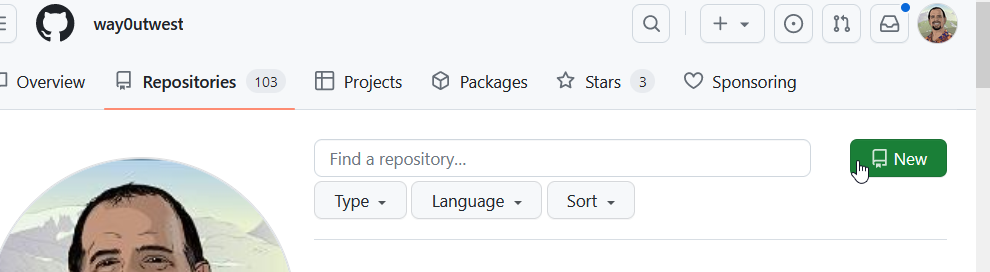
    In GitHub, if you go to your repositories page, you can see a “New” button on the right.

    2023-08-25 16_56_06-Your Repositories — Mozilla Firefox

    Click this and enter a name, as I’ve done below. BTW, I love the suggested name.

    2023-08-25 16_56_30-New repository — Mozilla Firefox

    If you look at the image above, near the bottom, you can see my mouse pointer.

    DO NOT check this box if you want an empty repo. Don’t add a .gitignore either. You’ll be adding code from your own project, which likely has a gitignore file and might have a repo. If not, just create a readme.md file in your local git repo.

    Don’t add a license file either.

    Pushing My Project

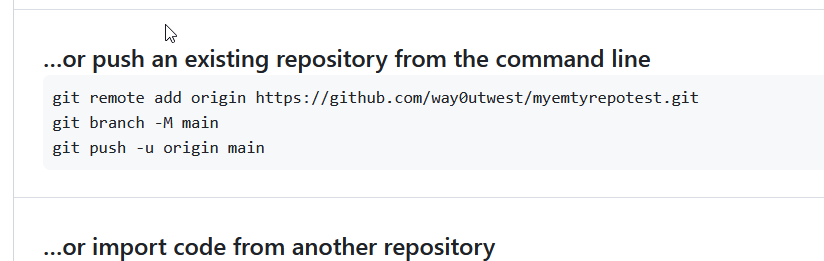
    Now when you create this, you get the details of how to push your repository. If you have never used git, just open a command prompt and paste these lines in one by one and run them.

    2023-08-25 17_00_57-way0utwest_myemtyrepotest — Mozilla Firefox

    That’s it and now you can work and commit in either repo and deal with merges.

    SQLNewBlogger

    This post was easy for me, but I’ve been in the situation where I’ve made this mistake. In this case, I’d written the other post, so I knew what to do here. I spent another 10 minutes getting GitHub set, taking images, and writing this.

    Easy to do, 2 posts from one idea, and showcasing knowledge on another platform. I could do another one with BitBucket or somewhere else, and maybe I will. I have customers that use other platforms.

    Maybe you should do this and showcase your versatility to the next person that wants to interview you. If you want to work with software and Git, show them you know the basics. Or even more.