Author: way0utwest

  • Daily Coping 8 Jun 2022

    I started to add a daily coping tip to the SQLServerCentral newsletter and to the Community Circle, which is helping me deal with the issues in the world. I’m adding my responses for each day here. All my coping tips are under this tag.

    Today’s tip is to send a friend a photo from a time you enjoyed together.

    During the pandemic, this tip has come up a bit, but it’s also been something I’ve enjoyed doing a few times. In fact, as I write this, I just sent a photo out to a few people. In 2020, I started coaching earlier in the season than normal because of new protocols. As a result, the weather was nicer than normal and after a couple months of hard work, I took the team outside one day. Me, a few kids, and a few parents watching. We had a fun practice, semi-serious, but a good break.

    I saw a picture from that day and sent it to a few parents.

    sandvb

    I also grabbed a shot at DataGrillen recently, where I met Kay Sauter in person and spent a few minutes chatting. I dropped this one on Twitter, to remind both of us of a good time.


    20220603_153229

  • Daily Coping 7 Jun 2022

    I started to add a daily coping tip to the SQLServerCentral newsletter and to the Community Circle, which is helping me deal with the issues in the world. I’m adding my responses for each day here. All my coping tips are under this tag.

    Today’s tip is to take a few minutes to chat, email, or talk with someone you haven’t contacted in awhile.

    It’s always good to spend time with someone that you care about and miss, but don’t see often. For me, that’s a lot of people that I encounter in my travels for work.

    I was traveling to SQL Saturday Jacksonville 2022 recently. I flew from Denver to Houston and had about a 60 minute layover before my next flight. I posted a picture and then got a chat message back almost immediately. Ben Weissman, who lives in Germany, was actually flying to Houston at that time. He noted he had a bit of time and we arranged to meet in the airport and chat for a few minutes. Totally worth the time it took for me to make the meeting.

    20220513_105757

    As part of the same trip I went to Cambridge to the Redgate office. We have a chef that does lunch for people in the office. I’ve known him for years, and when I went for a late lunch with no one in line behind me, I took a few minutes to chat with him and catch up.

    Take time to keep in touch

  • Are Cubes Dead?

    I was talking with a friend recently about technology. This individual is a person focused on business intelligence, originally a developer, but now an architect and consultant. They have a fair number of clients and have worked with them to build solutions to assist in analysis and decision-making for all sorts of organizations. This person has primarily worked in the Microsoft stack but has embraced NoSQL, Hadoop, and other technologies. In many ways they view the world as I do, using what works well for a particular situation without prejudice. They want to be effective, using whatever technology may be best in the current situation.

    In their career, this person has extensive SQL Server Analysis Services experience and has built many cubes over the years that clients access with any number of front-end tools. I would guess that cube design and construction have made this person a lot of money over the years.

    As we talked, I wasn’t surprised to hear my friend say they thought cubes were dead. It was an approach to analysis that they wouldn’t recommend anymore. That is something I’ve felt for some time. As data volumes grow and competition increases, there is a need for more real-time analysis. The processing time for cubes doesn’t make sense.

    Hardware advances, query technologies against files in data lakes, and automatic ingestion of large volumes of data into columnar formats have reduced the need for data mart cubes. I see less and less content produced in this area, both by vendors and individuals working with technology. ETL has given way to ELT, and data lakes seem to be far more useful than data marts that pre-aggregate data in predefined ways.

    Most of you reading this work in the OLTP space, but there are plenty of you that built BI solutions or interact with those that need them. In the modern, 2020s era, do you find people still building new cubes and taking advantage of ROLAP/MOLAP/HOLAP systems? Or is this now legacy tech you can’t wait to remove from your infrastructure? I think BI is more important than ever, but cubes are dead.

    Steve Jones

    Listen to the podcast at Libsyn, Stitcher, Spotify, or iTunes.

  • Getting Neo4J Running in Docker on Windows

    I was doing a little experimenting with graph databases. My goal was to run Neo4j in a docker container, but it wasn’t quite as simple as I expected. I started with a How-To, but it wasn’t enough. This post covers a few things I did to get this working.

    In looking at the How-To, I got this command:

    docker run \
         --name testneo4j \
         -p7474:7474 -p7687:7687 \
         -d \
         -v $HOME/neo4j/data:/data \
         -v $HOME/neo4j/logs:/logs \
         -v $HOME/neo4j/import:/var/lib/neo4j/import \
         -v $HOME/neo4j/plugins:/plugins \
         --env NEO4J_AUTH=neo4j/test \
         neo4j:latest

    That’s the basic command I was looking for to run. I tried it, but this doesn’t paste well into a Windows shell. I put the entire thing in a .CMD file to run, making it one long line in the file.

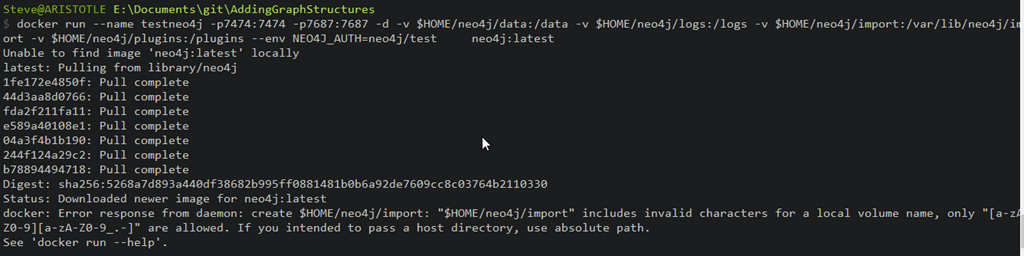
    However, when I ran it, I got this:

    2022-05-09 18_56_46-cmd

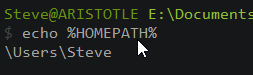
    What’s wrong? Well, $Home is a Linux concept, and it’s looking to map some volumes to folders. The Windows equivalent is %HOMEPATH%. If I check that variable, I see it’s /Users/Steve on my machine.

    2022-05-09 18_57_47-cmd

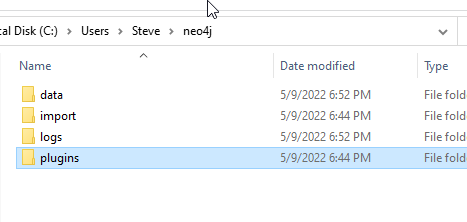
    I created the folders needed for the four volumes, as you can see here:

    2022-05-09 18_58_13-neo4j

    I tried again, but this didn’t work. I realized, I needed to edit $HOME to %HOMEPATH%. I should have done that immediately.

    The next attempt has me seeing this:

    2022-05-09 18_59_16-cmd

    Of course that isn’t the right path. I added a “C:” to each volume and things worked.

    2022-05-09 19_00_49-cmd

    The final command (For me):

    docker run --name testneo4j -p7474:7474 -p7687:7687 -d -v c:%HOMEPATH%\neo4j\data:/data -v c:%HOMEPATH%\neo4j\logs:/logs -v c:%HOMEPATH%\neo4j\import:/var/lib/neo4j/import -v c:%HOMEPATH%\neo4j\plugins:/plugins --env NEO4J_AUTH=neo4j/test     neo4j:latest

    If you want to play with Neo4j and don’t want to install things, you can try this. Of course, you still need a query method from an app or a client tool.