Author: way0utwest

  • Azure Redundancy for Storage

    This is part of a series on my preparation for the DP-900 exam. This is the Microsoft Azure Data Fundamentals, part of a number of certification paths. You can read various posts I’ve created as part of this learning experience.

    In a previous post, I discussed the makeup of Azure regions and Availability Zones. These are important concepts to understand how storage protection works. This post looks at the various redundancy types: LRS, ZRS, GRS, and GZRS and RA-GZRS.

    Note: This isn’t directly on DP-900, but these concepts did help me understand better how the Azure options fit together.

    As I discuss these, this infographic might help. Also, MS Docs has an article.

    2022-02-04 09_43_49-Azure Resiliency Infographic_PostFinal

    Local Redundant Storage – LRS

    As it might imply, this means that your storage bits are copied synchronously to redundant storage in the local area. In this case, this means the data center where your  storage is located. Your files (or VHD or whatever) is copied three times into separate locations. This means that your files can survive a single node (computer or disk) failure.

    This also means you should forego software RAID for VMs or data files as there are already three copies that will acknowledge the write.

    You do not get to pick which data center, just the region where the data center lives. This means your resource could be in any of the data centers in a region, but there are three copies.

    Impressively, this gives you 11 9s of durability. However, a fire or major failure of a single data center might cause all your data to disappear.

    You can use managed disks with LRS.

    Zone Redundant Storage – ZRS

    The next level of protection is ZRS, where you get three copies, but this time the copies exist in three parts of an Availability Zone. This is why the AZ must be inside a 2ms latency boundary. This way your files can be copied from data center to data center inside of the AZ.

    In this way you achieve 12 9s of durability for your files. More importantly, if a single data center were to go offline, you would still have access to your files (or VHDs).

    You can use managed disks with ZRS.

    Geo-Redundant Storage – GRS

    This is a type of redundancy that is between LRS and GZRS. In GRS, the primary data center implements LRS, with 3 copies of files in the single data center. This gives you protection against node failures.

    A second copy, asynchronously, is made in a second region, where LRS is also implemented. This means 6 copies of your data, spread across 2 data centers, one in each of two regions. The image below shows this:
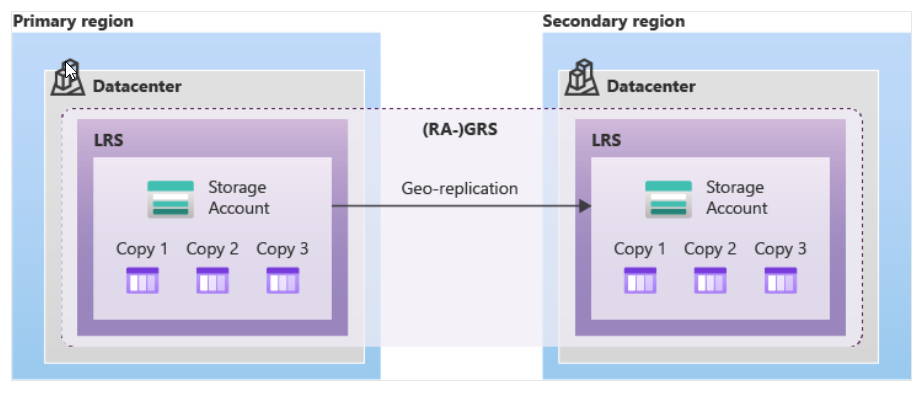
    2022-02-04 10_18_30-Data redundancy - Azure Storage _ Microsoft Docs

    Note, the files in the secondary region are not accessible unless there is a failover. However, if you add RA-GRS, the read access equivalent, you can access files in either zone.

    Geo-Zone Redundant Storage – GZRS

    GZRS expands the ZRS storage to include a second region. You still get three copies in your primary region spread out across an AZ, but you also get three copies in a secondary region. These are replicated asynchronously as the latency between regions isn’t bounded closely enough for synchronous changes.

    The secondary zone uses LRS for the copies. The difference between GRS and GZRS is the replication in the primary region.

    GZRS is supposed to give you 16 9s of durability.

    Read Access Geo-Zone Redundant Storage – RA-GZRS

    With GZRS, there is more protection for your files, but you cannot access the files in the secondary region unless you fail over from the primary region. The customer or Microsoft can initiate this.

    In some cases, you might wish that you could spread the read workload between the primary and secondary regions. With RA-GZRS, you can do this. Your clients can access files in the secondary or primary region.

    Availability of Azure Storage Options

    Not all Azure Storage options are available with the different redundancy options. In the redundancy article, there are two charts, I’ve reproduced below. This first one looks at the different redundancy options and which types of storage fit:

    2022-02-04 10_24_53-Data redundancy - Azure Storage _ Microsoft Docs

    This next one shows that the different account types fitting in the options.
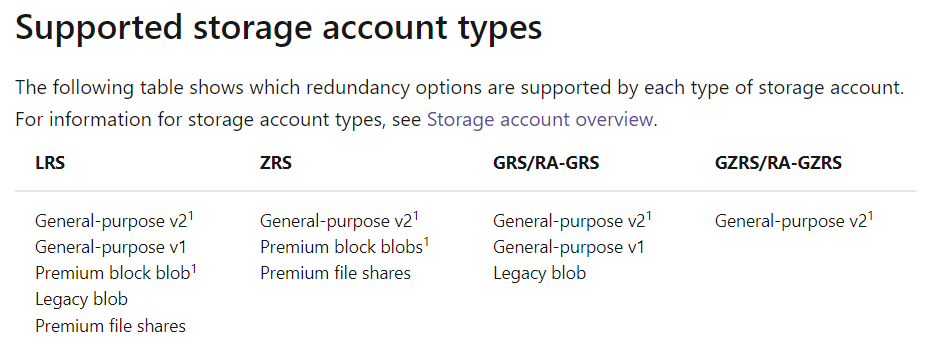
    2022-02-04 10_25_14-Data redundancy - Azure Storage _ Microsoft Docs

  • A Real World Security Reminder

    A saw a tweet from Brent Ozar about USB ports on slot machines to charge your devices. There are also wireless charging pads. Convenient, but also potential security problems, especially for IT workers that hold privileged access to code or data.

    Please, don’t use public USB ports for charging a device. You never know if there is any data access taking place. Yes, I know that most phones ask you to approve things, but have you ever hit the wrong button on your UI? Know how to turn it off? How quickly would data move or malware install? Just don’t plug in.

    Next, beware of physical security. My wife was using a wireless pad at a Starbucks a few years ago. She was sitting there talking with my daughter, and occasionally checking her phone (she gets LOTS of texts). Someone walked up and started talking with them, pleasantly and unassuming. After a few minutes, they walked away.

    A minute or two later my wife realized her phone was gone. They both looked around and then ran outside. They couldn’t find the person, and since this was a trip to visit colleges, she ended up purchasing a new phone. An expensive trip for us all.

    That reminds me of a few stories in the past from my former CEO, Simon Galbraith. He wrote a piece in 2005 about the issues of losing backup tapes. That used to be a problem, along with the loss of laptops. He also shared a story internally about finding a USB drive near our HQ. Our IT staff investigated the USB drive on an air-gapped computer since USB drives are sometimes spread around with malware.

    In this case, we found that it had been lost by our auditor. No Redgate information was on it, but there was data on it from another client. An accident, but one that could have had severe consequences if someone else found the drive. A good reason to be sure that any data you move around outside of production is masked or anonymized, no matter how secure you think your development laptop or mobile device is in your possession. Mistakes happen.

    We also need to be careful with devices. These days, with BYOD and MFA, it’s especially important that we secure devices and limit the disclosure of data on locked screens. Whether for a practical joke or malicious purpose, having someone else get access to our credentials is not something we want to explain to our employer.

    Steve Jones

    Listen to the podcast at Libsyn, Stitcher, Spotify, or iTunes.

  • Daily Coping 23 Feb 2022

    I started to add a daily coping tip to the SQLServerCentral newsletter and to the Community Circle, which is helping me deal with the issues in the world. I’m adding my responses for each day here. All my coping tips are under this tag.

    Today’s tip is to looking back at the pandemic, what has returned to normal for you in life that you appreciate?

    For me, it’s coaching. While 2021 had a lot of things happen, most of the practice and competition days felt strange. We were almost normal at the end of last season in June, but just recently we’ve seen things look normal overall, like 2019 normal, and I really appreciate it.

    I think the kids do as well.

  • Daily Coping 22 Feb 2022

    I started to add a daily coping tip to the SQLServerCentral newsletter and to the Community Circle, which is helping me deal with the issues in the world. I’m adding my responses for each day here. All my coping tips are under this tag.

    Today’s tip is to looking back at the pandemic, what things have changed in how you live your life?

    This is an interesting tip to me, as I’ve been thinking about how the last two years has gone as my life is slowly coming out of the pandemic and moving into the endemic phase.

    Note: I know not everyone feels this way and that’s fine. This is my view

    Travel and work is the biggest change for me. I’ve spent a lot of time on the road, usually 30+ days a year outside of my home country, and attended lots of events (work and personal), meeting and chatting with lots of people.

    That changed with the pandemic. One flight in 2020, and a few camping trips, but seeing relatively few people. 2021 was better, with about 10 trips, but mostly personal and seeing few people related to work.

    2022 is looking better, but still slower, with less travel.

    I cook more now. I got in the habit of spending more time in the evenings cooking, which is relaxing. It’s cheaper and better for me and the family. That has continued, and I’m finding myself making time to cook, rather than “grabbing” something out.

    A slower lifestyle. That was the flipside of 2020. Things slowed down and I spent more time with family, and more time not being as busy. That again is changing, and I’m not quite sure how I feel. I like the chaos of being busy, but I also miss the slow times. It ave me a glimpse of what retirement could be, and I enjoyed it.

    The last thing is that I’ve put up with video calls for years. Nearly 15 years at this point, though I bet 80% or so of all calls in my life have taken place since March 2020.

    I realize how poor video calls are compared with live meetings and how much I hate them. I am really fatigued with Zoom and look to avoid the calls. I’ve considered opening up a weekly call for people that might want to chat, but I can’t find the energy or enthusiasm.

    There’s likely more, but those are the things that came to mind today.