Author: way0utwest

  • Changing the Connection for Data Masker

    Data Masker for SQL Server is a great tool ensuring the data you use in non-production environments is compliant with any regulations by obfuscating and changing sensitive data. This is part of a series of posts on Data Masker from Redgate Software.

    I needed to check something for a customer recently in Data Masker. However, I didn’t want to mask my existing database. Instead, I wanted to make a copy of the db and then use my masking set. However, the existing masking set includes a setting for the connection string.

    When I first started using Data Masker, this was something I hadn’t thought about. The new masking set dialog asks for an instance/database name, and then this gets hidden. The first time I needed to change the connection, I hunted through all the menus, looking for a project option.

    The Controller

    I was lucky enough to work with the developer of the Data Masker product, who contracted with Redgate for a bit after the acquisition. I emailed him in frustration and he spent a little time explaining the architecture decision. Since Data Masker can connect to multiple databases for different situations, the connection is actually in the controller. This allows one masking set to handle multiple databases.

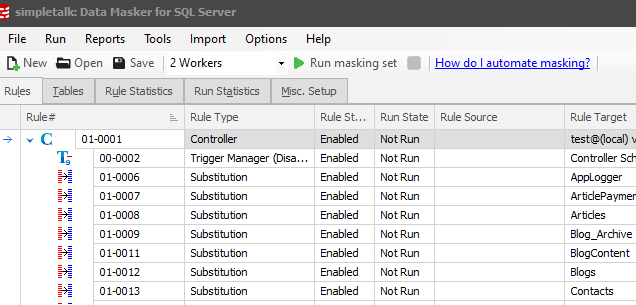
    As you can see below, all of my rules are indented below the controller. This means they all use the connection setting in the controller.
    2021-09-10 10_10_42-simpletalk_ Data Masker for SQL Server

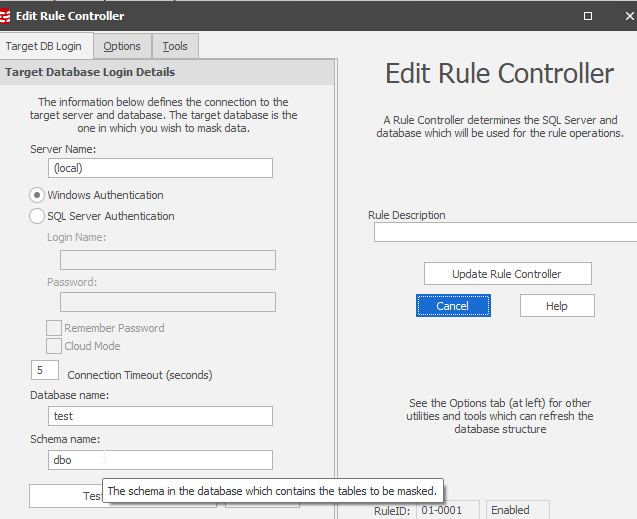
    To change to connection string, I click “Edit Rule” with the controller highlighted. This lets me see all the settings right away.
    2021-09-10 10_12_41-Edit Rule Controller

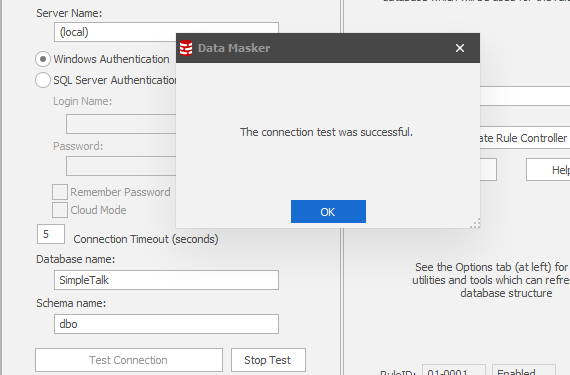
    I can change the database name (or other settings) and then I always click “Test Connection” as I have been known to mis-type things, and this isn’t a drop down.
    2021-09-10 10_13_45-Edit Rule Controller

    Don’t forget to click “Update Rule Controller”. There is no save here. That’s what does it.

    Data Masker is an incredibly powerful tool for protecting sensitive data. I see more and more customers using it all the time to comply with GDPR and other government regulations. If you’ve never tried it, download an eval today and check out our library of articles.

  • Unix vs PowerShell

    I saw an article on using awk, sed, and grep on Linux. I used to know how to use those, though I was by no means an expert. However, working with a stream of text with an input and output was a valuable skill I’ve used over and over in my career. There are plenty of times when I’ve needed to handle a long set of text, and my practice with Unix in university helped me a lot. I’ve only lightly needed to use Perl and regex in my career, but I was glad I had some idea of what I was doing.

    In the last few years, I’ve spent quite a bit of time working with PowerShell (PoSh) instead of text-based utilities. While I found some of the design cumbersome and unintuitive, overall, the idea of working with objects instead of a stream of text is really nice.

    PowerShell was devised to get around some of the complexities of these utilities. It was built to be an integrated shell, with lots of improvements on the way one might use the utilities above in a bash or Korn shell. While it can take a bit of getting used to, in many ways, I do think it’s superior to the old paradigm of chaining together lots of utilities.

    What’s more, it’s fairly easy to enhance PoSh with your own routines, and many vendors have taken advantage of this to provide APIs and interfaces with their tools. Plenty of corporate Ops and IT departments have done the same thing, publishing routines that anyone in their organization can expect to exist and use.

    I loved Unix, way more than DOS in most ways when I was in university. If I’d been a decade younger, I might have even evolved into Linux and pursued a career in that environment. These days, with plenty of MS software, including SQL Server, moving to Linux, I’m happy to change to that platform. However with PoSh being available cross platform, I think I’d be looking to use PowerShell as my shell and scripting platform of choice, even on Linux.

    Steve Jones

    Listen to the podcast at Libsyn, Stitcher, Spotify, or iTunes.

  • Daily Coping 13 Sep 2021

    I started to add a daily coping tip to the SQLServerCentral newsletter and to the Community Circle, which is helping me deal with the issues in the world. I’m adding my responses for each day here. All my coping tips are under this tag.

    Today’s tip is to focus on the basics, eat well, exercise, get rest.

    Easy coping tips for me, for the most part, and something I do often. I make exercise a priority, and often am happy to go to bed early to get rest. I try to eat well, though I sometimes indulge myself too often as food comforts me.

    However, with just 3 of us at home, and my wife being a little more careful with eating, I have been tailoring my cooking to be healthier. Shrimp Kabobs a couple nights ago, after a salad for lunch and a couple protein bars to get me through the day. A little yoga on a break from work, and no late nights.

    Taking care of my physical self helps the rest of my cope on many, many days.

  • The State of Data Growth

    About a decade ago I did some presentations on Filestream and Filetable in SQL Server.  These were technologies that Microsoft added with the idea that lots of data would need to be linked to data in a database, but wasn’t necessarily a good fit for a relational table. At the time, I looked at the growth of data, which was incredible back then. Statistics I had from that time were from the invention of the printing press for the next 500 years, we created 1 EB of data. In the 2011/2012 time frame, we created 2EB each day.

    That’s changed. I saw a blog on the story behind the explosive growth of data, which looked at a recent IDC report that showed we created and replicated (a strange term) about 64ZB of data in 2020. With a ZB being 1000 EB, we can see that a decade has brought us multiple orders of magnitude of data growth.

    That doesn’t mean we need to store all this data. The report notes that a lot of this is consumption data, which is transferred, but not saved. This means that we do need strong networks, but that most of the time the data is being viewed and not actually stored. That’s certainly the case with things I see on Netflix, where I may end up transferring part of a show multiple times to get through it, usually because I fall asleep.

    The estimate for the next 5 years, through 2025, does indicate that we expect to need 200% more storage capacity and that a lot of data storage is going to be at the edge, in devices and server machines, as well as in the core, made up of data centers, cloud and private. While plenty of this data will be outside of databases, and plenty will be in non-relational stores, this does tell me that working in the database business as a career is one that’s going to be in demand for a while.

    I’ve enjoyed my career working with data, and I expect to keep doing so for the foreseeable future. I am confident there will always be work for those that know how to work with data in a variety of situations. I also expect a very high demand, and high compensation for those that do it well.

    Steve Jones