Author: way0utwest

  • The Slow Upgrade of SQL Server Versions

    Every so often Brent Ozar releases a report of his Constant Care customers, showing the versions in use. While I don’t know this client group is representative of the overall SQL Server customer base, I do think it’s close enough to draw some rough conclusions.

    The top version adoption graph that the summer 2021 report shows has 33-34% of the installed based on 2016, about 34% newer (and under support) versions, leaving the last third running older versions. However, the graph I found interesting is the lower one, which shows the distribution over time.

    What I see in this graph is that the older versions (2008-2014) held about 45% of installs in Q1 of 2020. Now they have 31%. The 2017/2019 versions went from 19% to 34%. Those are fairly close numbers, which indicates that a fair amount of these older versions were possibly replaced with newer versions. There could be brand new instances as well as retirement of old ones that weren’t replaced, but in general I’d think this shows that the ten-ish year lifecycle of an instance is probably a good guess. This is about 12 years for 2008, and 7 for 2014, but that’s around ten.

    I tend to think that many of us dislike upgrading our instances across major versions too often. While some DBAs might want to, there aren’t often good business reasons for doing so, and many DBAs are just busy. Taking time to upgrade major versions for the same application, especially on the same hardware, doesn’t always seem worth it.

    In my experience, business people want a long lifetime for a major version. It’s just too expensive and time consuming to both doing this too often. I’ve also found after a couple years, DBAs know the ins and outs of a version, what works well, what tricks are needed to keep things tuned and running. Not to mention that a workload on one version isn’t always faster, and sometimes it’s slower, on a new version. There are definitely DBAs that might not want to bother changing versions and potentially having issues with their current workload from changes, like the change in the cardinality estimator in 2014.

    With modern hardware, for most applications, I think that many instances can run for 10 years. This might be even more true when we factor in that many database servers are virtualized, which means adding a few more cores or RAM is much simpler than in years past.

    How often do you upgrade versions? I’m sure some of you do this regularly, and I know some applications might benefit from upgrades more often then every decade, but I bet a lot of you don’t bother to change this too often. After all, “working” is a feature, and if you have that one, why take chances?

    Steve Jones

    Listen to the podcast at Libsyn, Stitcher, Spotify, or iTunes.

  • Daily Coping 16 Aug 2021

    I started to add a daily coping tip to the SQLServerCentral newsletter and to the Community Circle, which is helping me deal with the issues in the world. I’m adding my responses for each day here. All my coping tips are under this tag. 

    Today’s tip is to check in with someone who may be lonely or feeling anxious.

    I have a friend going through a tough time with their relationship. As a result, I’ve been a little worried about their mental health. Since I can’t go see them, I have made it a point to reach out periodically, every few days or each week, to check on them and see if they are enjoying some things in life.

    Touching base is important, maybe more important as it’s difficult to see many people during this time. While a typed note or a phone call is different, it still is a way to connect.

  • The Tesla Ordering Experience

    This is part of a series that covers my experience with a Tesla Model Y. If you are thinking of ordering one, I’ve got a referral code. You get 1,000 free Supercharger miles and so do I. Use: http://ts.la/john92950

    I’ve never ordered a car before. My Dad ordered one when I was a kid, picking out the options at the showroom and then having the car appear a few months later. I thought that was cool and looked forward to the day when I could do that.

    Fast forward 40-some years, and I’ve never done that. Instead, I’ve tended to get lots of used cars. I think I’ve owned 30 cars, and while a few were new, all were off the lot. I have gone to a dealer intending to buy and picking from available models. I’ve also gone for a specific car and set of options and purchased that one. In all those cases, I might have some some research, but in a short period of time I had a car I could drive. I think the quickest was about 20 minutes for a lease and the longest for 5-6 hours of waiting and being annoyed at inefficient salespeople and finance managers.

    The Tesla Sales Experience

    There isn’t a Tesla lot. There are some dealer stores, but they are more like retail stores, where you can see a car, schedule a test drive, but you don’t get a car that day. There are some used Teslas available, but I don’t know how quickly you could get one for yourself.

    Instead, you order a Tesla online. You can do this at the store, with a salesperson, or do it at home, but the process is the same. You go to Tesla.com and then pick a model. You click “Order Now” and then decide on your options. This is similar to other car manufacturers, but Tesla has relatively few choices.

    This is my process, which I followed from the comfort of my home at 10pm on a Friday night.

    My Decisions

    To get started, you go to Tesla.com and then pick your model. On every page, and in every section on the car, there is an “Order now” button.

    2021-07-30 17_18_26-Model Y _ Tesla

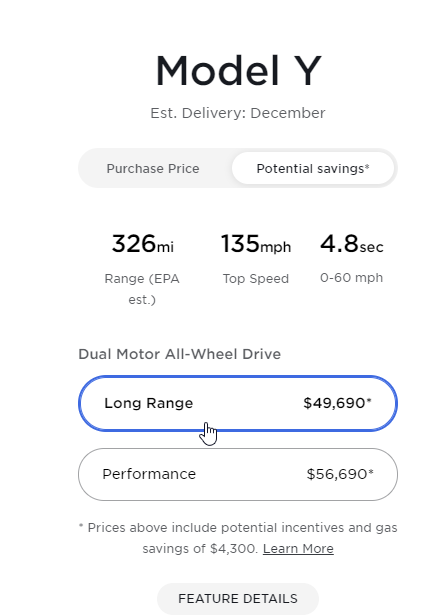
    In my case, I wanted a Model Y. For this model, there are only two choices, as of mid 2021. There is the long range version with AWD and the performance version. I was more concerned with range, and could live with a 1s slower 0-60 time.

    2021-07-30 17_18_39-Design Your Model Y _ Tesla

    I selected this car and then the options went to the color. The default white is no charge, but all other colors cost more. I chose, or rather my wife wanted, the dark silver. We live on gravel roads, and white / black cars don’t look good. Something similar to road dust us better Winking smile

    Note: Red is $2k more, the others $1k.

    2021-07-30 17_18_49-Window

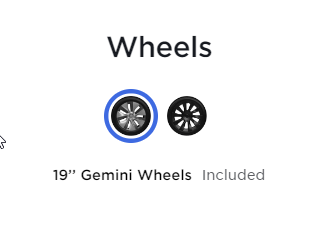
    Next is wheels. I’m not a big wheel guy. I think some look nice, and the 20” induction ones are good looking and $2k more, but everyone notes they are a stiffer ride and chip/damage easily. I’m find with 19” wheels. Cheaper for tires, and for a second winter set.

    2021-07-30 17_19_00-Design Your Model Y _ Tesla

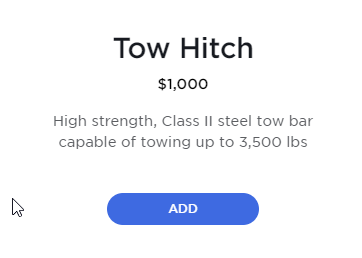
    The next section asks if you want a tow hitch. I don’t plan on towing, as we have other vehicles to do this. If I need one, I can get a small hitch from a third party for less, and really, I don’t plan on towing anything with lights. Mostly this would be a bike/ski rack, so I’m skipping this option.

    2021-07-30 17_19_04-Design Your Model Y _ Tesla

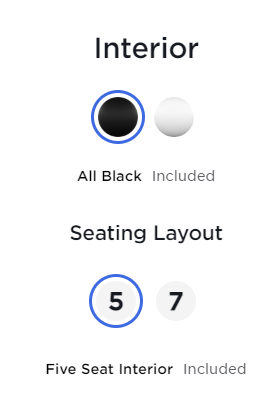
    The default interior is black, which I am fine with. It will show less dirt. White looks nice, but it doesn’t fit my lifestyle. This is a $1k option. For the seating, I’ve seen 7 seats in many cars, including my X5’s model, and the back seats aren’t usable. Plus, it’s $3k and my dogs won’t like the seats. They prefer the open space.

    2021-07-30 17_19_08-Design Your Model Y _ Tesla

    The last option is Full self driving. I’m not sold on most of this, and it’s $10k. Plus it’s in beta. The recent updates from actual drivers on the latest beta haven’t been great, so I’ll skip this.

    2021-07-30 17_19_14-Design Your Model Y _ Tesla

    Since Tesla is somewhat building to match demand, you’ll likely need to wait a period of time. I caught the beginning of a sales boom, where demand is far outpacing. When I ordered in May, the estimate was July. It’s not late August. Here, for an order shown late in July, it’s December, and my guess is you’d get a car in January.

    2021-07-30 17_19_19-Design Your Model Y _ Tesla

    If you click this, you get a summary, shown below. You also decide whether you want to buy it, get a loan, or a lease. You then can put your $100 down, and your terms are set.

    2021-07-30 17_19_26-Design Your Model Y _ Tesla

    I chose a loan, which defaults to $4500 down. That’s fine for me, and once I paid my $100, Tesla started to send me emails and give me further steps, like filling out the credit app, choosing a delivery location, and prepping for insurance. These were things I needed to do, and I liked getting reminders when I’d forgotten some.

    I still haven’t done the insurance, which they note I need to have done to pick up the car. I’ll get that done when they give me an actual delivery date.

    All in all, this was a smooth process and I look forward to getting my car. If I don’t back out.

    There is also a rambling video version of this post on My Colorado Tesla Experience Channel. You can see all of these posts by following the Tesla tag.

  • What’s Important to Your Organization

    I’ve had the chance to work in a number of organizations in my career. Every one of these places needed to run a network and software applications to support the business. Most of them also built some a portion of the software they used. No matter how much software they built, but there was always a need to manage a software lifecycle with new applications, patches, and the retirement of systems over time.

    While every organization recognized the value of software, some saw this as an expense, like salaries or buildings. The funds needed were the “cost of doing business.” In these organizations there was always a focus on controlling or reducing costs, doing what needed to be done, and being efficient with how computing was integrated into the business. These organizations seemed to be stodgy and traditional, with management focused more on the analog world than the digital one. Some were quite successful, which I often think is a combination of good management, good staff, and luck.

    These days, I think that view that software is an expense is less and less successful in many organizations. Over time, this will see a deterioration in the success for those businesses. It might be a slow decline over decades, or a more rapid one in a few years. I truly believe in software eating the world, and every company needs to be a technology company. They don’t all need to build software, but they do need to manage it, and more importantly, take advantage of software to better run their businesses.

    We see this in all kinds of industries. Perhaps it’s highly visible in the automotive industry, but in plenty of others, from finance to insurance to retail to manufacturing, the use of software as a strategic asset improves the competitiveness of business. Even in government, organizations are finding that making better use of software allows them to offer more services at a lower cost.

    I wonder how many of you see your employers treating software as a strategic part of their business model. Do they aim to increase profits or become more efficient or even innovate in their industry with the power of modern computing? Or is it just a tool that they depend on, and consider the cost of doing business? If your group isn’t seen as strategic, likely they don’t value your work as highly, don’t provide training, and don’t create opportunity or innovation that ensures your work is interesting. If those are things that matter to you, perhaps it is time to look around for other employment.

    Steve Jones

    Listen to the podcast at Libsyn, Stitcher, Spotify, or iTunes.