Author: way0utwest

  • Data Science, BI, and Reports

    Data science, along with the Artificial Intelligence (AI) and Machine Learning (ML) fields, is often seen as the new direction in which we ought to move our analysis of all the bits and bytes that we collect and store in our databases. There is so much hype now about those technologies, and managers are buying in.

    I’m not sure I agree. I do think that AI and ML will increasingly be used, but they’re just a part of what you use to analyze data. Buck Woody has a good post about the way in which we might examine our technology stacks used for BI work.

    We have a lot of reporting technologies to enable us to make better decisions, and there is a space for all of them. Many people like Excel, some use tools like Power BI and Tableau, still others prefer to get insight boiled down to a single number that influences them to move one way or the other.

    There is a lot being written about AI and ML technologies and certainly many organizations experimenting with them. Data Ccience covers these areas and more, asking our data not just what it says, but potentially what this might mean in the future.

    However, this doesn’t replace traditional BI and reporting. As Buck notes, these are tools and you should use the ones that work for your organization. Learn about them, experiment, understand the impact they have on your audience, and choose the best tools for the job.

    I’m sure this area will continue to evolve, and we’ll get new tools and techniques to help organizations make better decisions. Whether this will actually improve forecasting is likely up to the skills of both the technical and business people.

    Steve Jones
  • Micro Credentials

    For all of my career, there has been a constant debate about the value of certifications. Early on I saw one boss move ahead because of his CNE (Certified Netware Engineer) credential. That got me moving in that direction, though I switched to an MCSE (Microsoft Certified Systems Engineer) track once Windows gained prominence and I found myself working in that arena.

    These days there seem to be less certifications around in one sense. Certainly Microsoft and other vendors are spending less effort building and maintaining a program. At the same time, there is a variety of different products that you can get certified in using online learning. A friend recently showed me the Redis University where you can complete courses and get a certificate. We even have Redgate University, designed to help you improve your ability to use our products.

    Like many credentials, completing a course doesn’t mean you are an expert, or competent, or even qualified with a product. There are numerous stories of people holding credentials and being unable to perform simple tasks in the real world. I’d counter with the fact that there are plenty of people with lots of experience on paper that equally cannot perform fairly rudimentary tasks. I do think that people that have made an effort to complete some course have likely learned something.

    Microsoft Philanthropies is experimenting with micro credentials, an idea of helping people to learn skills and tasks that aren’t equivalent to formal education, but perhaps can take the place of other educational opportunities, such as a college degree. It’s an interesting idea, and it fits nicely with my thoughts that your career requires continual learning and improvement, or as they put it, up-skilling.

    There is a great quote in the article:  “Careers are no longer ladders. They are more like vines in a rainforest. You can swing on one and then grab another.” I think that’s true in technology, and likely true in many other fields as well. I’ve seen plenty of issues with workers trying to undertake year+ long programs to retrain in some other field, only to find out there aren’t enough jobs or the skills are becoming obsolete quickly.

    The future, in my mind, is that we need to be adaptable and flexible. We should have some basic skills, like logical problem solving and communication, but the specific syntax and muscle memory to work on any particular implementation are something we need to pick up quickly and gain competence in without a long learning period. This doesn’t mean that expertise isn’t valued, but flexibility and the willingness to continue to improve skills over time is more valuable.

    Will this replace traditional universities in our business? I don’t know, but I do think it could. There are still places where a formal education is valuable and useful, but I’m not sure if it matters in the field of technology. At the same time, unless organizations that hire individuals stop requiring four year degrees, I’m not sure this matters. I hope they do, because a degree says something about you, but not necessarily more than other experiences and efforts that you can undertake.

    Steve Jones

    Listen to the podcast at Libsyn, Stitcher or iTunes.

  • Batch Scripting SQLCMD–#SQLNewBlogger

    Another post for me that is simple and hopefully serves as an example for people trying to get blogging as #SQLNewBloggers.

    I wouldn’t do this anymore, but I ran across a post where someone couldn’t use PowerShell in their organization. A poor decision, IMHO, for the Microsoft platform, but it is a restriction. In this case, the user wanted to get a batch file to run a SQLCMD script. This post shows how.

    Two Files

    Let’s suppose I have two files in a folder. In this case, I have a version.sql file that contains this:

    select @@version

    The other is my batch file, which I’ll name runsql.cmd. In this file, I’ll do a few things. First, suppress the code with this:

    @@echo off

    That’s just a good habit, though you might leave this out until things are working. Now, I will use a loop to get a list of files with an extension. I use the FOR loop in this way:

    for %%x in (*.sql) do (

    This gets a list of all .sql files in the current folder. For each one, we will process all statements inside the parenthesis. The open is on the line above, the close will be below.

    The next lines are my sqlcmd call and the various items I need. In my case, I’ll get the instance name as a parameter and use trusted authentication.

      sqlcmd -S "%1" -E -i %%x
    )

    I could use other parameters (%2, %3, etc.) to get a user and password if I wanted to. Instead, I’ll get the instance as a parameter, and then pass the filename in to sqlcmd with the –i parameter.

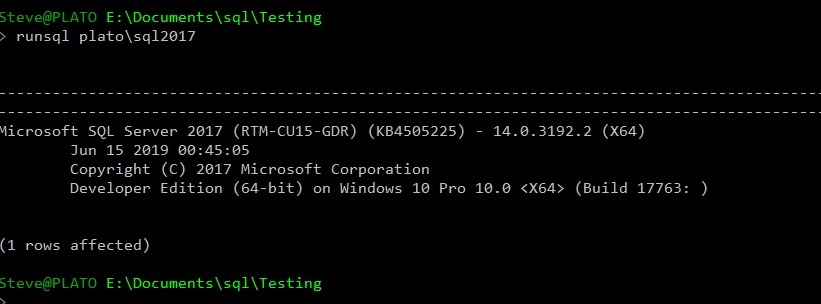
    When I run this, with my single .sql file, I see this:

    2019-10-15 10_55_48-cmd

    Easy to do, and I could add other .sql files in here if I wanted them to run.

    SQLNewBlogger

    This was a quick post to write in answer to someone asking a question. I knew about the %1, %2, and searched to find a quick SO post on getting filenames into a variable. It actually took about 5 minutes to research and test (and post) and then about 10 minutes to write this up.

    You could do this, showing some knowledge of learning and creating a solution. For extra credit, how can I capture output of this?

  • Learning from Exercise

    A long time ago I decided to run every day. I did for a bit, in fact, I had a neat milestone along the way and continued on for 1564 days. That was quite a memorable period in my life, and one that I look back upon fondly. I’ve aged a bit, and while I could do it again, I also have decided there are other things that matter more to me, so I have moved on in life.  I learned a lot from that time, lessons about myself and life that continue to help me today. Some of them even apply to work and my career, little nuggets of wisdom that help me find ways to find success in my life.

    Apart from some better fitness, one of the main benefits for me was the sense of accomplishment. I had no bad days where I would think I wished I had run. None. That seems obvious, but it also provided me some comfort that I had moved things forward in my life. I took that lesson back to work, where I sometimes have bad days. I have days where nothing goes right, or I have people that take over my day and schedule.

    I know there are also a number of things that I need to do at work, which aren’t that important, or even aren’t that critical, but they provide a measure of satisfaction that I’ve moved things forward. These days that is often getting things scheduled for the newsletter. In the past it might be doing a little space extrapolation (though I’d just look at this in SQL Monitor today). Low value items, but I get some accomplishment in the midst of otherwise stressful times when I get something small done that is on my list.

    The other thing that came from the running streak was the feeling of getting away from other parts of my life. Whether with family or work, I might be overwhelmed or stressed or otherwise out of sorts in my day. Taking 20-30 minutes for myself was a way of resetting my day, and it was a welcome break. While exercise is my thing, and even today it’s a priority around work, I’ve had other crutches that help me cope. I love to read, so taking 5 minutes to escape in a book every day is something that feels similar to exercise.

    I know other friends that might play a short game, play with a pet. Having some other consistent, distracting activity is a good release when things are tough. No matter how busy we are, or what’s broken, taking 5, 10, 15 minutes away can help refresh you and get you ready to go back into the trenches and deal with others.

    I’m sure jobs exist that can’t spare the time, but I’ve never had one. I haven’t always realized it until later, but I wish someone had told me to take 10 minutes away in a crisis to reset myself and then come back. I know I’ll remember that the next time I end up being stressed during an IT problem at work.

    Steve Jones

    Listen to the podcast at Libsyn, Stitcher or iTunes.