Author: way0utwest

  • Feedback and Change

    Recently I heard from a number of people that they received an email from the PASS organization asking them for some feedback on why they weren’t registered for this year’s Summit. I didn’t get the email, which is both good and bad. I’m teaching two precons, but not attending the Summit, so it might be good to actually have my feedback.

    I think the email is a good idea, though since it comes directly from Grant, I hope someone is triaging his email. Rather, I hope that there actually is a need for people to triage his email because there will be lots of responses.

    This is a good chance for anyone to give feedback to our professional organization as to why they aren’t attending this year as opposed to previous years. There will be all sorts of reasons, but I’d like to think that if there is a pattern of something the conference doesn’t do well, the organization will address the issue. Or at least explain why things are a certain way.

    Those of you that have followed me for a long time know I have a love/dislike relationship with PASS. I do support many efforts they manage, and I’m generally pleased with their stewardship of SQL Saturday. However, if you peruse the list of posts I’ve made about them on my blog, you might find some older notes that showcase some displeasure. I haven’t changed many of my thoughts, but instead I provide feedback privately to people when I disagree. I am trying to be a better version of myself online, and limit my public criticism.

    PASS has been slow to change across two decades, and I’d argue, resistant to many ideas from the community. I understand that it can be difficult to change the way that the organization works, and that I certainly don’t have all the information that impacts decisions. I also feel that transparency and accountability are important, with too little of that over the years from those that have served on the board. My view is that there should be more public justification for spending decisions as well as open and honest disclosure about difficult topics. I also would like to see more data from the org made available publicly. After all, we are a data organization.

    However, I do see the organization changing slowly. I have been a member since 1999, when the first Summit took place in Chicago. We have a much wider group of speakers, more rotation for speakers at all levels, plenty of new speakers, new events and virtual chapters, policy changes to better support the board and governance, and probably plenty of other things I’ve missed. While I’m not always in agreement with specific decisions, I do think there has been change over the last decade.

    I’d like to see more change, and I think more comes about with feedback. If you got the email, I’d appreciate you sending feedback to Grant and the board. Me, Steve, is asking you to send feedback to PASS. Long, short, it doesn’t matter, but be specific.

    If you’re not sure about what to say, or don’t want to send it yourself, feel free to send it to me (sjones at this domain) and I’ll give you feedback or send it on anonymously. In fact, I’d encourage everyone that would like to see something changed to send a note to the board members or the info@pass.org email.

    Changes takes time and it takes effort. Be a part of that.

    Steve Jones

    Listen to the podcast at Libsyn, Stitcher or iTunes.

  • Just Getting Specific Files in PoSh–#SQLNewBlogger

    Another post for me that is simple and hopefully serves as an example for people trying to get blogging as #SQLNewBloggers.

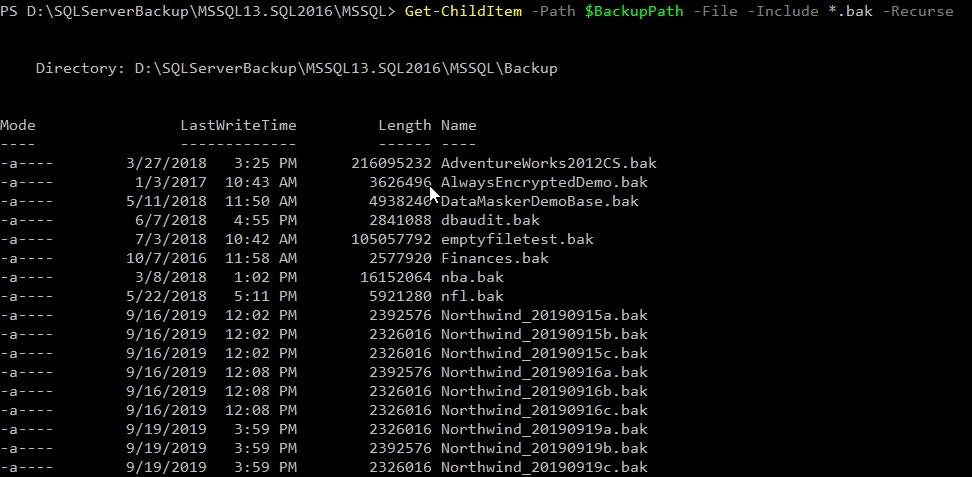
    Just a quick one today, but a tip I hope I remember. While working on a script, I wanted to just get backup files in PoSh. I tried this:

    Get-ChildItem -Path $BackupPath -File -Include *.bak

    That got me this:

    2019-09-23 10_06_19-cmd - powershell

    Nothing.

    Why not? Apparently, you need the –Recurse parameter, even though there are no subdirectories in this folder. A bug, IMHO, but who knows. In any case, adding the parameter makes things work. Thanks, SO.

    2019-09-23 10_11_59-cmd - powershell

    SQLNewBlogger

    This was a quick 5 minute thing. After researching and testing for 10 minutes, and finding the solution, I wrote this up.

    You could do that with anything you get working.

  • Priorities and Productivity

    Time is a resource for all of us, both at work and in our lives. As I get older, I think time might be the most valuable resource I have, the same amount each day, but an ever decreasing set in my life. As a result, I try to avoid wasting time and taking advantage of what I have when I can.

    At work, we often have more tasks than we can complete in any point in time. I have rarely been without work, though certainly there are slower times when deadlines aren’t providing pressure to get things done. For many of us, we can struggle to manage our work, especially without strong management to help us.

    There was an interesting blog from Trainline, from a technical worker that was promoted to manager and had a whole new set of tasks and responsibilities. He decided to adopt some of the same agile principles he used as a developer to manage his time. It’s an interesting read, and perhaps one that might help some of you better organize your own work.

    The principles of Lean Thinking and visualization are two of the items he used, along with building a Customer-Value map. You can read the basic descriptions, but to really understand how these concepts work, you will want to do more research and spend some time practicing the concepts. However, there are a couple of other techniques in the post that I think are worth pointing out.

    The idea that work has an effort and value you can use to help determine which tasks are worth tackling is important. I think sometimes we consider value without effort, but organizing tasks into grid is useful. There is also the concept of important v urgent tasks, and how these two may or may not be related. As I read about these, I realize that I often do this internally with my work.

    I know there are important things to do, many of which aren’t urgent. Finding time to get those done is useful, not only because they get off my plate, but the more often I can avoid creating urgency, the less stress I have. I also find that urgency can sometimes be my own fault for procrastinating a task.

    There are certainly many times when managers will prioritize work for us, but I often find for developers and DBAs, that we have a fair amount of autonomy. Many of us also have a known backlog of work. Developing some skill and techniques to manage your own workload will serve you well, and you might consider adopting some of the ideas in the post in your own career.

    Steve Jones

    Listen to the podcast at Libsyn, Stitcher or iTunes.
  • T-SQL Tuesday #119–Changing My Mind

    After missing the last T-SQL Tuesday, I’m back for the latest invitation from Alex Yates. In this one, Alex asks us to write about something in IT where you changed your mind. Some belief you held, and then decided to go a different way. It’s a good topic, especially as the world has both dramatically changed and also stayed the same in many ways.

    A Strong Belief

    As a young man, I used to think strongly about lots of technology topics. Many of those have been argued about on the Internet in forums, chat boards, and even at times at events. I had my own thoughts, and often argued my own views.

    As I’ve gotten older, I’ve started to hold those strong opinions a little looser. I still have them, but I also know that sometimes things might not be as clear cut as I imagined. I also have learned that my own knowledge is often incomplete, or my application of a technique might be more narrowly focused than I assumed.

    I change my mind constantly, but I’ll give you a relatively recent one that has started to move my career.

    Containers

    I’ve been learning and talking about containers with people for nearly 10 years. It was in 2010 that I met a company using them extensively, and while enamored by the technology, I wasn’t sure how useful it was for me. This company uses Java, where versioning is an issue. In .NET, it’s less of a problem.

    When Microsoft started to work towards containers in the 2015 timeframe, I had a change to take part in early discussions with program managers. These were casual, but I wasn’t convinced that this would really make a difference in SQL Server. I kept an open mind, but most of their arguments and thoughts felt self serving for Microsoft’s business rather than good technical arguments.

    That changed sometime late last year. The work that’s been done on SQL Sever 2017 and 2019 to allow upgrades/downgrades, the scale out capabilities coming in 2019 (and with Hyperscale) and the possibilities of Kubernetes (or some other orchestration tech), make me rethink containers.

    Containers are the future of SQL Server. I’d bet on it, though it’s going to be 5 or 10 years for most of us to get there. However, I’m spending more time learning and working with them because I think this is where databases will move.

    I wouldn’t have said that two years ago, but my mind has changed.