Author: way0utwest

  • Taxing Travels

    It was a long weekend of travel for me not too long ago, starting at 4:30am on Friday and ending at 7:30pm Sunday night. This was for SQL Saturday #884 in Pensacola, an event I’ve attended 4 or 5 times, a few with my daughter. It’s always enjoyable, and this year was no different.

    However, the travel was surprisingly hard. I need to write a bit more about this, but I was surprised by both the issues that cropped up and how well the flights actually went. I’ll also mention that I had the 3 of nicest flight attendants I’ve ever interacted with on the three different flights. Thanks, @United staff.

    Flight 1

    This started when I hope at 430am Friday. I showered, and checked my phone, seeing a message that my flight was delayed. That’s pretty cool that two hours before flight time they can let me know of issues. I was thinking since this was such an early flight that the plane would be in Denver overnight, but I wasn’t thinking. There are early flights East of here and they can fly to arrive at Denver in time.

    Or not. In this case, weather in the Chicago region delayed the plane, which is why I try to avoid Chicago. In a big deal, but about an hour delay. With a 2 hour layover, I wasn’t too concerned, and headed to the airport. I arrived, got a cup of coffee and went through email/Slack at the gate. Travel doesn’t necessarily stop me from needing to deal with other work, so I made use of the time.

    Our plane arrived, people got off, I was ready to get on. Unfortunately, we were missing a flight attendant. One would think that scheduling staff is easy. It’s not, especially across time zones, locations, and potential limits on working hours. I don’t know if an employee had an issue in Denver or was on another flight or what. In any case, I know people that are in the airline industry and on call. They try to get  to the airport quickly when called, but things happened. In this case, we added about 15 minutes to our delay over just over an hour.

    Flight 2

    One of the really neat things in the United mobile app is that I get information on gates and times, updated during the flight. Almost all United planes have wifi for entertainment, and you can purchase Internet access, but you get access to United data for free, like where your plane is flying.  You can look at a map that gives you an idea of how close you are.

    In this case, I was watching because we kept banking slightly. The generic flight map looks like this:
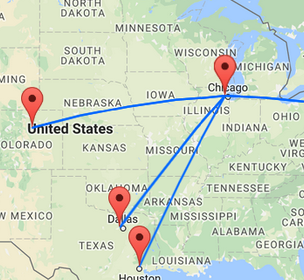
    den-ord

    Mine looked more like this (I should have taken a screenshot):
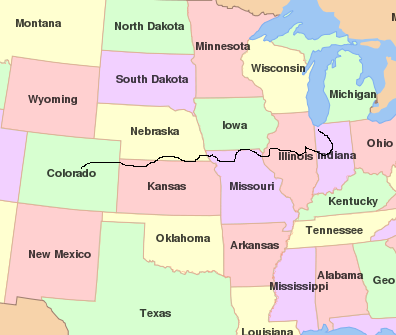
    p2-us-map

    To avoid weather, we kept turning. We actually came into Chicago from the North, after circling around the East. I got a side view out of the plane of the downtown area as we came in.

    20190628_101503

    We were late, and I had about 35 minutes before the other flight left, which means 25 minutes to get there. One thing I’ve learned is that the major airports have gate maps in the airline magazine. In this case I was going from one end of C concourse in O’Hare to the other end of F concourse. Not an easy journey. I jogged, and got there with about 10 minutes to spare. If I hadn’t been able to jog, life would have been rough.

    Normally I get a text on delays, but I think the stack of flights was delaying messaging because as I walked up to the gate, I could see the delay message. As I talked to an agent, my phone vibrated with the delay alert. This is one place I think United could do a better job of data sharing, but in any case, this was another scheduling issue.

    My plane was at the gate, workers were outside, so no lightning delays. However, our flight attendants and a pilot were in Milwaukee, which isn’t that far a drive from Chicago. They couldn’t take off because of weather, so we were delayed, even as other planes were coming and going.

    About 2 hours here, but again, a great flight attendant that was very pleasant when we did get going. I took the time to eat some lunch and do a little writing. I’d started some things on the plane that I finished on the ground.

    Flight 3

    After the event, I was at the airport a little early. I sat at a restaurant, writing up some notes from the weekend for changing a presentation as well as reporting for Redgate. The plane arrived on time and we started boarding. I fly enough to be part of the pre-boarding group, so after those with disabilities and families, I scanned my pass and started down the jetway. There I found a line of 6 or 7 people, with a few already on the plane. Since someone had gone with a wheelchair first, I assumed that this was the delay.

    Then I heard someone on the plane tell us to drop people from coming down the jetway. A few minutes later an agent came down and had us all walk back up the jetway and back into the terminal.

    Apparently there was a ground stop in Denver that the pilot had heard, so I can forgive the app not updating me. A 45 minute delay, under mostly sunny skies in Pensacola, though clouds in the distance. This was more concerning, and a little stressful. No work getting done now as I was worn out and annoyed.

    Almost an hour later, we start boarding and get on. The pilot will try to hurry and we take off. I have a couple drinks, thinking this is the end of a long weekend. It’s not.

    As we get close to Denver, we get good news and bad news.

    Good news: Denver is landing planes, albeit slowly.

    Bad news: we need to circle a bit and have an hour of fuel. If we don’t get landing clearance in an hour, we’ll go land somewhere else. Fortunately we have a little plane, so lots of choices.

    30 minutes later we get clearance and land. About two hours later than planned, but still, I’m home.

    Lots of Challenges

    I wrote this because I was thinking about all the challenges in flight operations and trying to coordinate many moving parts. It’s quite a logistical challenge, and while computers can help, I’m sure many humans need to be involved in some decisions along the way.

    These were really minor hassles in my life, and I’m not complaining. More, I’m in awe of the amount of data that must be managed and used to make decisions and direct humans. I didn’t check bags, but I have, and I’m always amazed how well my bags get from point A to point B, especially when I’m running to make connections.

    Nothing went as planned in my flights, but it all worked out well for me. Not for some others, but weather can be a big factor in traveling. I think the main thing I’ve learned is avoid Chicago and Chicago based planes whenever I can.

  • Fines for Data Access

    Most of us know about the principle of least privilege. After I wrote about network segmentation recently, I’d hope that most of us know that limiting access to production data from all workstations might also be a good idea. Many of us also know that unusual patterns of access might indicate an issue. I wonder how many of us have a system in place to look for unusual access, especially this is something that might help us prevent, or at least detect, potential hacking activities.

    I wonder if we’ll get to the point where we need to do more and not only implement better auditing of system, but also data access. Will we need to actually monitor what data is accessed and ensure there is a valid need to do so? That was probably needed in this case, where various employees accessed a woman’s DMV data for who knows what purposes. This is a creepy story, and I’d hope that it’s the rare man that actually does this in any company, for any kind of data.

    As a general recommendation: please don’t spy on someone that you want to date. It’s very much an invasion of privacy and no way to develop a relationship with anyone.

    There were logs of access in this case, which isn’t the case in some states, but there should be more logging of access. The default “black box” trace in SQL Server doesn’t give us much information, though if you have a monitoring system in place, you likely do get more data. The logs of who and what are important, and they are something I’d like to see built into SQL Server by default, an easy way to log activity, with some archival/management of the data.

    Too many of us don’t log anything, and maybe it’s not important for some applications, but in the cases where sensitive data is stored, I think logging ought to be required, and I’m hoping GDPR 2.0 or other laws mandate this, perhaps with some retention of a year. I know I’d certainly like to see this built into more applications.

    The way we handle personal information has been poor for most of the digital age, and I would like to see that changed in a number of ways. I think requiring compliance against a standard might be the best way, though without specifying an implementation. This way we accept the responsibility of safeguarding data that we already should feel.

    Steve Jones

    Listen to the podcast at Libsyn

  • Come See the Future of Database DevOps at SQL Sat Austin

    I’ll be coming to SQL Saturday #890 – Austin in just over a week. Austin is a great technology town, and this should be one of the larger SQL Saturday events. I know traffic is tough, but the event is at St Edwards University, which isn’t downtown, so hopefully some of you can come.

    I’ve got two talks, and I’m excited about both. I’m doing a DevOps talk about the overview of how to incorporate the database into a DevOps flow. This has been a popular talk across the last few years, and I’ve given it at the Summit a couple of times.

    The other talk is one I’m more excited. The Future of Database Development with Containers is a look at how we might use SQL Server in software development in the future. It’s something Microsoft has shown some ideas with, but I’ve got some cool Redgate technology to show off as well, with a database-as-a-service from the Foundry.

    Register today and come see me and a few other fantastic sessions.

    If you want more training, there is a great pre-con on Friday as well. You can learn Data Science with Chris Hyde and add to your skillset. It’s good preparation if your company wants to perform more complex data analysis.

  • Balancing Hard and Soft Skills

    Many of us would prefer that the technology industry were a strict meritocracy. One where we get opportunities and are compensated according to our skills. We learn to code better, or manage more systems, and we’re seen as more valuable (and rewarded appropriately). Or maybe many of us would prefer that things stay the same, since we might worry that we’d be paid less because our skills aren’t as sharp as our co-workers or our competition for that next job.

    In any case, we don’t work in a strict meritocracy, but if we did, we might recognize that it’s not just your programming skills that are being measured. In this piece on hard and soft skills, the author notes that the importance of soft skills is both more and less serious than we might imagine. If that sounds contradictory, it is, but read the article and you’ll see that this is a complex issue.

    The main point from the author is one that we’ve realized at Redgate for some time, and it’s why we’re constantly refocusing our efforts on teamwork. Most modern systems are too complex to be built by one person, which means a group of people need to work together. DevOps asks us to build a culture of collaboration and communication, which are critical soft skills. It matters less and less if you’re an amazing developer that can’t work with others for some reason.

    I do think that the more you advance in your career, the more important these skills become as your job is not just code. It’s also helping shape the direction of software, teaching others, and sharing what you know. If you don’t have the skills to interact well with others, then I suspect your ceiling may be lower than you like. Or worse, your tenure shorter than you’d prefer.

    At Redgate, we do embed a lot of customer research, discussions, and more inside development teams.  At times, I think we do too much, but then I stop and think about the teams I’ve worked with that didn’t do this. They didn’t necessarily code quicker, certainly lacked understanding and empathy, and certainly didn’t make more customers happy. We’re trying to adopt more soft skills inside the company, while learning to build better software. We still value technical programming skills, but not necessarily above teamwork. More alongside teamwork.

    To build a team, we need to value those in the team, and work with them, not against them. Those are skills that can certainly help us in our career, as well as skills that help any organization learn to operate more smoothly, with more retention. At least, more retention of those that have strong soft skills.

    Steve Jones

    Listen to the podcast at Libsyn