Author: way0utwest

  • The End of Support

    With the accelerating pace of development and more frequent releases, we are seeing a bunching up of SQL Server support milestones. From 2008 through 2016, we had a new version every two years. Last year we saw another version, which means 5 versions in a ten year span. With 5 years of main support and 5 of security patches + extended support, Microsoft has quite a few active branches of code.

    We now see SQL Server 2008 and R2 coming to the end of support on July 8, 2019. There are plenty of options for customers, including doing nothing. After all, if you’ve been running SQL Server 2005 or even 2000, you’ve been without support for some time. That might not be a policy of your organization, particularly if you adhere to any standards or are bound by regulation. In those cases, you may need to have active support under contract.

    There is a good argument to be made that you should have active support for your core systems, such as the OS or your database platform. If a bug or security issue is discovered, would you want to upgrade on a very short timeline or apply a patch to your existing version? Think about running SQL Server 2008 today and a critical security problem is discovered in October. Do you want to upgrade to SQL Server 201x this year? Or would you wish that you would have planned and executed an upgrade in June and have to apply a GDR patch in October?

    I tend to view patches as much lower risk than an upgrade, mostly because the number of changes is smaller, and an upgrade reduces my options, not to mention often increases my costs. That might change over time, as I upgrade other instances and gain experience with a new version. SQL Server 2017 still feels new to me, but SQL Server 2014 and SQL Server 2016 feel older. If I had to perform an emergency upgrade to an instance, I’d be more comfortable moving from 2008 to 2016 than 2017 right now.

    I wonder how many of you view the upgrades as more risky? These days the migration tools analyze for keyword issues, and many of those can be alleviated with compatibility levels. Perhaps some of you aren’t worried and will run your SQL Server 2008 instances until they die, only upgrading if forced. If so, let us know.

    If you’ve got R2 instances, however, please get rid of them. The sooner we get rid of this horribly confusing version name, the better.

    One late note, after this was written, Microsoft offer to add additional extended support if you migrate to Azure.

    Steve Jones

    The Voice of the DBA Podcast

    Listen to the MP3 Audio ( 3.6MB) podcast or subscribe to the feed at iTunes and Libsyn.

  • The Figleaf Data Masking Beta

    I’ve been using the Redgate Software Data Masker for SQL Server in a number of situations to help customers. This is a tool we purchased in 2017 and is a part of the SQL Provision bundle to make building safe, secure dev and test databases.

    Project Figleaf is the next version of our data masking product and you can help us make it better. There’s a beta out that you can download and play with. Our development team is conducting research to better understand how we can meet your data masking needs.

    As much as I like Data Masker, it’s a clunky, cumbersome tool that takes some getting used to working with. The UI is old, and at times, a bit of an impediment. It works well, and I’ve grown used to it, but we can do better, and we’re trying.

    If you work with sensitive information in your production systems, don’t bring that back to dev and test. Instead, give our new Figleaf beta a try and see if this is something that might be helpful to you. Or even download Data Masker and try that.

  • The Age of Multiple Databases

    I can still remember learning to store data in files, reading one record at a time, testing for end of lines and end of files. It was slow and cumbersome, but for a teenager, it was amazing. We built applications that could help run Dungeon and Dragons games, and the ability to store information about our games was amazing. I even adapted some of these routines to store data about various chemistry experiments in school, making my report writing (and data fudging) must easier.

    In time I stumbled upon the basic database structure of dBase, thinking this was vastly superior. I could control the structure of each table, but have the power of quick access and indexes. Of course, I learned to make sure I opened all the indexes with the data file, otherwise I might “lose” some data over time.

    Those first database structures felt great, and even superior to SQL Server when it was just one person. Initial queries were much quicker under dBase type applications (Clipper, FoxPro, etc) than under SQL Server, though that quickly changed as the number of users grew. For the last two decades, I’ve been entranced and thrilled with the power of relational systems. They solve many problems well, and I find them fairly easy to develop against.

    Not everyone feels the same, and there have been many different types of data stores built in the last decade, each designed to solve different types of problems. I ran across a post about the different specialty databases available in AWS from Werner Vogels, Amazon’s CTO. The piece is interesting as he notes that one type of database can’t meet all the needs of modern applications, at least, it can’t meet the needs of very large scale systems like Amazon’s eCommerce site. Instead, there are situations and problems better solved by specialty systems.

    Amazon built a key-value, extremely fast database to back a system that mostly needed those types of simple lookups. Over the years, in response to their needs or those of their customers, they’ve added other types of databases in their AWS cloud. Mr. Vogels lists six databases in AWS, including relational stores. He talks a bit about where each can be used. He also cites some customers that have had success in different applications with different data stores.

    Microsoft has done similar things in Azure and their data platform. Most of us know SQL Server as the relational engine, but we have an in-memory component and with 2017, we also get graph capabilities, albeit rudimentary ones. In Azure, they have CosmosDB, which include a number of different types of data stores (key-value, document, graph, etc.). I know Google has multiple databases available as well.

    As we build larger systems that reach out to more people, I wonder sometimes if we ought to be architecting to use multiple data stores from the beginning, choosing the type that works best for the problem and not choosing to just use one database for all parts of an application. I already have some customers that supplement their SQL Server with Redis, Elastisearch, AWS or Azure queues, cloud storage buckets/containers, and more.

    I’m a practical person, who likes to pick the solution that works well for the problem I need to solve. I have no issue with using multiple technologies, and as my career as advanced, I think it’s easier than ever to do so. If you haven’t considered other data stores, perhaps you want to learn a bit about them and see if they could help improve your system. Keeping an open mind and considering alternatives is good, and I recommend it. What I don’t think you should do is choose another technology because you like it or are interested in learning more about it. Pick the solution that works best.

    Steve Jones

    The Voice of the DBA Podcast

    Listen to the MP3 Audio ( 4.8MB) podcast or subscribe to the feed at iTunes and Libsyn.

  • Solving Ken’s FizzBuzz 3D–#SQLNewBlogger

    Another post for me that is simple and hopefully serves as an example for people trying to get blogging as #SQLNewBloggers.

    I like the FizzBuzz test. It’s cute and fun, and I’ve had my kids solve it, just to think about what it means to structure a simple problem. It’s not a great test of whether you’re a good programmer, but if you can’t solve this, you probably aren’t.

    Ken Fisher set up a challenge to solve FizzBuzz with SQL, but in a 3D manner. He added a few challenge to this, like no modulus operator. I don’t know why you’d deliberately avoid using this, but it’s a programming exercise, so why not. I took the challenges because, well, Ken asked me do.

    SQLNewBlogger

    I’m putting this part first, because this is a good exercise, and a great post for your blog. Solve this yourself first, and write about it. Then you can read my code.

    The coding part of this probably took me 20-25 minutes to do. I worked on it in a few stages, pausing to do other work and let the solution simmer a bit. I realized a few times that I was making it harder, so the breaks were helpful.

    Writing this up was about 30 minutes, but it made me think about what I’d done.

    Building a Solution

    My first thought with this is I need a tally table. Of course, I’m building a set of coordinates from 1 to 100. I started here.

    WITH myTally (n)
    AS
    -- SQL Prompt formatting off
    (SELECT n = ROW_NUMBER() OVER (ORDER BY (SELECT null))
      FROM (VALUES (1), (2), (3), (4), (5), (6), (7), (8), (9), (10)) a(n)
       CROSS JOIN (VALUES (1), (2), (3), (4), (5), (6), (7), (8), (9), (10)) b(n)
    )
    , cteCoordinates (x, y, z)
    -- SQL Prompt formatting on
    AS
    (
    SELECT a.n ,
            b.n ,
            c.n
    FROM myTally AS a
         CROSS JOIN myTally AS b
         CROSS JOIN myTally AS c
    )
    SELECT x, y, z
    FROM cteCoordinates;

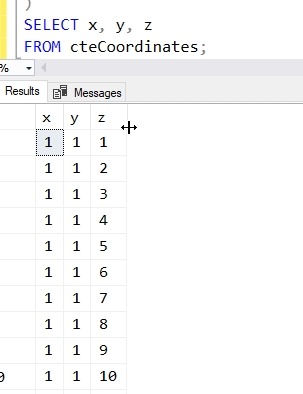
    This gave me my list of numbers.

    2018-07-02 14_40_48-SQLQuery4.sql - (local)_SQL2016.sandbox (vstsbuild (53))_ - Microsoft SQL Server

    My next step was to think about the FizzBuzz test. I can’t use Modulo, so how can I determine if I am evenly divisible by 3? I decided to look at the simple division operator. I got these results, but notice anything?
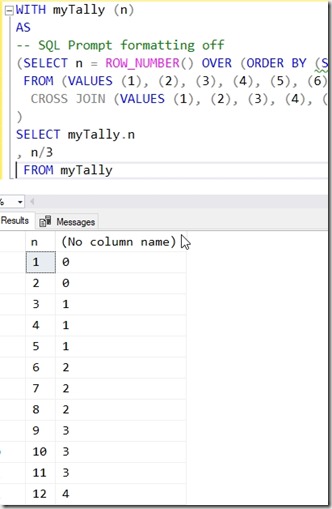
    2018-07-02 14_42_55-SQLQuery4.sql - (local)_SQL2016.sandbox (vstsbuild (53))_ - Microsoft SQL Server

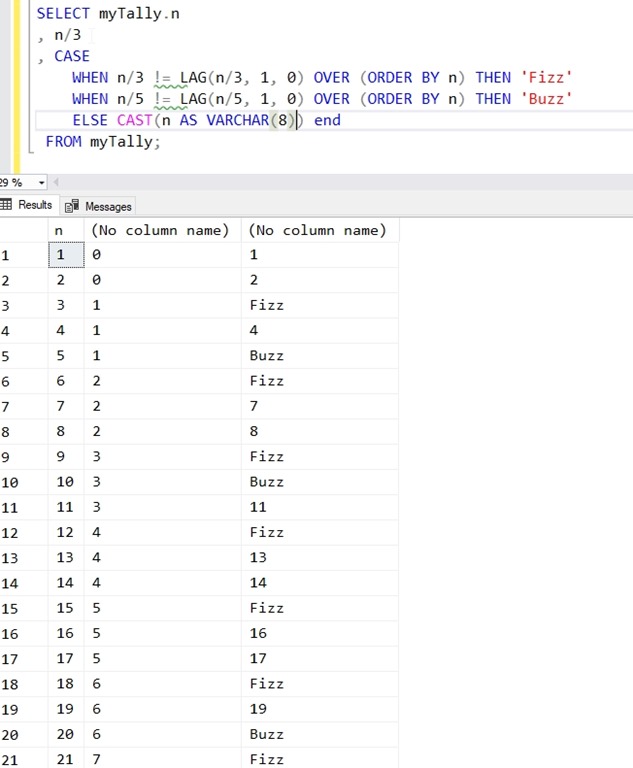
    I get a new number every time the division changes. Immediately I think of window functions here. So I decided to do some checking here. Since I’m looking for a change, I went with a LAG function.

    If the LAG isn’t equal to the current value, I’ve had a change. Therefore, a Fizz.
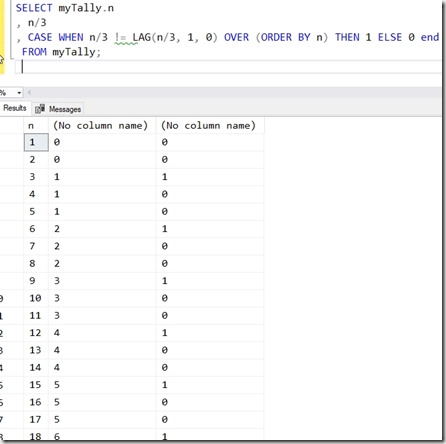
    2018-07-02 14_45_44-SQLQuery4.sql - (local)_SQL2016.sandbox (vstsbuild (53))_ - Microsoft SQL Server

    Let’s clean this up to show Fizz and add the Buzz with a 5.
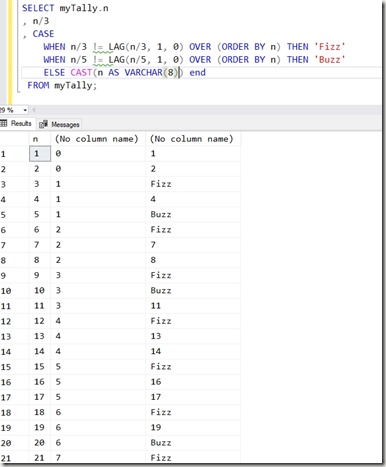
    2018-07-02 14_47_27-SQLQuery4.sql - (local)_SQL2016.sandbox (vstsbuild (53))_ - Microsoft SQL Server

    I’m getting there, but what about FizzBuzz? Well, the CASE will execute in order, so let’s add that one at the top.
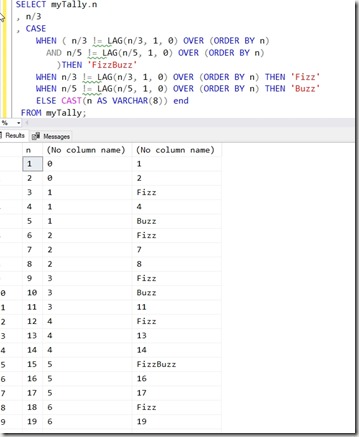
    2018-07-02 14_49_00-SQLQuery4.sql - (local)_SQL2016.sandbox (vstsbuild (53))_ - Microsoft SQL Server

    I’ve mostly solved this, so let’s put this in my query. I’ll substitute the CASE in for each item of the cross join. I get this:

    WITH myTally (n)
    AS
    -- SQL Prompt formatting off
    (SELECT n = ROW_NUMBER() OVER (ORDER BY (SELECT null))
      FROM (VALUES (1), (2), (3), (4), (5), (6), (7), (8), (9), (10)) a(n)
       CROSS JOIN (VALUES (1), (2), (3), (4), (5), (6), (7), (8), (9), (10)) b(n)
    ),
    cteCoordinates (x, y, z)
    AS
    ( SELECT
    CASE
         WHEN ( a.n/3 != LAG(a.n/3, 1, 0) OVER (ORDER BY a.n)
           AND  a.n/5 != LAG(a.n/5, 1, 0) OVER (ORDER BY a.n)
             )THEN 'FizzBuzz'
         WHEN a.n/3 != LAG(a.n/3, 1, 0) OVER (ORDER BY a.n) THEN 'Fizz'
         WHEN a.n/5 != LAG(a.n/5, 1, 0) OVER (ORDER BY a.n) THEN 'Buzz'
         ELSE CAST(a.n AS VARCHAR(8)) END,
    case WHEN ( b.n/3 != LAG(b.n/3, 1, 0) OVER (ORDER BY b.n)
           AND   b.n/5 != LAG(b.n/5, 1, 0) OVER (ORDER BY b.n)
             )THEN 'FizzBuzz'
         WHEN b.n/3 != LAG(b.n/3, 1, 0) OVER (ORDER BY b.n) THEN 'Fizz'
         WHEN b.n/5 != LAG(b.n/5, 1, 0) OVER (ORDER BY b.n) THEN 'Buzz'
         ELSE CAST(b.n AS VARCHAR(8)) END,
    case WHEN ( c.n/3 != LAG(c.n/3, 1, 0) OVER (ORDER BY c.n)
           AND  c.n/5 != LAG(c.n/5, 1, 0) OVER (ORDER BY c.n)
             )THEN 'FizzBuzz'
         WHEN c.n/3 != LAG(c.n/3, 1, 0) OVER (ORDER BY c.n) THEN 'Fizz'
         WHEN c.n/5 != LAG(c.n/5, 1, 0) OVER (ORDER BY c.n) THEN 'Buzz'
         ELSE CAST(c.n AS VARCHAR(8)) END
        FROM mytally a
        CROSS JOIN mytally b
        CROSS JOIN mytally c
    )
    SELECT *
      FROM cteCoordinates
      ORDER BY cteCoordinates.x, cteCoordinates.y, cteCoordinates.z

    That doesn’t seem to work. Even forgetting the ordering, I have a mess.

    2018-07-02 14_58_53-SQLQuery4.sql - (local)_SQL2016.sandbox (vstsbuild (53))_ - Microsoft SQL Server

    At this point I took a break. Clearly I’m overlooking something in my five minutes of work.

    Debugging

    Let’s move the items around and get some ideas here. I’ll get the actual numbers and then the FizzBuzz results. When I print the coordinate values along with the decodes, I see this.

    2018-07-02 15_04_06-SQLQuery4.sql - (local)_SQL2016.sandbox (vstsbuild (53))_ - Microsoft SQL Server

    What’s my error? I’m not thinking of LAG() correctly. This is by row, and the lagging for the x and y coordinates (the first two columns), aren’t changing at the same rate.

    Aha.

    Let’s change this. I’ll setup a simpler CTE first, one that takes the values from 1-100 and returns the value as well as the FizzBuzz calculation. This gives me this code:

    WITH myTally (n)
    AS
    (
    SELECT n = ROW_NUMBER() OVER (ORDER BY (SELECT NULL))
    FROM
    -- SQL Prompt formatting off
    (    VALUES (1) ,(2) ,(3) ,(4) ,(5) ,(6) ,(7) ,(8) ,(9) ,(10)) AS a (n)
         CROSS JOIN    ( VALUES (1), (2), (3), (4), (5), (6), (7), (8), (9), (10) ) AS b (n)
         CROSS JOIN    ( VALUES (1), (2), (3), (4), (5), (6), (7), (8), (9), (10) ) AS c (n)
    -- SQL Prompt formatting on
    ) ,
          cteFizzBuzz (x, n)
    AS
    (
    SELECT CASE
                WHEN (n / 3 != LAG(n / 3, 1, 0) OVER (ORDER BY n)) AND (n / 5 != LAG(n / 5, 1, 0) OVER (ORDER BY n))
                   THEN 'FizzBuzz'
                WHEN n / 3 != LAG(n / 3, 1, 0) OVER (ORDER BY n) THEN
                    'Fizz'
                WHEN n / 5 != LAG(n / 5, 1, 0) OVER (ORDER BY n) THEN
                    'Buzz'
                ELSE
                    CAST(n AS VARCHAR(8))
            END, n
    FROM myTally
    ) ,    cteCoordinates (x, y, z)

    Now that I have this, let’s build the coordinates now. I’ll use the first set of code above as an example, and cross join the cteFizzBuzz with itself. I’ll make this the third CTE.

    ) ,    cteFinal (x, y, z, a, b, c)
    AS
    (
    SELECT a.n, b.n, c.n, a.x, b.x, c.x
    FROM           cteFizzBuzz AS a
         CROSS JOIN cteFizzBuzz AS b
         CROSS JOIN cteFizzBuzz AS c
    )

    Note that I’m returning the original values (for sorting) and the calculated FizzBuzz values, which are characters. If I didn’t care about this, I could ignore the first few columns.

    In my outer query, I display the words, but order by the numbers.

    SELECT 
        c.a, c.b, c.c
      FROM cteFinal c
      ORDER BY c.x, c.y, c.z

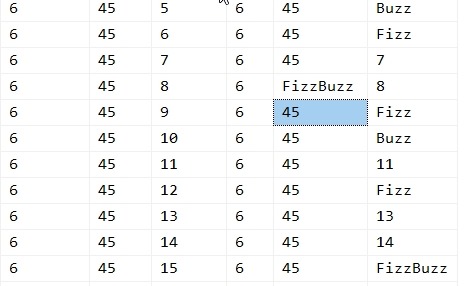
    This gives me the answer (scrolled down to show a few cases).
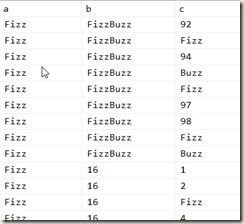
    2018-07-02 15_12_18-SQLQuery5.sql - (local)_SQL2016.sandbox (vstsbuild (54))_ - Microsoft SQL Server

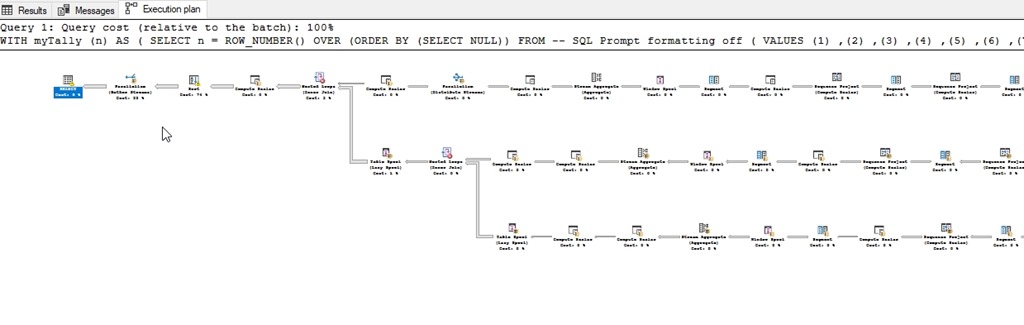
    On my machine, this takes about 4s to run. Not bad, and probably not optimal. The query plan is a mess, but this is for fun in a quick run, so let’s leave this  for now.
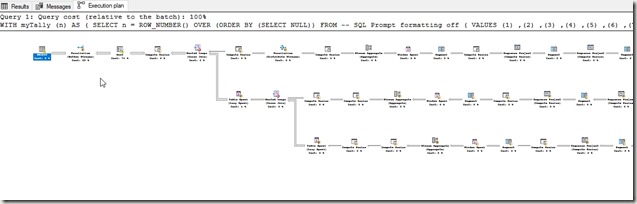
    2018-07-02 15_14_08-SQLQuery5.sql - (local)_SQL2016.sandbox (vstsbuild (54))_ - Microsoft SQL Server

    There are likely better solutions. I’m not an optimization guy out of the box. I get things done first, then I’ll go back and evaluate some time to tune things. In this case, adding in 3 more values (to 300) takes 1:58s. Going to 500 rows caused an SSMS out of memory error.

    If I send the results to a temp table, things are better:

    • 100x100x100 (1,000,000 rows) – 00:01
    • 300x300x300 (27,000,000 rows) – 00:06
    • 500 x 500 x 500 (125,000,000 rows)  – 00:29
    • 1000x1000x1000 (1,000,000,000 rows) – 6:48

    Note, don’t send results to the client if you don’t need to.