Author: way0utwest

  • Docker Challenges

    I’ve been trying to get time to play with Docker more. I had it setup on my old laptop and was experimenting with different ways of working with containers and databases before I switched. Since then I’ve been slightly hamstrung as I’ve been a VMWare person for some time. I have demos and various machines setup, so I haven’t gotten this working on my desktop.

    On the new laptop, I decided to get this moving on my last trip. I installed the Docker msi, rebooted, and …

    Nothing. I saw a service, but none of the “docker …” commands would work. I’d get errors and when I tried to run Docker for Windows, nothing happened. No app, nothing in the task bar, just a big fat nada. I’d get an error about Virtualbox, and despite some bcedit and other commands, I couldn’t get this to work.

    This has been a  low priority, despite the fact that I’d like to do a database container presentation and Redgate is doing some work here. On a recent trip, I had some time to play, so I sat down and started debugging. I went back and found the Windows 10 Quick Start on Microsoft’s site and went from there.

    A few things on this. First, I uninstalled the old Docker for Windows and rebooted the machine. I made sure virtualization was enabled in BIOS and then went through the Docker instructions. I downloaded the new Community Edition .exe for 64 bit Windows and installed it. Another restart and I was amazed to see the Docker icon in the status bar. I made progress.

    I tried a “docker run hello-world”, but got an error. Before I could start swearing, I got the Docker popup that I needed to log into the Docker Cloud. That necessitated creating a DockerID (way0utwest, of course), which was fun since I couldn’t minimize the Docker popup and I was afraid to close it. Once I registered and confirmed my email, I could run the Hello World container.

    Docker is interesting and I’ll do some more work and writing about it, especially the basics. If you’ve never tried a container, it’s one of those technologies to put on your list.
  • The Data Submarine

    For some reason, this came to mind: under the sea, under the sea. That’s what I thought of as I was reading about Microsoft sinking a data center. There are probably jokes to be made about Microsoft and sinking, though they’re less humorous as the company’s stock price has risen quite a bit in the last few years.

    The is a research project from Microsoft on future data center design. Using modular devices that can be submerged for years at a time, only having a connection for power and data back to the surface. These are designed as sealed environments, without the creature comforts needed in data centers for human technicians. The systems inside are built to live on their own, using the water for cooling the heat generated by computations.

    There won’t be any repairs or replacements for failures. With the equivalent of twelve racks of servers in the system, I wonder how long they will list. I find it interesting that the experiment is designed for a year, though the device should have a timeline of 5 years. Does that mean that Microsoft expects current hardware to last for five years? Is that the new lifecycle of modern chips and storage? Or perhaps they find the lifecycle is shorter, but this is more a test of the extreme lifetime that they expect and they’ll track and chart the failures across time of components? I expect they already know some of the expected lifetime of hardware from their massive Azure data centers, which they can compare to this environment.

    It’s an interesting idea, and one that might see smaller, modular data centers spread around bodies of water where there is enough movement to carry heat away. This should reduce power consumption, as less is needed for cooling. This can also reduce latency, with devices perhaps located closer to clients for heavy compute capabilities or even content delivery.

    I’m not sure these will work at larger scales, as heat attracts life, with plant and animals potentially migrating to be near the submersibles. Who knows if were would be interference with operations, but I wouldn’t be surprised to find that some level of maintenance is needed. We might see the rise of a new type of job, like undersea gardener or window washer that keeps the submarines clear of encroaching biology.

    Of course, I wouldn’t be surprised to see Roomba-like automated devices that put many of these humans out of work.

    Steve Jones

    The Voice of the DBA Podcast

    Listen to the MP3 Audio ( 3.4MB) podcast or subscribe to the feed at iTunes and Libsyn.

  • DevOps Debugs the Demo

    I had my 24 Hours of Pass session today, Database DevOps to Ensure Compliance, and my demo broke. At least, it broke for me. I kept going and talked over things, but I hate that. It would have been impressive if it had worked.

    Debugging

    In a live session, I might have debugged this a bit more. I’ve had things fail a few times over the years, but before I was doing the DevOps thing, I couldn’t usually figure things out until I got back to a desk. With DevOps, I’ve solved a few things with the instrumentation.

    In this case, I was cognizant of time, as another session was starting after mine, without the break that usually comes. Plus since it’s online, I can’t tell if anyone really wants to know what happened.

    I do, and as soon as the webinar ended, I looked at the release and realized what happened.

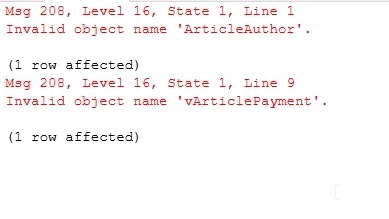
    The Error

    I had this error.

    2018-06-12 16_11_47-Window

    I’d made four changes in Development that were supposed to deploy through to Production. I know they do because I’d done this not 15 minutes before the webinar, so the process was working. No errors, so what was wrong?

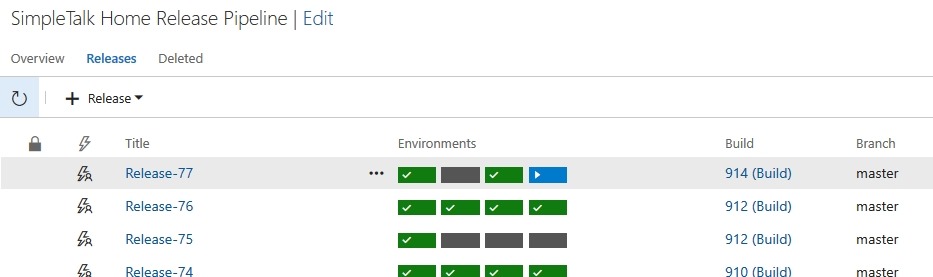
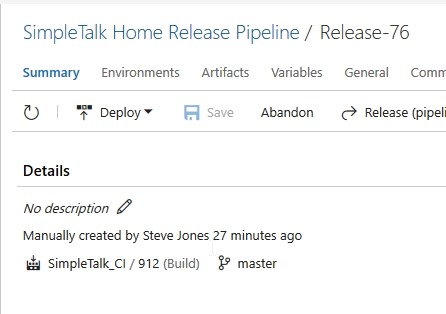
    One thing I’d done was to practice a change, which created a build. I didn’t deploy this forward, so it was essentially sitting in the VCS, but wasn’t in downstream environments. When I looked at my release, I saw this:

    2018-06-12 15_55_38-Window

    Note the build number above, 912. This was my previous build. As soon as I clicked to the CI process, I saw that my last build was 914.

    2018-06-12 16_14_09-Window

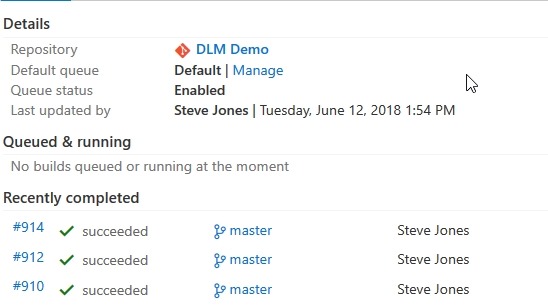
    I’d been in such a hurry to kick off the release that I clicked too soon. The build completed, but the release page hadn’t gotten an update and picked build 912. Since I hadn’t deployed this, I didn’t get the warning that I was re-deploying a build that had already gotten to the QA database.

    I created a new release after the webinar, and it went. With ultimate confidence in myself, I just sent it to Production from QA.

    2018-06-12 16_17_29-Window

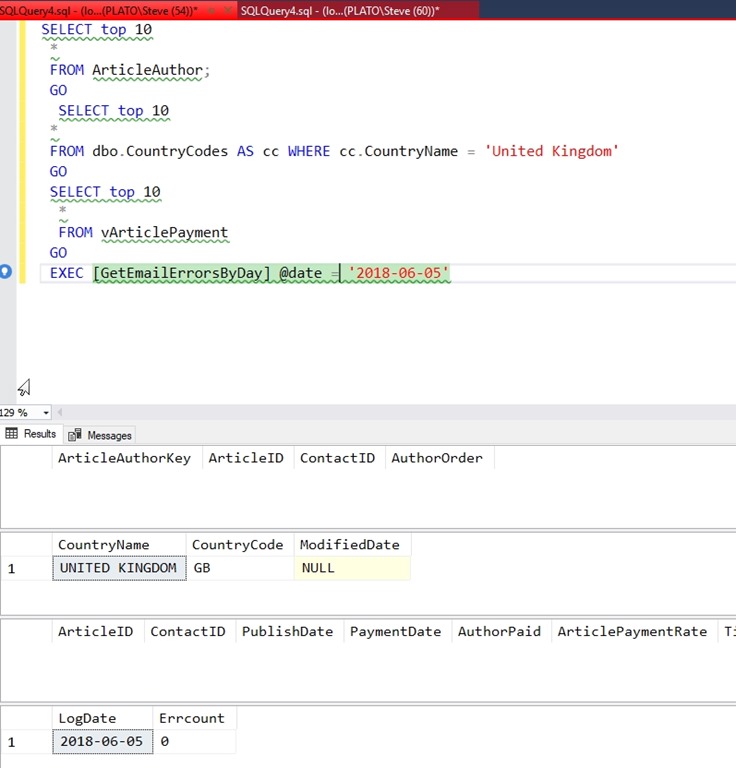
    And it worked:

    2018-06-12 16_17_53-Window

    Apologies for the issues. I’m not sure why Visualstudio.com was so slow here. Apparently the audio worked, so I’m guessing it was their site.

    In any case, I’ll be hosting a webinar doing DevOps in a slightly different way on June 28. Register and join us if you want to see something similar but different.

  • It’s Azure T-SQL Tuesday #103

    tsqltuesdayI’m slightly surprised that there haven’t been more invitations about Azure, with the main development branch of SQL Server being in the Azure cloud, but I’m glad this one came along.

    The invitation is from Björn Peters, and he asks us to write about Azure SQL Database or Managed Instances. We can really write anything that’s a part of the platform, which gives us lots of choices.

    I’ve got two quick items.

    T-SQL Tuesday

    Did you know tsqltuesday.com is hosted on Azure? It’s actually at http://tsqltuesday.azurewebsites.net. When Brent gave me to the domain, and Adam wanted a quick site, I provisioned a WordPress site on Azure in a few minutes. It actually took longer to square away the initial DNS and domain name movement than getting the site up and configured. Templates and known configuration settings help to ensure that you can build a new version of xxx, very quickly.

    The cost was low as well, about $3.60/month and initially $5/month for the hosted MySQL database.

    This changed last year, when the MySQL hosting option was discontinued. I could have upgraded to $15/month, but decided to experiment. Azure has a MySQL as a Service PaaS offering for the same $15/mo, so I moved to that. I was somewhat amazed how easy it was to provision this database on my own and get things running. While the site costs me a little money, it’s a donation to the community, and I’m happy to see so many people participating in the monthly event.

    Quick Labs

    One of the things that I needed to do last year was setup a new cluster and Availability Group for a proof of concept. I have typically done this by getting some VMs ready on my desktop, making connections, etc. However, in this case, I decided to use Azure instead. I was curious about whether this was faster or easier.

    It was.

    Across a few days, as I learned a bit about provisioning new machines and connecting them with networking, I was able to get my set up with 3 machines, a load balancer, storage, etc. I had a working set of Availability Groups, that I could access from anywhere.

    Then I tore it down and started again.

    One of the great things about Azure is that you can use the Azure Resource Manager to provision new services fairly quickly. It’s not as instantaneous as you would like, though it’s not bad. I think the fact that you request actions and then wait until you are notified of something completing in the portal makes the process seem slow.

    In my case, the few days became < 1 hour the second time around.

    Plus, I didn’t use resources on my local machine, where I might have to balance the load with other tasks. I could also shut down my system and reduce costs. With ARM, I could even get rid of the lab and rebuild it in an hour in the future.

    To me, this is the place where the cloud makes lots of sense. If you have a load that is sporadic and can be up or down on demand, then the cloud is helpful. You can remove resources you don’t need, only paying as you go.

    If I were using this every day, I’d probably stick with the local system, but for a periodic use item, it makes sense to fire up the lab when I need it, rather than keeping it alive all the time.

    I look forward to doing more with Azure in the future and learning even more about how to build up the resources I need, when I need them.