Author: way0utwest

  • T-SQL Tuesday #098–2018 Goals

    tsqltuesdayA great topic for T-SQL Tuesday this time from @sqlmal. It’s Setting Learning Goals for 2018, and it’s a topic I both loathe and love. I hate making commitments that I can’t keep, and I constantly find that a chaotic life will get in the way of learning over time.

    As an example, I tried reading the Powershell in a Month of Lunches book. I managed to get to Day 19. It’s not that I don’t like PoSh or have given up (I still blog on the topic). It’s that the setup was more complex later in the book (really need a domain) and I became busy at work.

    Goals do have a way of focusing a person on a task, and they’re good in that sense. With a year of less travel coming, this was a timely topic for me and forced me to stop and think a bit about the way I want to drive learning in 2018.

    Goals for 2018

    What do I want to learn next year? Here’s a short (ish) list, in no order:

    • CosmosDB
    • Python
    • Pester
    • Extended Events
    • Entity Framework

    I could try to tackle all of these, but that certainly won’t help me do well. This is too large a list to become strong at all of them, though I could spend time improving my skills a little bit in all these areas.

    Of these items, I could relate many of these to my job, which can make it hard to choose. In addition to these items, I’ve got other things that I know will be a part of my learning next year. Product changes, new integrations between our products and others, plus who knows what will come about.

    Picking Two

    If I have to say that I’ll spend 100 hours on something next year and try to get better, I’ll say that the two areas I’ll focus on are Extended Events and Python. While I may dabble in the others, I think that these two areas will be more important to my career as well as my job over time.

    I need a much better understanding of how XE works apart from trace, and I need a lot more comfort in gathering and analyzing the data.

    I also think that Python, with its addition to SQL Server ML and the popularity of the language in new packages and modules means that this is an area that provides some variety, excitement, and a relation to my job. Plus, it’s in SQL Data Generator, so I should have lots more examples there.

    My goals for these two are to spend 50 hours on each over the year, in a combination of course work (articles, videos, etc.) and practical work (building things and trying to use the technology to solve problems).

    Caveats

    There’s always something that comes up, and while I don’t want to start making excuses, I recognize that there are a few things that might derail my plan and make me change.

    First, GDPR. I have no idea how this will impact Redgate and my, but I might need to spend a bunch of time early in the year on this. We are getting calls, questions, and requests from clients, and as some of our new integrations and products come out, this might eat up time.

    Second, travel. I haven’t planned on much, but I’ve really only set the first 4 months of the year. After that, we’ll see. Who knows what might come up or what demands arise.

    Third, life at home. I never know what will happen here and how things might change, so that could change how I focus. Plus, I have a sabbatical coming, so we’ll see how that affects me.

    Getting Ready

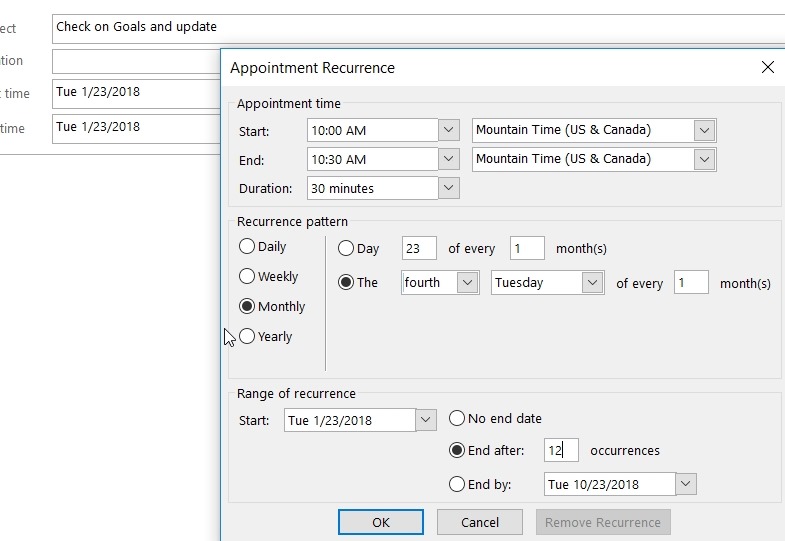
    I’m doing a few things right now. First, I’m setting a monthly reminder to update my goal progress. I’ll try to write a post each month, for better or worse, on where I am.
    2017-12-06 17_22_15-Appointment Recurrence

    Second, I’m setting an appointment for myself to sit down and plan some things out the last week of December. That’s a good time to spend an hour or two and try to come up with a plan. It won’t be perfect, but it will give me a direction on which to start. I can amend this during my monthly review if needed.

    That’s it, thanks to Mala for a great topic, and we’ll see how it goes.

  • Renaming a Column–#SQLNewBlogger

    Another post for me that is simple and hopefully serves as an example for people trying to get blogging as #SQLNewBloggers.

    One of the things I rarely do is rename objects. There are good reasons to do so, but often the changes required in other objects and applications isn’t worth the hassle. This is one reason why it would be good to spend a few minutes in design and come up with good names from the beginning.

    In any case, do you know how to do this? You could use SSMS and easily change the design of the table. Of course, SSMS might try to rebuild the table, which might not be what you want. Hopefully that’s not the case, though you should always get the script instead of just saving the change.

    The code you’d like to see is a simple meta data change that uses sp_rename. In my case, I want to change Qty to Quantity. I’d use this code:

    EXEC sp_rename @objname = ‘Sales.OrderLines.Qty’ ,
    @newname = ‘Quantity’ ,
    @objtype = ‘column’;

    I wish we had a direct ALTER TABLE statement that worked here, or better yet, an ALTER TABLE that allowed the entire table code to be shown (that’s not coming), but I’m not holding onto any hope that Microsoft will change this.

    If you’re a person that thinks you might need a temp table that you insert data into and then two renames of the tables, that’s not the best way. Simple meta data changes are always preferred.

    SQLNewBlogger

    I ran into this while helping someone test a change and thought this was a good, easy reminder of how to change names. You could show you understand this in a blog in five minutes.

  • Sharing Data

    One of the things that’s written into various computer laws is that unauthorized access of a computer system with another’s credentials is a crime. That’s been drilled into me at various organizations where no one was supposed to share any credentials. That is something many sysadmins drill into users, while sharing their own system level credentials for accounts like root, sa, system, and more. I’ve seen no shortage of these accounts in use across multiple services or multiple people from those that would admonish a manager for sharing their password with an assistant.
    This week Troy Hunt wrote about politicians sharing passwords, and the problems with doing so. It’s an interesting read, and certainly points out that the expediency of having users share a workload has plenty of downsides in accountability and auditing of actions. I think there’s little excuse for sharing security credentials in UK gvoernment as there are other solutions to handle this issue. I am more sympathetic in real time environments, like hospitals, where the login process might literally cause a death in the event of a delay.
    Leaving aside the authentication aspect, we often share data among individuals inside of an organization. In fact, outside of sysadmins, there might not be many people that really understand who should have access, let alone who has access, to some data. In fact, over time it seems that most organizations tend to lean towards allowing an ever-growing number of people to access data in file shares. While we might prevent database access and grant/revoke this at times, the output from our systems often ends up in Excel sheets or other files and people that might not have direct access still see the data.
    The real physical world is just as bad, since many people may leave data lying around on desks or tacked to a wall. Just like credentials on a post-it, we have lots of data available for others to read, though physical access is required. However, have you thought about how many people have physical access? It’s not just your co-workers, but also janitorial staff, tradespeople, and others likely wander regularly through your office spaces.
    Security is a tough battle, one that is interesting in that most of the time we don’t need much more than good passwords. Most people don’t have the time or inclination to deal with their own data, much less yours. However, when an attack is targeted on your organization, from outside or within, it’s extremely difficult to ensure data won’t get lost.
    I don’t have a great solution, but I do think that there are good reasons to limit access to data on our systems, not the least of which is auditing and accountability. Beyond that, however, we have to hope that our users have some judgment about with whom they may share reports and other data.
    Steve Jones
  • SSMS Updates in 17.4

    SSMS 17.4 is out, and if you haven’t upgraded from SQL 204, 2012, 2008, etc., you should do so. You can run your bundled SSMS side by side with the new versions, but it seems that the 17x versions are improving andbecoming more stable.

    You can download the new version and use it for free. That alone should be a reason to update your workstations.

    This update includes a few new interesting items.

    • Vulnerability Assessment – Scanning for security and misconfiguration issues
    • Always On Dashboard – New latency reports
    • Showplan – some fixes and new operator icons
    • XE Profiler – Very cool to see this being enhanced.

    There are other updates and fixes as well. I’m sure there are some bugs, but for the most part, I think that SSMS 17.x is the way to go forward.