Category: Blog

  • Daily Coping 17 Feb 2022

    I started to add a daily coping tip to the SQLServerCentral newsletter and to the Community Circle, which is helping me deal with the issues in the world. I’m adding my responses for each day here. All my coping tips are under this tag.

    Today’s tip is to smile at people today and try to brighten their day.

    This is something I try to practice regularly, and it’s something I did this past weekend. I coached at a tournament, which means I was around lots of other people. I miss that in the tech world, but I am getting the experience with coaching.

    Since we are now without masks, I can smile at people as I walk past, see them, interact. I smiled at referees, other players, other coaches, even parents. Usually saying hi if they meet my eye, but often getting a smile back in returns.

    Smiling is infectious. Do it often.

  • DP-900: What’s a Region and an Availability Zone

    This is part of a series on my preparation for the DP-900 exam. This is the Microsoft Azure Data Fundamentals, part of a number of certification paths. You can read various posts I’ve created as part of this learning experience.

    This isn’t covered per se on the exam, but it does matter for understanding some other concepts, like reliability and other HA (high availability) concepts. I decided to do a quick post on these concepts as learning them helped me better understand some other things, like LRS and ZRS.

    Geographies

    I didn’t see this on the test, but it could be in the pool of questions. A geography is roughly a country, but not always. You can see this list in the link below:
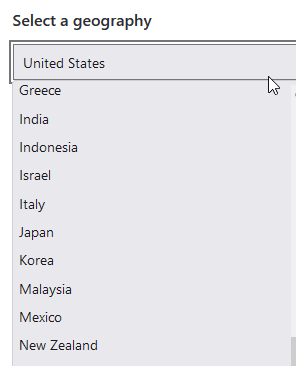
    Azure Geographies

    Note there is an “Asia Pacific” geography, which is Hong Kong and Singapore listed as regions.
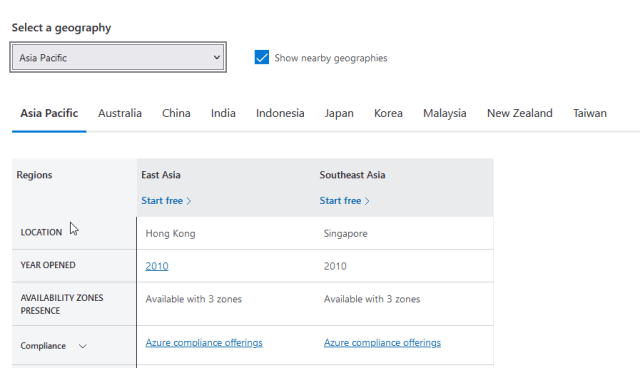
    2 regions in Asia Pacific

    Region

    A region is an area in a country. Regions don’t span countries, and there can be multiple regions in a country. Microsoft has a list of regions available in various geographies. As an example, if the United States is selected, you can see these regions:

    • Central US (Iowa)
    • East US (Virginia)
    • East US 2 (Virginia)
    • West Central US (Wyoming)

    and more. If you pick the UK, you will see UK South and UK West (as of Feb 2022). These are located in the London and Cardiff areas, respectively.

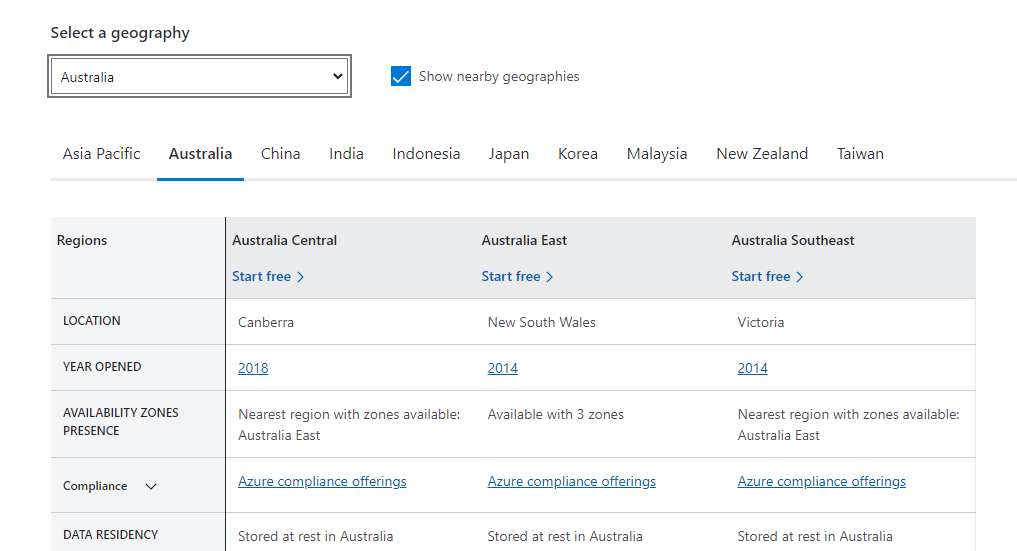
    You can think of a country as divided into regions, separately from their province/state/county governmental borders. A set of data centers is then built to make up a “region” for Azure. The Australia regions are shown in the image below:

    2022-02-04 08_59_42-Choose the Right Azure Region for You _ Microsoft Azure

    In the image we have a Canberra location,  which is a city. Victoria and New South Wales are states, and the location in these states isn’t specified. Some inconsistency here, but think of a region as an area in a country. This region provides a low latency network between the various data centers in the region.

    Regions are a unit where different services are provided. Not all regions are equal as some capabilities are deployed in some regions first. It is always important to verify a particular service or feature is in a particular region before you plan a deployment.

    Availability Zone

    The Availability Zone concept is a more ephemeral one. This is a set of data centers inside of a region. These are within a latency boundary, meaning that network communication between hosts in two different data centers is 2ms of less.

    When you have at least 3 data centers inside of this latency boundary, they an comprise an Availability Zone. This is a concept for redundancy purposes and to survive some sort of disaster in a single data center. If a single data center loses power or some other issue, the other data centers in the AZ can take over. This could be a single server or rack of servers failing as well, with servers inside another data center in the AZ taking over.

    Zone Redundant Service (ZRS) is the concept here that is used with an Availability Zone. With this, there are copies of the service in the different zones that allow a service to continue to function, despite a local failure in a DC. This is in contrast to Local Redundant Services, which have multiple nodes inside of a data center, but would be unavailable if that particular data center failed.

    Here is an image from MS Docs that shows there are three zones inside of a region that are connected together.

    2022-02-04 09_37_19-Azure regions and availability zones _ Microsoft Docs

    The documentation notes there are a minimum of 3 zones to have an AZ, and I’m guessing some regions potentially have 4 or more zones to ensure services are uninterrupted and capacity is available.

    Overall Hierarchy

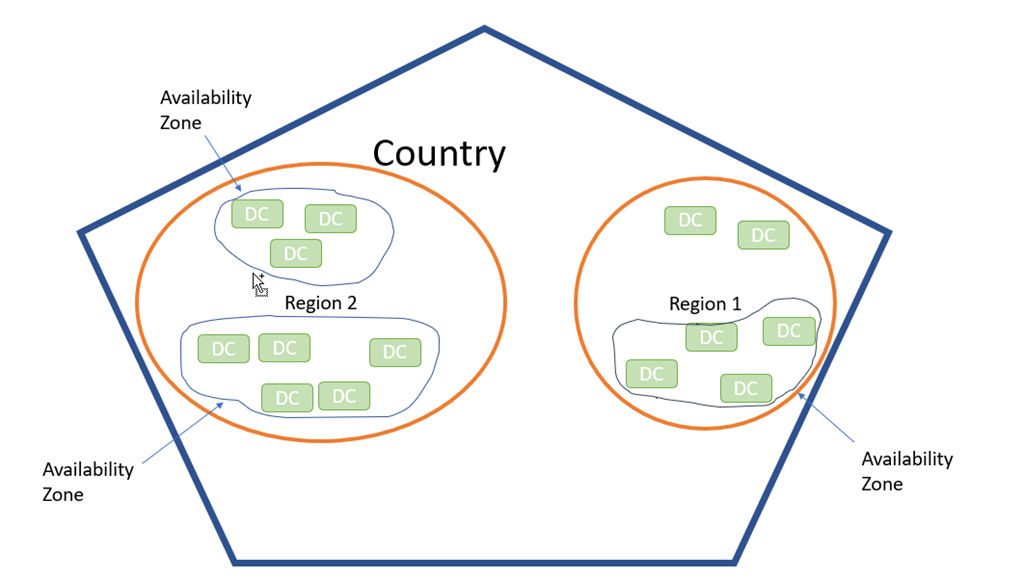
    I didn’t find a great image that explains things. I made a simple one, showing a country, with regions, then AZs, and data centers.

    2022-02-04 09_36_50-Presentation1 - PowerPoint

    Note, Azure calls areas of the world geographies. So the US is a geography, which might help if there were governmental or political changes over time.

    The basic idea is to understand this relating to storage, which will be another post where I examine the different levels of protection offered by Azure.
  • Daily Coping 16 Feb 2022

    I started to add a daily coping tip to the SQLServerCentral newsletter and to the Community Circle, which is helping me deal with the issues in the world. I’m adding my responses for each day here. All my coping tips are under this tag.

    Today’s tip is to focus on being kind rather than right.

    I’ve had this tip a few times, and I usually think about interactions with other people. Today, I’m thinking about myself.

    I set some goals for myself at various points, and I want to revisit some of those things today, with the idea of being kind to myself rather than a straightforward SMART goals evaluation.

    I set a January goal of working out every day.  Before I even started, I had to delay slightly with an injury. Here was my January progress:

    2022-02-09 13_21_34-MapMyRun

    I track my workouts on MapMyRun.com, and as you can see, I missed 3 days after starting back working out on Jan 4. If I check February, I managed to work out the first, but missed the second and third.

    I didn’t get to the goal, but I understand why. Jan 9 and 23 I coached all day down in the Springs, leaving the house by 6am and not returning home until 6 or 7 at night. A long day, standing all day, and I gave myself permission to not push. The 24th I actually felt sick, a bit of a cold, and I mostly rested in bed that day.

    It was a goal, not a requirement, so I can live with that.

    I’ve also been dieting and trying to clean up my life this year after some slightly high health numbers. I set a goal of not drinking for a month, and I did a good job there. I had a beer on Jan 1, returning from Las Vegas. I didn’t have another until Feb 1, when I was celebrating with my wife. I had a couple while on holiday that week, but since then I’ve been avoiding alcohol again. Same with my diet. I’ve been fairly strict for a little over a month, but I am accepting a few meals here and there where I deviate a bit from the plan.

    In both cases, it’s OK. I’m being kind, rather than berating myself for small breaks.

    I’ve had a few days off as well, skipping some chores or taking it easy on the weekends, something I rarely do, but I’m being kind and accepting of life as it comes and I make decisions.

  • Daily Coping 15 Feb 2022

    I started to add a daily coping tip to the SQLServerCentral newsletter and to the Community Circle, which is helping me deal with the issues in the world. I’m adding my responses for each day here. All my coping tips are under this tag.

    Today’s tip is to send an encouraging note to someone that needs a boost.

    I reached out to a friend recently, just to check on them and see how they were coping with life. This person has had a hard year. In this case, they responded with an issue that was weighing them down.

    I send back a few notes to remind them of good things, and the things that I appreciate and like about this person. I empathized with their struggle and told them I was hoping they would continue to dream of the future and what they could make.