Category: Blog

  • Typing Alternative Characters

    I tend to work in the US English world. I’m somewhat embarrassed to note that I really only know one language and most of my work has been with US centric industries. I’ve rarely had the need to deal with Unicode and most of my databases have used varchar() everywhere. However, I know a little about nvarchar and am trying to be better about becoming familiar with using these structures.

    Recently I was working on a piece and needed to type a £ character. If I were on one of the Redgate demo systems, that would be no problem. There’s a key for this character. However, I’m a US centric guy on a US system.

    I could have cut and pasted the character, but I was wondering if there was a way to type it. There is.

    You can use ALT codes to type the Unicode character. In this case, it’s 0163, so you can hold down the ALT key and then type  ‘0163’. Doing that gets you £.

    Pretty cool.

  • Off to SQL in the City 2018

    I’m off today on a plane, flying to the UK for this Wednesday’s SQL in the City broadcast. This is our first event of 2018, and I’m excited. We’ll be talking GDPR and security, not the most exciting of topics, but we also have some cool new products to show off. I’m excited to see what people think of the work that our development teams have been doing.

    I’m also doing the keynote, which is both a little exciting and scary. Usually Simon Galbraith, founder and CEO does these, but for some reason I’ve been picked this time. I hope you enjoy what I have to say, and hopefully I don’t mess things up.

    I’ll also be showing you some improvements to SQL Clone with integrated data masking. This is a very well thought out product, which will really help many of you prepare databases for development and test without exposing sensitive data.

    Register today and I’ll see you, or rather, you’ll see me on Wednesday.

  • Classifying Data with SSMS 17.5

    I upgraded SSMS to 17.5 recently and found an interesting addition. This version has incorporated the ability to classify data. With the GDPR coming for many of us, this is a welcome addition.

    This is a quick look at this feature.

    Classify a Database

    If I select a database and right click it in SSMS, I get a few new items in the Tasks menu (as shown).
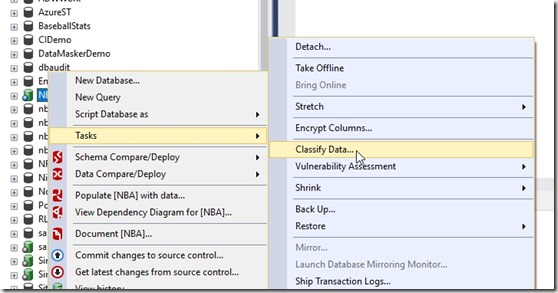
    2018-02-16 13_15_58-SQLQuery1.sql - Atlas.master (sa (51))_ - Microsoft SQL Server Management Studio

    I’ll select “Classify Data”, and I get a new tab opened. I see there are some recommendations and also a list of classifications of data.
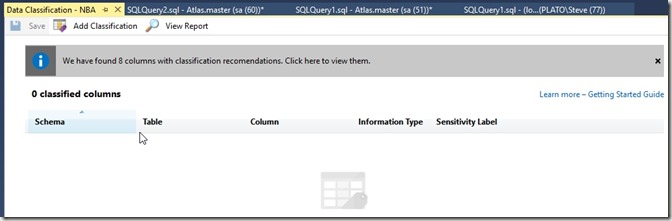
    2018-02-16 13_16_28-Data Classification - NBA - Microsoft SQL Server Management Studio

    There’s a getting started link, which takes me to the SQL Server Security Blog. I suspect that’s an incorrect link. I think it should go here: SQL Data Discovery and Classification.

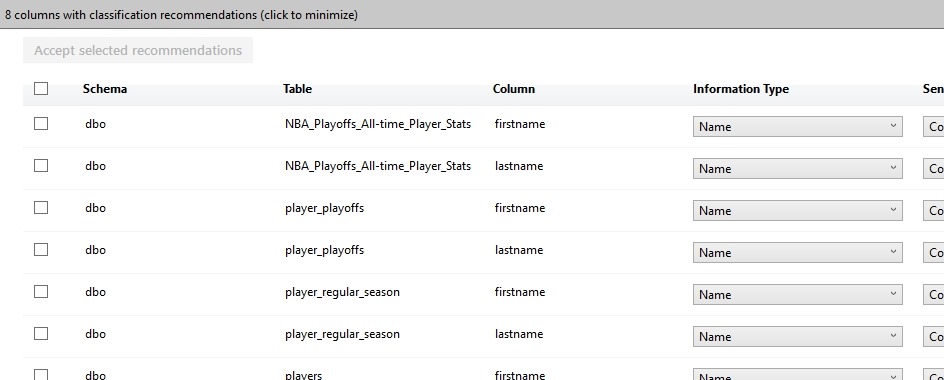
    Below this, I see a list of the recommendations. This has grabbed tables that appear to continue to contain some data that might be sensitive and require classification. One of the tenets of the GDPR  is that you know your data. You aren’t allowed to figure this out later, but rather you must proactively know what data you are collecting and processing.
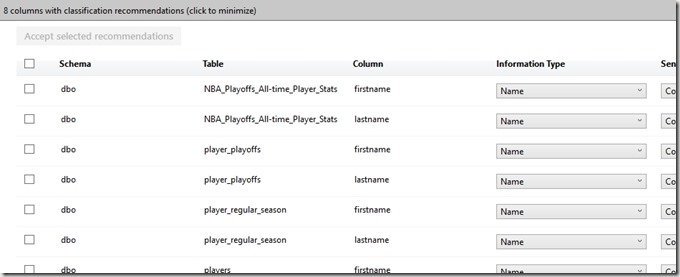
    2018-02-16 13_17_47-Data Classification - NBA - Microsoft SQL Server Management Studio

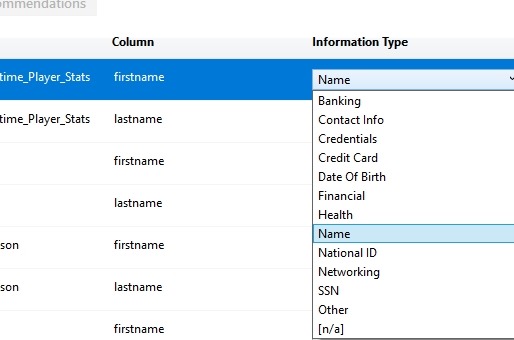
    Here we can see a few drop downs to the right. I’ll scroll and look at these. First is the Information Type. This is listed as a name, but I have other options I can set. The list is the types of that that might be sensitive information about a data subject (a human or entity) that I need to classify.
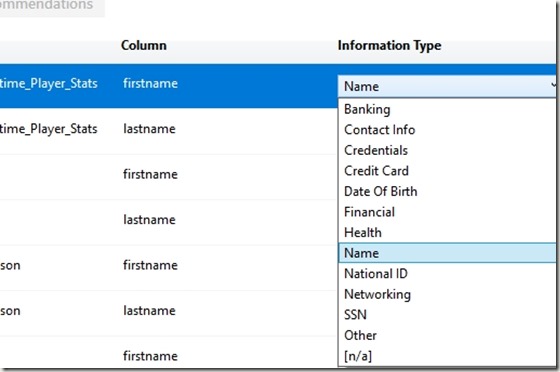
    2018-02-16 13_19_36-

    Beside this is the sensitivity label. My choices here are shown below. These range from public information, which removes some of my responsibility to highly confidential and applying to the GDPR.
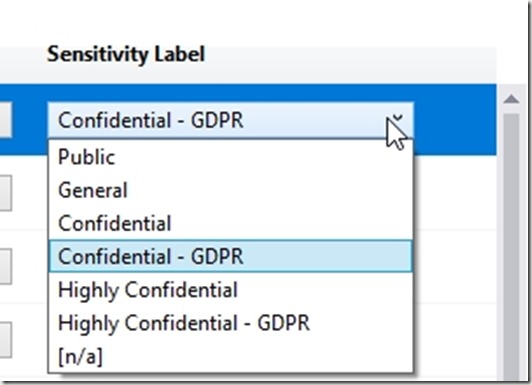
    2018-02-16 13_21_14-Data Classification - NBA - Microsoft SQL Server Management Studio

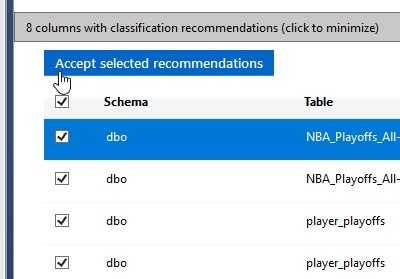
    If I’m happy with these recommendations, I can select them all (or a subset) on the left. I can click the “Accept” button to add them to the classifications I have for this database.

    2018-02-16 13_22_07-Data Classification - NBA - Microsoft SQL Server Management Studio

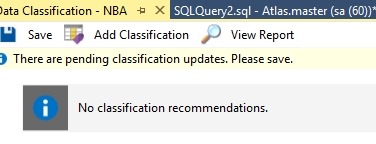
    This doesn’t save them, but adds them to the list. At the top of this tab I can see the need to “Save” my changes.
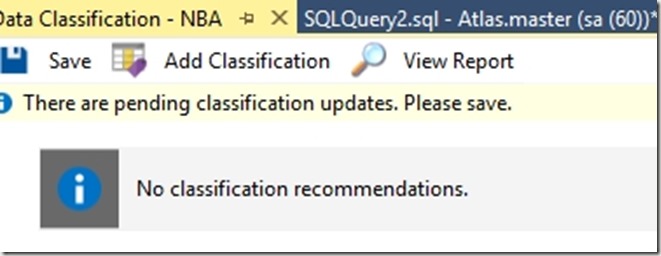
    2018-02-16 13_22_13-Data Classification - NBA - Microsoft SQL Server Management Studio

    Once I’ve done this, I could add more, or view a report. The report shows me this:
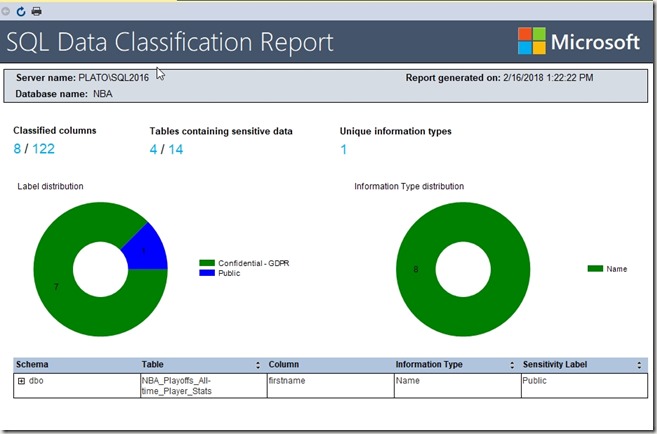
    2018-02-16 13_22_26-Data Classification - 2_16_2018 1_22 PM - PLATO_SQL2016 - Microsoft SQL Server M

    Implementation

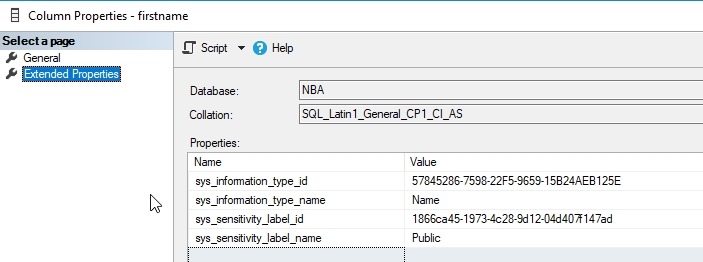
    My guess was that these are implemented as extended properties, which makes sense. That’s how many things could make SQL Server better, and I’m right. If I examine the EP for the firstname column in one table, I see this:
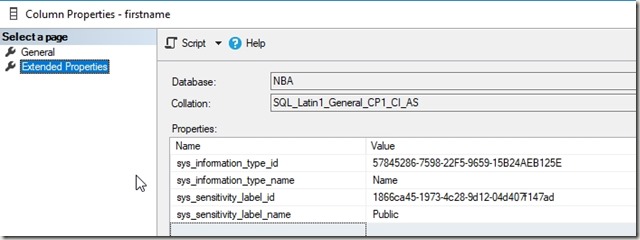
    2018-02-16 13_26_46-Column Properties - firstname

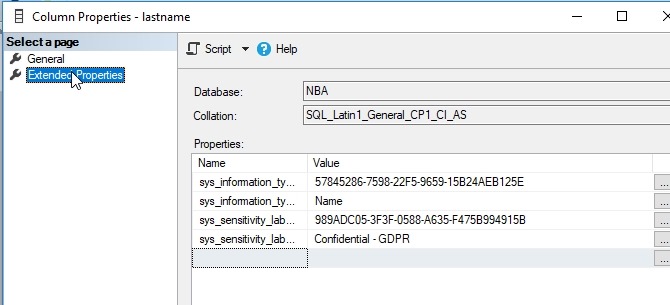
    This was the column I changed to public information. The lastname column in the same table is marked as confidential.
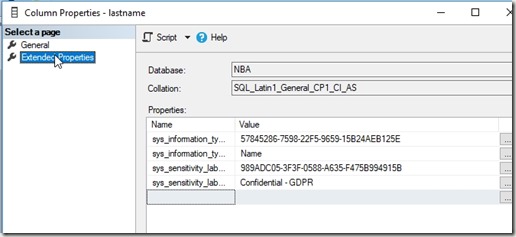
    2018-02-16 13_26_55-Column Properties - lastname

    Helpful?

    Ultimately is this useful? Yes. I can see other products taking advantage of this, such as the new Data Masker from Redgate, which could let you know which columns are sensitive and not masked. I’d also expect that this is useful and important for ETL and other operations to carry this metadata to new columns that might contain transformations or movement of this data.

  • Use the Proper User for Azure MySQL DB

    I wrote about migrating the MySQL database from a third party provide to Azure MySQL DB recently. This was due to the provider raising the price substantially for me to host the site. However, after migrating the data, I ran into an issue.

    I’d read a blog on moving WordPress data and followed the instructions, but after updating my connection string, I kept getting this at tsqltuesday.com

    Error Making Database Connection

    It appeared big and bold in the browser, with no additional information. There was a time I dug into MySQL, but it’s been a long time. In any case, I wasn’t sure what the issue was, so I started messing around.

    In MySQL Workbench, I could add a new user with their GUI and grant privileges. I did this for a user called “tsql2sday”, with a password. However, when I updated the connection string in my Azure App Service, this didn’t work.

    I tried a number of items, including manually creating my own user and assigning privileges, making this a DBA (super) user, and more. Nothing seemed to work. Some of you might have even seen the error messages as I tried to get this to work.

    Eventually I checked something. In the original app service connection string, my old third party database just had the user name. This was the same for my connection in MySQL workbench. However, with my new Azure MySQL database, I needed user@dbname. For me, this was tsql2sday@tsqldb in MySQL Workbench.

    Once I added the @ and host to the connection string in the App Service, I could connect. Whew, as I wasn’t looking forward to another hosting bill.

    I think all the data is there, but if you find issues with tsqltuesday.com, let me know.