Category: Blog

  • Quick Command Shells–#SQLNewBlogger

    Another post for me that is simple and hopefully serves as an example for people trying to get blogging as #SQLNewBloggers.

    This isn’t a SQL post, per se, but since I’ve been using lots of PowerShell for SQL stuff at times, this is a handy trick I picked up.

    I was reading the announcement on the Windows Insider build 14971, which will have a few new things. One of these is the default command shell won’t be cmd.exe any longer. It will be PowerShell.

    Buried in the announcement was a tip I’d never heard. I don’t have any real cmd additions to my Windows machines, so to get to a particular folder in a command shell, I usually do lots of “cd”s or I right click in the address bar, and copy the path. Thankfully Windows 10 lets me paste this easily into a command prompt.

    2016-11-21 16_21_20-EndtoEndEncryptionwithSQL2016

    There’s another way.

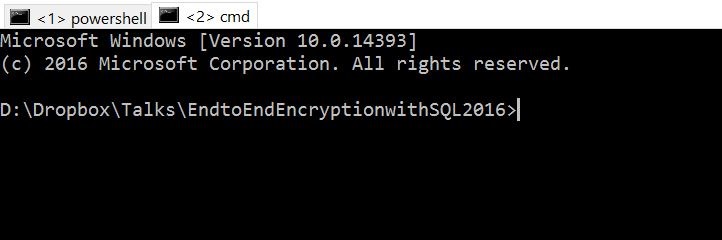
    I can click the address bar and type “cmd”.

    2016-11-21 16_21_47-EndtoEndEncryptionwithSQL2016

    When I do this, I get a new command prompt at that location, as shown here. I do install ConEmu on my machines, so that’s where the prompt opens.
    2016-11-21 16_21_55-cmd

    That’s super handy.

    We’ll see how may workflow changes when PoSh is the default shell, but I’m looking forward to it.

    #SQLNewBlogger

    The quick tips that help me work more efficiently are what I’m writing in these posts. Here’s one that took my 5 minutes, and you can write this kind of post as well. Show off what you know, do, and have learned.

  • A Well Deserved Break

    This week I’m on vacation taking a bit of time away with the family after a week in the Redgate offices.

    I hope everyone has a great holiday week and an enjoyable Christmas.

  • Connecting to a Specific Port–#SQLNewBlogger

    Another post for me that is simple and hopefully serves as an example for people trying to get blogging as #SQLNewBloggers.

    I recently blogged about finding the port your SQL Server uses. At the end of that post I showed a connection to a server using a port. This is something I’ve used rarely, but it’s been very helpful.

    The specification for specifying a port can vary. For example, my build server at home runs TeamCity on port 8077. In my case, the URL to connect is:

    http://192.168.1.201:8077/overview.html

    If I had an FQDN, I might have this instead:

    http://Atlas.dkranch.net:8077/overview.html

    When I connect to SQL Server, I get this dialog:

    2016-11-15 15_28_10-Connect to Database Engine

    Some of you might note there is a “Connection Properties” tab, but there’s no port setting there, even if you choose TCP/IP.

    2016-11-15 15_28_27-Connect to Database Engine

    When I connect, I give a server name. In the example above, I used “.\SQL2016”. The default is that my client will try to connect on 1433 or use the SQLBrowser to get the port. However, I could specify the instance name like this:

    .\SQL2016, 1433

    For this instance, that wouldn’t work as the port is 6077. I’d have to write this:

    .\SQL2016, 60087

    But since I’m choosing a port, I don’t need that. I can use

    .,60087

    and I’ll connect.

    Learn to use the port in your connection string. At some point, this will help you to troubleshoot connection issues.

    #SQLNewBlogger

    This is a quick, easy post to write. It’s five minutes work for most of you. Maybe 10 if you have to Google/Bing.

  • Live #SQLintheCity–Behind the Scenes

    Here’s a shot from our engineer, behind the scenes of my live talk today.

    //platform.twitter.com/widgets.js