Tag: DLM

  • Get Away from the Heat and Learn some Database Version Control

    I have enjoyed the trips I’ve made to New Orleans and Baton Rouge in the past. It’s a good getaway, stopping in the French Quarter for a few minutes before an easy drive up the road. However it’s warm, and I can’t ever get my wife or kids to come with me. For some reason, they don’t seem to enjoy the warm, August Baton Rouge weather. I, however, am looking forward to a jog around University Lake.

    LSU University Lake at BREC Milford Wampold Park

    This might be the best time to run, but I’ll likely be going around when it’s sunnier, and a touch warmer.

    However if you want to get out of the heat, perhaps you’d like to come learn about Database Version Control with Ike Ellis and me? Redgate Software has partnered with Crafting Bytes to deliver our workshop in Baton Rouge. We’ve put the workshops on sale, and only $100 for a full day of training.

    What will we cover?

    We’ll show you how to get your database in a Version Control System (VCS). We use Redgate’s tools, but the idea of using version control can be done in other ways. I’m running the labs, and you’ll see how you can keep track of all of your database DDL code, including Lookup data!
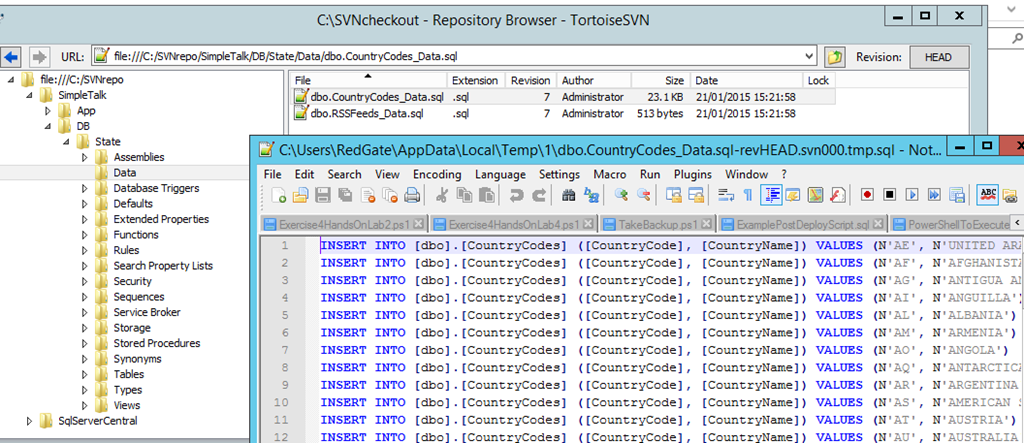
    2015-07-23 18_45_53-DLM-Workshop-2015-02-19-1708-export-i-fg1k1eq0 - VMware Workstation

    We are also covering some advanced features that the Redgate tools make easier. Things like branching, merging, and deployments. How many of you would love to know that development is done and we can deploy our changes like this:
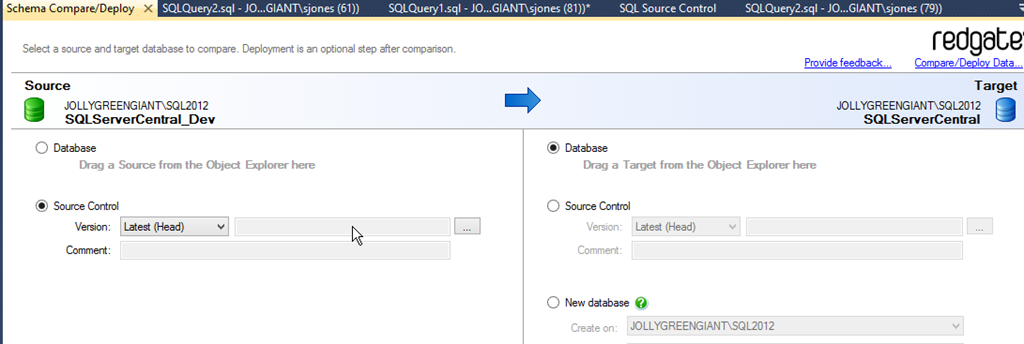
    2015-07-23 17_14_22-Schema Compare_Deploy - Microsoft SQL Server Management Studio

    I’ll show you how you can deploy your changes right from inside SSMS.

    This is an in-depth workshop, covering way more than I could ever do at a SQL Saturday or conference. What’s more, we provide you with a VM and let you actually work through the skills we teach you. You will get real practice during the day to give you the confidence and practice for your own environment back at the office.

    I hope to see you at either the workshop or SQL Saturday #423 in Baton Rouge.

  • Database Lifecycle Workshops

    Trying to implement version control, and Continuous Integration (CI), and automated releases of code is hard. The concept is simple, but all of the various processes, tools, and links that need to be connected can be hard. I’ve seen too many organizations that struggle to get started, often because they see the entire process as just too complex and overwhelming.

    It’s not.

    Whether you’re trying to release application code or database code, you need to treat them in a similar manner. While there are lots of books, tools, blogs, and companies that can help you work with application code, the database has been more challenging.

    At Redgate, we’ve put together a few workshops to help break down the stages of engineering your database delivery and get you moving to help smooth the process of making database changes. These workshops are coming to locations all around the US and UK in the next few months. Check out our schedule, which has dates in :

    • Bellevue, WA (May 15)
    • London, UK (May 20)
    • Philadelphia (June 4)
    • Belfast, Northern Ireland (June 26)
    • London (July 8)
    • San Diego, CA (July 16)
    • Manchester, UK (July 24)
    • Baton Rouge, LA (July 31)

    There are more dates, and we’re certainly open to scheduling more locations and even private classes if you’d like. Contact us if you have a request.

    Most of these classes are delivered by experienced partners of Redgate, often consultancy organizations that have been working with clients for years to build smoother application delivery processes, and are moving into the database space. The classes use our tools, and Grant, myself, or one of our other Redgate experts will be on hand to help you learn the skills you need to start implementing DLM concepts. We can even recommend consultants to work with you for a two day DLM Health Check or on longer term projects that help you build better software. Contact DLMPartners@red-gate.com for more information.

    We find that many of our customers are struggling with different parts of building a smooth software pipeline. They want to get better, and they find the Redgate tools help, but they need a little push or confidence to implement an engineered process.

    Our three workshops are designed to teach you about different parts of a DLM environment. They map to the Database Lifecycle, helping you move to a different stage and a better engineered process at each step. The three workshops are:

    • Database Source Control – getting your database code into a Version Control System and dealing with the issues of branching, merging, team coordination and more.
    • Database Continuous Integration – learning to automate the building and testing of your code each time a change is checked into a VCS. This lets you find issues quickly.
    • Automated Database Deployment – Gain the skills to automatically generate upgrade scripts and ensure they are tested and deployed smoothly, without any of the release day stress many of you experience.

    These classes won’t solve your DLM challenges in a day, but they’ll give you the skills and confidence to move forward. Ask you boss to send you and get a bit of training to help you start building better software.

    Come join us and learn to ship often and ship safe.

  • Implementing Continuous Integration in Redmond

    On May 15, 2015, Redgate Software and one of our partners, Northwest Cadence, will be presenting one of the DLM Training Workshops I helped build in Redmond, WA. I’m excited to be traveling up to WA for the event and helping support Dan Wood as he delivers the training on Continuous Integration (CI).

    This is our Database Continuous Integration workshop, and it’s a great way to learn how you can take your database code and get it automatically tested and built in a CI process. CI has taken hold in many parts of the software industry, but not so much databases.

    This workshop uses the Redgate tools, which make the process easier. However you can just use concepts with your own scripting or other tools. Our goal here is to help you get comfortable with the idea of CI and

    Requirements

    The workshop assumes you have your database in a version control system (VCS). If you don’t, then you should. We have a workshop on using source control with databases as well, but really you should just script our your database and put is in SVN, Git, or something. Or just use SQL Source Control, which makes it really easy.

    The other requirement if you have a laptop with you. We’ve built a number of labs, and we really, really want you to try and implement this yourself. We’ll provide a virtual machine up in the cloud, but we want you to have the chance to actually do the work.

    Register and Learn

    You can register today and purchase a ticket if your company is interested and you want to get some hands on experience with the technology. If you want to learn how to better engineer your software development on SQL Server, and haven’t given this a try (or are worried about it), think about coming.

    Register today

    SQL Saturday #393 – Redmond

    Our workshop is the Friday before SQL Saturday #393 in Redmond, WA. That’s a free event, and you can come there as well. I’ll be delivering a talk there, hopefully on testing, which is certainly important to CI.

    Either way, you can get a full day of in depth training on Friday at the workshop, and then a variety of topics on Saturday at the SQL Saturday event.

    Hope to see you there.

  • Have you tried DLM Dashboard?

    DLM Dashboard is a new product from Redgate Software that’s free. Free as in beer, which should be attractive to many of you. The product is in Beta, but it’s fairly stable and has worked well for me. It’s still maturing, and we’re certainly looking for feedback on what works and what doesn’t.

    What Does DLM Dashboard Do?

    There are a couple of things DLM Dashboard does that I think many of you are interested in. Both of these promote DevOps collaboration, and I’d like to see these concepts take hold in most organizations.

    1. Track changes to Production
    2. See changes coming through Development

    There’s more to the dashboard, but essentially it works by tracking the version of the schema in all environments. If anything changes, then you get an alert on the dashboard (and email notification if you need it).

    That’s it. The versions are what you call them. You can set up versions as numbers (v4.2, 4.21, 4.22. 5.3, etc.) or you could do it by deployments (Mar 3 2015, Apr 6, 2015, etc). Whatever works for you.

    The Dashboard lets you know if it detects a change and the version is incorrect, or if it detects a known version that’s been deployed to a new environment.

    I’ll describe it more in other posts, but for now, check it out. It’s free, and it’s worth a few minutes of your time to try.

    Download DLM Dashboard