Tag: Redgate

  • What is Projectsv13 in SQL Change Automation?

    I got this question recently from someone that was evaluating the SQL Change Automation client in Visual Studio. After setting up a new PoC (Proof of Concept), they were confused about why there is a new entry in their list of SQL Servers.

    If you’re wondering, this is what you see in Visual Studio 2017, for the SQL Server Object Explorer.

    2018-09-18 20_20_30-SQLBuilds - Microsoft Visual Studio

    In my case, I’ve actually got a few different instances since I’ve been working with the SQL Change Automation (SCA) for years, across a few versions.

    As the instance names list, these are LocalDB instances. LocalDB is a version of SQL Server that is spun up in process, rather than a service. Other than that, it’s a real SQL Server instance that is running. In fact, if you want, you can connect to this with SSMS.

    2018-09-18 20_22_31-Connect to Database Engine

    If I connect with those credentials, this will appear in the SSMS Object Explorer as well, the same as any other instance.

    2018-09-18 20_22_48-SQLQuery3.sql - dkrSpectre_sql2017.sandbox (DKRSPECTRE_way0u (69))_ - Microsoft

    Why is this in SCA?

    As an early part of the SCA product, when it was in ReadyRoll, there was a desire to not impose burdens on application developers. If you were working with a project for C# or ASP.NET and wanted to include the database, the idea was to keep things simple.

    The simple way to get up and running is to use LocalDB, so no install, no worries with Express and a service running, just use LocalDB. This used to be more of a default, but now it’s just one of the options.

    In my case, once I’ve setup my project to connect, the Shadow database, by default, is also right here, and I’ll see both databases under the (localdb)\Projectsv13 instance.

    2018-09-18 20_27_51-SQLBuilds - Microsoft Visual Studio

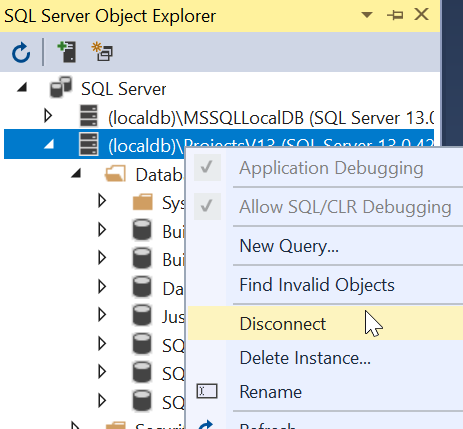
    All of this is configurable, so you can set things to work in whatever manner works best for you. If you typically have a development instance, either local or remote, you can easily use those instead, and you’ll never need to worry about LocalDB. In fact, if this bothers you, you can disconnect or even delete the instance.

    2018-09-18 20_32_02- 

    LocalDB is a lightweight way to work with SQL Server, but you don’t need to use it.

  • Learn about SQL Source Control in Redgate University

    I love the SQL Source Control product from Redgate. It’s not perfect, and it can be slow to run at times, but the simplicity of what it does, of getting my code quickly and easily to a VCS is fantastic. I really appreciate it.

    This is one of the tools I enjoy demoing and showing off how to ensure you get all the code from you system stored away. I wish I had been able to purchase this product years ago when I was building database software as my day job.

    We now have a course to help you learn how to use SQL Source Control at Redgate University. This is a series of 10 sections (as of now) that cover a variety of ways in which you can capture development code with SQL Source Control and even deploy those changes to another database.

    Give the course a try, and see what you might learn about this product. We’ve got other courses as at Redgate University, with more coming all the time.

    If you’ve got ideas or suggestions for the courses, send us a note at https://www.red-gate.com/hub/university.

  • SQL in the City Summits–Coming to New York, London, and Chicago

    I love New York. Every time I get to travel to the city, I get excited and look forward to the trip. I was able to spend a night in Brooklyn earlier this year, touring a college with my daughter. Now I’m very lucky to get a second trip this year, with Redgate for a SQL in the City Summit.

    Social all 1200x628

    We have 3 live Summit events coming in October to a few cities: New York, London, and Chicago. These are in person events where we have presentations scheduled for customers and potential customers. These are thought provoking talks and interactive workshops, aimed a C-level and senior staff. If you’re got someone in your organization that might be interested, pass this link along: https://www.red-gate.com/hub/events/redgate-events/sqlinthecity-summit/

    We have Redgate speakers and expert guests, including Bob Ward of Microsoft. If you have the chance to go, contact your account rep today and get a code to register. These are paid events, though a limited number of free tickets are available.

    The schedule is:

    This will be a busy month of travel for me, with the PASS Summit coming the week after Chicago. It should be an inspirational and exciting set of events, and I hope to see some of your at one of these Summits.

  • Redgate University is Growing

    There isn’t a degree to be gained, but you can get a lot of information about Redgate products at Redgate University. This is the place to learn how to best use the products. This is a work in progress and we’ve started with a few of the more popular items, but we should grow the list over time.

    I’m in a few of the SQL Monitor classes, helping to teach them. The classes are designed to be short and focused on one topic. If you watch them in order, you’ll get a flow of how to use the product and what features are available.

    This is a great idea to help someone bone up on their tools and learn to get the most out of them. Even if you use some of our products regularly, you might want to skip through the modules and see what we cover. I’m sure there are things for you to learn.

    I think I’m on the hook to record a few later this year, but we’ll see how this goes. These are quick to record, but there is a lot of prep to get material ready.

    If there are things you’d like to see, either within one of the courses up there or in another product, let us know. The email for ideas is: university@red-gate.com