Tag: sql server

  • Tracking Logins with Extended Events

    Another post for me that is simple and hopefully serves as an example for people trying to get blogging as#SQLNewBloggers.

    I was building a question the other day on Extended Events and needed to build a new session. One of the easier sessions to build is with the logins, so I decided to use that, and then wrote this post on how to build the session.

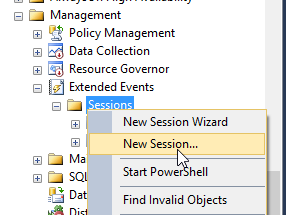
    The first thing is to to to the Management tab in SSMS and then the Extended Events folder. I right click the Sessions folder and select New Session.
    2015-11-18 10_40_06-Cortana

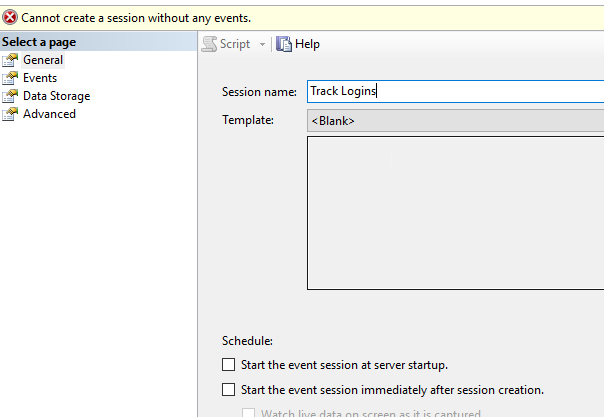
    This gives you a dialog. Like many in SSMS, we start with a name. You could select run at server startup, which I’d do in the case of this being a production system.
    2015-11-18 10_40_55-Photos

    When I click next, I get to the "Events" tab, which lists all events. I’ll scroll down to login and select that. I need to click the arrow to the right.
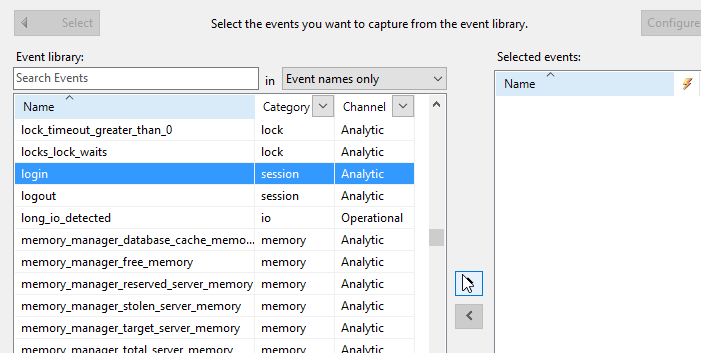
    2015-11-18 10_41_12-Photos

    Once I do that, my event is in the session.
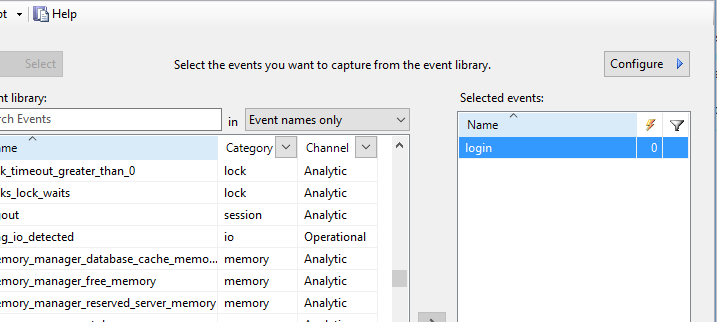
    2015-11-18 10_41_19-Photos

    After I pick the events, I choose the fields I’m going to capture. There is a "Configure" button in the upper right that you click. This scrolls the dialog over.
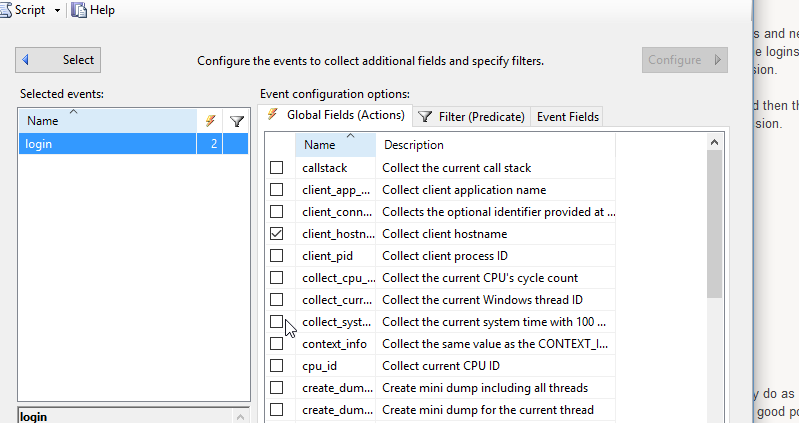
    2015-11-18 10_41_38-Photos

    I can select any number of fields for capture. You can see I’ve picked the client_hostname. I would also add the NT_Username and Username from the list. You could add more, but in this case, I’m more concerned with seeing who’s logged in.

    I could add filters, but I choose not to. I click on Data Storage to determine where to store this data.

    2015-11-18 10_45_59-Photos

    For auditing, I might want a file. In this case, for testing, I’ll use the ring buffer, in memory storage.
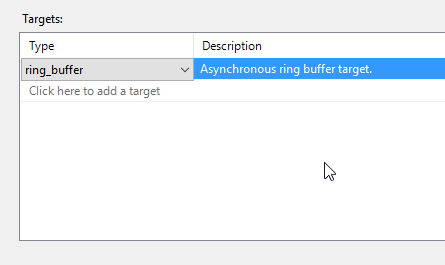
    2015-11-18 10_46_15-Photos

    That’s it for getting the session set up. However it’s not started. To do that, I need to right click the session and select Start.
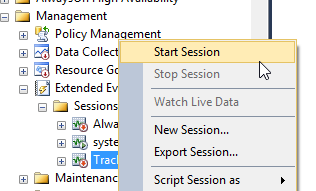
    2015-11-18 10_47_34-Start

    This will allow the server to start collecting data. Is it working? Let’s see. We’ll watch the data. Right click the session again and select Watch Live Data

    2015-11-18 10_47_43-Cortana

    This pops open a window. I usually make this a separate vertical tab group. Once that’s open, I’ll click "New Query" in SSMS, which will log me in again
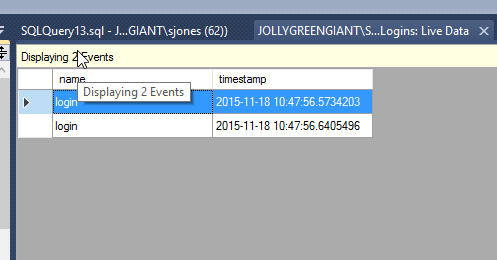
    2015-11-18 10_48_05-Photos

    As you can see, a few events popped up here. I am capturing data. Don’t forget to stop the session after this if you don’t need it.

    SQLNewBlogger

    This post came out of work I was doing, and which I’d likely do as a DBA. However as soon as I got things working and tested, I knew this was a good post. In fact, I got a couple posts from the process. The setup and testing took about 20 minutes, including a little research. However the writing for this was about 10 minutes.

    References

    A few things I used.

  • The Writeable Warm Standby

    I saw a question recently that went like this: I get one full backup from FTP. I’ll get daily log backups through FTP after this, but never another full. I need to restore this daily log backup and allow the group receiving the database to read/write the copy, and then reset it with the new log backup overnight.

    First, this is untenable. At some point you’ll have some issue with transfer, lose a log, or the database will go corrupt. I can guanantee you that at some point you will need another full backup. Not every week, or even every month, but you will need one.

    Second, this is a tough situation. I saw some answers, which I agreed with, but I started thinking about ways to get that data moved. My first thought it use STANDBY and move the data every day to a clean database. I’ve done this before, and in the GB range, even 100s of GB, this can work. It helps if you can whack indexes and constraints on the destination, but a copy of data table-by-table goes fast.

    However then I thought about other ways. You can’t take a backup of a standby database, nor can you take a snapshot. However while searching, I saw an answer to this post on SO.

    TL;DR: copy the mdf/ldf to a new database.

    That was interesting, so I decided to test it. Turns out, it works pretty well. HOWEVER, it’s dangerous, and I think you should be very careful about this. I wouldn’t count on this being production stable, and certainly not data stable. You better have other copies of this data.

    Here’s what I did. First, create a database with some data.

    CREATE DATABASE mydb;
    GO
    USE mydb;
    GO
    CREATE TABLE mytable(id INT);
    GO
    INSERT mytable SELECT 1;
    GO
    

    Next, let’s back this up, take if offline, and then copy files.

    USE master;
    GO
    BACKUP DATABASE mydb
     TO DISK = 'mydb.bak';
    GO
    

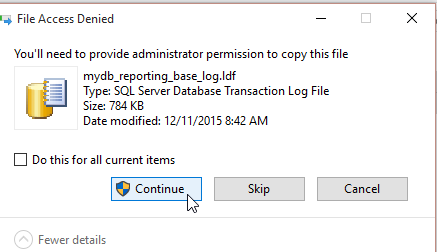
    Now we can copy the files to new files. There are UAC issues here, so you’ll need to add some rights to the files if you do this regularly. I left a comment in my script, but I actually did a CTRL+C,CTRL+V in the data folder, allowing the UAC permissions to work.

    2015-12-11 08_42_22-Photos

    Once that was done, I had new files:

    2015-12-11 08_28_15-Photos

    I tried to run at attach, but got a permissions error:

    Msg 5120, Level 16, State 101, Line 30
    Unable to open the physical file “D:\SQLServer\MSSQL11.MSSQLSERVER\MSSQL\DATA\mydb_reporting.mdf”. Operating system error 5: “5(Access is denied.)”.

    The solution I found was to run SSMS as an administrator. Annoying, but it works.

    At least for the OS error. However, then you get this:

    Msg 1824, Level 16, State 1, Line 35 Cannot attach a database that was being restored.

    You can’t do this. At least not easily.

    You can do this. First, delete the files you copied over, then run this:

    CREATE DATABASE mydb_reporting
    go
    alter database mydb_reporting set offline;

    The next step is to delete the MDF and LDF files, which will be mydb_reporting.mdf and mydb_reporting_log.ldf  by default. I could specify other names, and would if this were something I needed to script.

    Once those files were deleted, I’d next copy my files again and rename them. That would result in this:

    • mydb_reporting_base.mdf –> mydb_reporting.mdf
    • mydb_reporting_base_log.mdf –> mydb_reporting_log.ldf

    Now I can go back to SSMS. In SSMS, I do a simple ALTER.

    ALTER DATABASE MYDB_Reporting SET ONLINE

    Then I can run this:

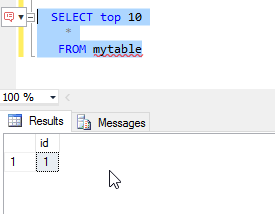
    2015-12-11 09_03_28-Start

    I have a copy of my database. Can I apply logs and move forward? Let’s try. First, let’s add data and make a log backup

    USE mydb
    GO
    INSERT mytable SELECT 99
    GO
    
    BACKUP LOG mydb TO DISK = 'mydblog.trn'   
    GO
    

    Next we restore again. We also set the databases offline again.

    RESTORE LOG mydb_reporting_base
     FROM DISK = 'D:\SQLServer\MSSQL11.MSSQLSERVER\MSSQL\Backup\mydblog.trn'
     WITH  MOVE N'mydb' TO N'D:\SQLServer\MSSQL11.MSSQLSERVER\MSSQL\DATA\mydb_reporting_base.mdf'
        ,  MOVE N'mydb_log' TO N'D:\SQLServer\MSSQL11.MSSQLSERVER\MSSQL\DATA\mydb_reporting_base_log.ldf'
        , STANDBY = 'D:\SQLServer\MSSQL11.MSSQLSERVER\MSSQL\Backup\undo.log';
    GO
    USE master
    GO
    ALTER DATABASE mydb_reporting_base
     SET OFFLINE;
    GO
    ALTER DATABASE mydb_reporting SET OFFLINE
    GO
    

    Once again it’s file copy time. The UAC comes into play again as I copy and rename the _base files. However once that’s done, things work.

    2015-12-11 10_17_02-Photos

    This works, but I am not recommending this as something you should do, especially for critical systems. This can work, but it’s dangerous, and really not supported by MS.

  • Custom Schemas

    One of the things I seem to see more and more is an expanded use of schemas in their development efforts. This isn’t something I had done much in the past as almost half of my career was with SQL Server 2000 or earlier, where we didn’t really have schemas and we were loathe to tie too many objects to owners. However the last decade has had schemas as a first class citizen in all SQL Server versions since 2005.

    I’ve seen a number of software packages use schemas, but it seemed more as a way of separating out development efforts than any well thought out architecture. However there have been a few interesting uses of schemas as a way of duplicating tables for various uses. ETL and auditing are two of the more common uses, though there have been others.

    I ran into an interesting approach recently that I found interesting. A group of developers had added a new schema to separate out their custom objects from all other objects in the database. They did this as the database was created by, and maintained by a third party application. They wanted to create new objects, but wanted them separate from the vendor’s objects, and used a new schema.

    I thought this was a good idea and wondered who else be doing something similar. This Friday, I wanted to ask the question of the rest of you.

    Do you have a custom or reporting schema as a way to separate objects from those that aren’t under your development control?

    Let us know if you’ve created some interesting use of schemas. Or are there reasons you don’t use schemas? Have you never considered the advantages of using schemas to group  objects in their own section of the database?

    I think schemas can be a powerful way of grouping objects, applying separate security, and  organizing your database in a way that makes it easier for developers, and report writers, to manage the complex objects that may clutter up your database.

    Steve Jones

    The Voice of the DBA Podcast

    Listen to the MP3 Audio ( 2.2MB) podcast or subscribe to the feed at iTunes and LibSyn.

  • Using Automated Tests to Raise Code Quality

    Abstract

    Agile development practices can speed the development of applications and increase the rate at which you can deploy features for your customers. But unless you include a high level of test coverage in your code, these practices can also increase the number of bugs that are released. Databases can be particularly challenging for developers. This session examines database refactorings that introduce bugs, which are detected by automated tests. This approach allows developers to rapidly fix their code before a customer is affected.

    Level: 200

    Demos

    These are the demos shown in this talk.

    • Adding test data inline
    • Added test data in a procedure
    • Adding test data from a separate set of tables.
    • Exclusions to SQL Cop or other tests with Extended Properties.
    • Using FakeFunction
    • Using SpyProcedure
    • The boundary issues with multiple requirements for a function.
    • 0-1-Some testing
    • Catching dependencies.

    Downloads

    Here are the downloads for the talk.