Tag: sql server

  • 2013 in Review

    Last year I took a few guesses about 2013. I was right about smartphones, and encryption has slowly become more important late in 2013. BYOD has become a hot topic that continues to be a problem, but I think most companies are resigned to the fact that they’ll have to accept and co-exist with personal devices in the workplace.

    As far as SQL Server goes, it seems more and more companies are looking to implement SSD storage, but I’m not sure it’s the standard for new hardware. I see plenty of people still stuck with spinning disks as part of their SAN storage, or even in local disks. We didn’t move to dedicated SAN storage for SQL Servers, at least not in any large wave. However there has been trends for some companies moving away from SANs and back to local storage, especially for the people that are thinking about flash storage, like the FusionIO cards.

    It has felt like a quiet year for SQL Server in 2013. Microsoft is in between releases, with 2012 slowly maturing this part year as people adopt it, find issues, and publish guidance, solutions, or workarounds. Some of us have been following the upcoming SQL Server 2014 release, but that is still months away from RTM. There were two big changes with SQL Server this year: HDInsight (Hadoop) and the growth of SQL Server in the Azure cloud as Windows Azure SQL Database. While both of those were used by a small group of SQL Server pros, they have dramatically expanded the cases and situations in which SQL Server can be used.

    In the SQL Server community, I don’t think we had any radical changes occur. We had a lot of SQL Saturdays in 2013 ( 84 by my count), a new conference (SQL Interesction) along with ones we’ve had for years (SQL Bits, PASS Summit, SQL Connections). We continued to publish lots of information at SQLServerCentral and Database Weekly, and there was no shortage of new bloggers and writers sharing their knowledge with the community.

    In the database world, there was continued media attention given to a variety of RDBMSes and NoSQL platforms, but all the news has felt evolutionary, not revolutionary. The world at large continues to underestimate the importance of data and data professionals, but slowly more managers and companies are having more respect for the jobs that we do. However, despite the many people that were awarded MCMs before the termination of that program, I still find large numbers of SQL Server professionals learn the bare minimum they need to acceptably do their job. I keep hoping that the efforts of sites like SQLServerCentral and events like SQL Saturday will change that, but it feels like we’ve barely made a dent in our profession.

    However we’ll keep trying, and encouraging people, and I hope you continue to do the same.

    Steve Jones

    Video and Audio versions

    Today’s podcast features music by Everyday Jones. No relation, but I stumbled on to them and really like the music. Support this great duo at www.everydayjones.com.

    Follow Steve Jones on Twitter to find links and database related items and announcements.
    Steve Jones Windows Media Video ( 20.9MB) feed

    MP4 iPod Video ( 23.9MB) feed

    MP3 Audio ( 4.9MB) feed

    Feeds are available at iTunes and Mevio

    To submit an article, rant or editorial,
    log in to the Contribution Center

  • Memories of 2013

    the holiday season and are not too busy at work.  I hope most of you had a great year in 2013, and with that in mind, I wanted to ask you a simple question:

    What’s your best SQL Server memory of 2013?

    Maybe it was when you solved a problem or completed a project successfully. Maybe it was an event that you enjoyed, like a SQL Saturday or conference? Maybe it was a talk or a conversation you had with another SQL Server professional. Perhaps it was some social event involving SQL Server.

    It could be something you laughed at, a situation that taught you something, or an inspirational moment. Share it with us today, and remember what you enjoy about working in this field.

    I hope you had multiple great memories in 2013 and will make more in 2014. Happy Holidays.

    Steve Jones

    Video and Audio versions

    Today’s podcast features music by Everyday Jones. No relation, but I stumbled on to them and really like the music. Support this great duo at www.everydayjones.com.

    Follow Steve Jones on Twitter to find links and database related items and announcements.
    Steve Jones Windows Media Video ( 9.9MB) feed

    MP4 iPod Video ( 12.1MB) feed

    MP3 Audio ( 2.6MB) feed

    Feeds are available at iTunes and Mevio

    To submit an article, rant or editorial,
    log in to the Contribution Center

  • It’s not the platform

    I agree with Brent. Actually, I’ve felt this way for years when I’ve been asked the SQL Server v Oracle question, or even earlier in my career when I was asked about Windows v Unix. The choice doesn’t matter that much and it’s not really the platform; it’s the people.

    Oracle is often seen as the top platform in our industry for handling relational data, but if you give a copy of Oracle 12C to many of the SQL Server staffs that read this newsletter, and it likely won’t scale too well. At least not until they learn a bit about how the platform works. The same is true of SQL Server, which is often given to many under-trained and under-qualified people with the idea that they’ll just make it work.

    We should all be aware that while platforms can be expensive, they really pale in comparison to the cost of the people that will build software on the platform. You certainly might save money with a cheaper platform if you’re buying software, but don’t forget that additional platforms do need additional training for your staff. As I told a friend recently, anyone can setup SQL Server and get it to run. Until it doesn’t.

    Education and investment in knowledge is one of the most important areas that technologies and their employers can spend time and money on. However, it takes both of them working together to ensure it pays off.

    Steve Jones

    Video and Audio versions

    Today’s podcast features music by Everyday Jones. No relation, but I stumbled on to them and really like the music. Support this great duo at www.everydayjones.com.

    Follow Steve Jones on Twitter to find links and database related items and announcements.
    Steve Jones Windows Media Video ( 13.1MB) feedMP4 iPod Video ( 15.5MB) feed

    MP3 Audio ( 3.3MB) feed

    Feeds are available at iTunes and Mevio

    To submit an article, rant or editorial,
    log in to the Contribution Center

  • Symmetric Keys

    One of the encryption options in SQL Server is symmetric key encryption. This is the type of encryption most people think about when they consider encrypting data. In symmetric key encryption, we use a key to encrypt data, and then also use a key to decrypt data.

    The key used for encryption and decryption is the same in Symmetric Key Encryption. This is why we call this symmetric. Just like with a house lock,

    image

    the key that locks (encrypts) also unlocks (decrypts). This is a picture of my front door and the lock uses a single key.

    In SQL Server, we create a symmetric key and use that to encrypt data and also decrypt it. Here’s a simple example:

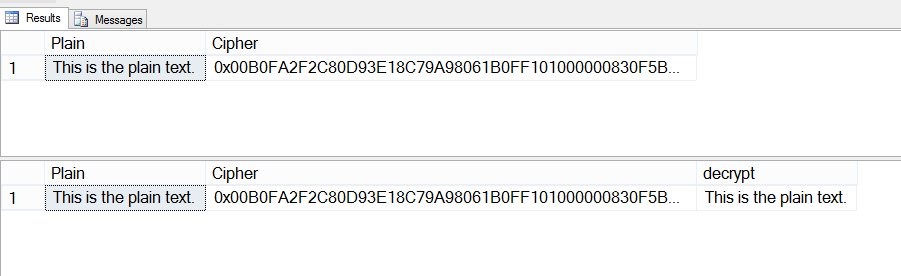
    DECLARE @plain VARCHAR(200), @cipher VARBINARY(5000), @decrypt VARCHAR(200) SELECT @plain = 'This is the plain text.' -- encrypt SELECT @cipher = ENCRYPTBYKEY(key_guid('MyFirstSymKey'),cast(@plain as NVARCHAR(200))); SELECT 'Plain' = @plain , 'Cipher' = @cipher -- decrypt SELECT @decrypt = CAST( DECRYPTBYKEY(@cipher) AS nVARCHAR(200)) SELECT 'Plain' = @plain , 'Cipher' = @cipher , 'decrypt' = @decrypt


    That’s it. If you run it, you see the original text, the encrypted text, and the decrypted text.


    symkey1


    In another post, I’ll go into more options that are available for symmetric key encryption.