Tag: SQLNewBlogger

  • Moving Objects to a New Schema

    Another post for me that is simple and hopefully serves as an example for people trying to get blogging as #SQLNewBloggers.

    I haven’t had the need to move an object from one schema to another in years. Really since SQL Server 2000. I wrote about deleting a user that owns a schema recently, but that’s often a first step. The next thing I might need to do is actually move objects from that schema to a new one.

    I actually ran across this command when I was looking how to move the schema to a new user. There’s actually a parameter for ALTER SCHEMA that will move objects. This is the TRANSFER argument and it works like this.

    I need a new schema for the object. In this case, I’ve got a table called SallyDev.Class. I want to move this to a new schema, and I’ll choose dbo for this example. I often have had developers build in their own schema and then I’ll transfer to the dbo schema, which is almost like a merge of code from one branch (SallyDev) to another (dbo).

    The format of the command is: ALTER SCHEMA <newschema> TRANSFER <object>

    The new schema name is just the name, with brackets if needed. Hint, if you need brackets, rename your schema, please.

    The object is the qualified name of the object, with the old schema. In this case, the command I’ll use is:

    ALTER SCHEMA dbo TRANSFER SallyDev.Class

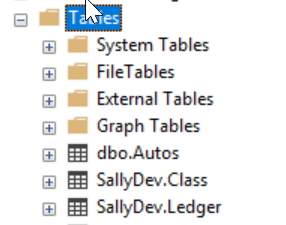
    Here’s my before look:

    2018-09-17 19_12_02-SQLQuery1.sql - dkrSpectre_sql2017.sandbox (DKRSPECTRE_way0u (68))_ - Microsoft

    When I run the code, it works:

    2018-09-17 19_13_03-SQLQuery1.sql - dkrSpectre_sql2017.sandbox (DKRSPECTRE_way0u (68))_ - Microsoft

    Now my object is moved. Success!

    2018-09-17 19_11_37-SQLQuery1.sql - dkrSpectre_sql2017.sandbox (DKRSPECTRE_way0u (68))_ - Microsoft

    SQLNewBlogger

    This is a quick view of a specific skill that can be handy. I won’t use this often, but if my team worked in this flow, or we had an issue, this not only shows how to resolve a single item move, but also helps me remember the command. I hadn’t seen this before, so a quick 10 minute blog is useful.

    This also gives me ideas for other blogs, like how to automate this for a number of objects.

  • Generating a Constrained Random Date–#SQLNewBlogger

    Another post for me that is simple and hopefully serves as an example for people trying to get blogging as #SQLNewBloggers.

    There have been lots of posts on the topic of generating random values, and some great articles. One of my favorites is Jeff Moden’s Generating Test Data: Part 1 – Generating Random Integers and Floats. Part 2 deals with dates, and that’s actually what I needed, but really I needed part 1.

    In my situation, I was helping a customer generate some random data. They had filled a table, Customers, with some data.

    2018-08-24 13_05_44-Microsoft Edge
    The goal was to populate a child table with some data. The child table had a date column that was supposed to be between the Entered and Exit dates in the Customer table.

    My update would have a join, obviously, and I can reference the enter and exit date, but how to get a date between them? My first thought was that I wanted a DATEADD() function. Something like this:

    UPDATE ce
    SET ce.EventTimeStamp = DATEADD( MINUTE, SomeRandomValue, c.CustomerExitedDateTime)), c.CustomerEnteredDateTime)
    FROM   dbo.Customer AS c
    INNER JOIN dbo.CustomerEvent AS ce
    ON ce.CustomerID = c.CustomerID

    The trick is what random value to use? If you look through Jeff’s article, you will see that the trick is to use a tally table and the NEWID() function. However, this doesn’t work:

     UPDATE ce
    SET ce.EventTimeStamp = DATEADD( MINUTE, NEWID(), c.CustomerEnteredDateTime)
    FROM   dbo.Customer AS c
    INNER JOIN dbo.CustomerEvent AS ce
    ON ce.CustomerID = c.CustomerID
    ;

    What I need to do is convert the GUID to a number. In this case, I added CHECKSUM around it, again, as in Jeff’s article. Then use ABS() to enclose this to get all positive numbers.

     UPDATE ce
    SET ce.EventTimeStamp = DATEADD( MINUTE, ABS(CHECKSUM((NEWID())))), c.CustomerEnteredDateTime)
    FROM   dbo.Customer AS c
    INNER JOIN dbo.CustomerEvent AS ce
    ON ce.CustomerID = c.CustomerID
    ;

    This gives me values, but they aren’t constrained. What I need to do is limit the upper random value so that the end time doesn’t exceed the Customer.CustomerExitDateTime for that row.

    To do this, I can constraint a large set of numbers to some value with the modulo function. This will limit what values can appear. The basic script is this:

    UPDATE ce
    SET ce.EventTimeStamp = DATEADD( MINUTE, ABS(CHECKSUM((NEWID())))) % 10, c.CustomerEnteredDateTime)
    FROM   dbo.Customer AS c
    INNER JOIN dbo.CustomerEvent AS ce
    ON ce.CustomerID = c.CustomerID
    ;

    This would give me values between 1 and 0 minutes after the start time, but this doesn’t mean these values won’t be after the exit time. This is also an unrealistic window if most of the time the enter and exit times vary by hours.

    What I did instead was to use the difference between the enter and exit times, with DATEDIFF() as my modulo function. That gives me:

    WITH myTally (n)
    AS
    -- SQL Prompt formatting off
    (SELECT n = ROW_NUMBER() OVER (ORDER BY (SELECT null))
      FROM (VALUES (1), (2), (3), (4), (5), (6), (7), (8), (9), (10)) a(n)
       CROSS JOIN (VALUES (1), (2), (3), (4), (5), (6), (7), (8), (9), (10)) b(n)
    )
    UPDATE ce
    SET ce.EventTimeStamp = DATEADD( MINUTE, ABS(CHECKSUM((NEWID()))) % (DATEDIFF(MINUTE, c.CustomerEnteredDateTime, c.CustomerExitedDateTime)), c.CustomerEnteredDateTime)
    FROM   dbo.Customer AS c
    INNER JOIN dbo.CustomerEvent AS ce
    ON ce.CustomerID = c.CustomerID
    ;

    I run this, and I get the table updated with a random set of values.

    2018-08-24 13_19_08-Microsoft Edge

    SQLNewBlogger

    This was a problem in my daily work. It was a customer, but it could easily be an internal query problem. I spent about 10 minutes grabbing screen shots and taking apart the query I’d built.

    You can do this, too. Show us your mind working with the solutions you write in your own blog.

  • Getting the Role Permissions–#SQLNewBlogger

    Another post for me that is simple and hopefully serves as an example for people trying to get blogging as #SQLNewBloggers.

    If you are wondering what permissions a role has, and don’t want to spend time searching and digging through Books Online, there are a few system procedures that can help. These will give you the permissions for a role, or all roles.

    Let’s see how to use these.

    Server Role Permissions

    Let’s say that you are wondering what a Processadmin can do. There is a procedure, sp_srvrrolepermission, that you can use to get the list of permissions. This can be run with no parameters, in which case you’ll get all roles and all permissions.

    2018-07-03 14_46_01-SQLQuery9.sql - (local)_SQL2016.EmptyFileTest (PLATO_Steve (74))_ - Microsoft SQ

    However, often you’ll want a more manageable set of data that a person can understand. Let’s see what processadmin can do.

    2018-07-03 14_45_47-SQLQuery9.sql - (local)_SQL2016.EmptyFileTest (PLATO_Steve (74))_ - Microsoft SQ

    Only two permissions here, so I can see that granting this isn’t going to affect security or databases.

    Database Roles

    The database has a related procedure, sp_dbfixedrolepermission, that looks for database roles. This can again be run without any parameters, as shown here.

    2018-07-03 14_50_24-SQLQuery9.sql - (local)_SQL2016.EmptyFileTest (PLATO_Steve (74))_ - Microsoft SQ

    If we include a role, we see just those permissions.

    2018-07-03 14_50_51-SQLQuery9.sql - (local)_SQL2016.EmptyFileTest (PLATO_Steve (74))_ - Microsoft SQ

    SQLNewBlogger

    This is a short post, really about 5 minutes, based on my need to solve another issue. However, this is something a DBA should know, and it’s something I’ll likely use again.

  • Solving Ken’s FizzBuzz 3D–#SQLNewBlogger

    Another post for me that is simple and hopefully serves as an example for people trying to get blogging as #SQLNewBloggers.

    I like the FizzBuzz test. It’s cute and fun, and I’ve had my kids solve it, just to think about what it means to structure a simple problem. It’s not a great test of whether you’re a good programmer, but if you can’t solve this, you probably aren’t.

    Ken Fisher set up a challenge to solve FizzBuzz with SQL, but in a 3D manner. He added a few challenge to this, like no modulus operator. I don’t know why you’d deliberately avoid using this, but it’s a programming exercise, so why not. I took the challenges because, well, Ken asked me do.

    SQLNewBlogger

    I’m putting this part first, because this is a good exercise, and a great post for your blog. Solve this yourself first, and write about it. Then you can read my code.

    The coding part of this probably took me 20-25 minutes to do. I worked on it in a few stages, pausing to do other work and let the solution simmer a bit. I realized a few times that I was making it harder, so the breaks were helpful.

    Writing this up was about 30 minutes, but it made me think about what I’d done.

    Building a Solution

    My first thought with this is I need a tally table. Of course, I’m building a set of coordinates from 1 to 100. I started here.

    WITH myTally (n)
    AS
    -- SQL Prompt formatting off
    (SELECT n = ROW_NUMBER() OVER (ORDER BY (SELECT null))
      FROM (VALUES (1), (2), (3), (4), (5), (6), (7), (8), (9), (10)) a(n)
       CROSS JOIN (VALUES (1), (2), (3), (4), (5), (6), (7), (8), (9), (10)) b(n)
    )
    , cteCoordinates (x, y, z)
    -- SQL Prompt formatting on
    AS
    (
    SELECT a.n ,
            b.n ,
            c.n
    FROM myTally AS a
         CROSS JOIN myTally AS b
         CROSS JOIN myTally AS c
    )
    SELECT x, y, z
    FROM cteCoordinates;

    This gave me my list of numbers.

    2018-07-02 14_40_48-SQLQuery4.sql - (local)_SQL2016.sandbox (vstsbuild (53))_ - Microsoft SQL Server

    My next step was to think about the FizzBuzz test. I can’t use Modulo, so how can I determine if I am evenly divisible by 3? I decided to look at the simple division operator. I got these results, but notice anything?

    2018-07-02 14_42_55-SQLQuery4.sql - (local)_SQL2016.sandbox (vstsbuild (53))_ - Microsoft SQL Server

    I get a new number every time the division changes. Immediately I think of window functions here. So I decided to do some checking here. Since I’m looking for a change, I went with a LAG function.

    If the LAG isn’t equal to the current value, I’ve had a change. Therefore, a Fizz.

    2018-07-02 14_45_44-SQLQuery4.sql - (local)_SQL2016.sandbox (vstsbuild (53))_ - Microsoft SQL Server

    Let’s clean this up to show Fizz and add the Buzz with a 5.

    2018-07-02 14_47_27-SQLQuery4.sql - (local)_SQL2016.sandbox (vstsbuild (53))_ - Microsoft SQL Server

    I’m getting there, but what about FizzBuzz? Well, the CASE will execute in order, so let’s add that one at the top.

    2018-07-02 14_49_00-SQLQuery4.sql - (local)_SQL2016.sandbox (vstsbuild (53))_ - Microsoft SQL Server

    I’ve mostly solved this, so let’s put this in my query. I’ll substitute the CASE in for each item of the cross join. I get this:

    WITH myTally (n)
    AS
    -- SQL Prompt formatting off
    (SELECT n = ROW_NUMBER() OVER (ORDER BY (SELECT null))
      FROM (VALUES (1), (2), (3), (4), (5), (6), (7), (8), (9), (10)) a(n)
       CROSS JOIN (VALUES (1), (2), (3), (4), (5), (6), (7), (8), (9), (10)) b(n)
    ),
    cteCoordinates (x, y, z)
    AS
    ( SELECT
    CASE
         WHEN ( a.n/3 != LAG(a.n/3, 1, 0) OVER (ORDER BY a.n)
           AND  a.n/5 != LAG(a.n/5, 1, 0) OVER (ORDER BY a.n)
             )THEN 'FizzBuzz'
         WHEN a.n/3 != LAG(a.n/3, 1, 0) OVER (ORDER BY a.n) THEN 'Fizz'
         WHEN a.n/5 != LAG(a.n/5, 1, 0) OVER (ORDER BY a.n) THEN 'Buzz'
         ELSE CAST(a.n AS VARCHAR(8)) END,
    case WHEN ( b.n/3 != LAG(b.n/3, 1, 0) OVER (ORDER BY b.n)
           AND   b.n/5 != LAG(b.n/5, 1, 0) OVER (ORDER BY b.n)
             )THEN 'FizzBuzz'
         WHEN b.n/3 != LAG(b.n/3, 1, 0) OVER (ORDER BY b.n) THEN 'Fizz'
         WHEN b.n/5 != LAG(b.n/5, 1, 0) OVER (ORDER BY b.n) THEN 'Buzz'
         ELSE CAST(b.n AS VARCHAR(8)) END,
    case WHEN ( c.n/3 != LAG(c.n/3, 1, 0) OVER (ORDER BY c.n)
           AND  c.n/5 != LAG(c.n/5, 1, 0) OVER (ORDER BY c.n)
             )THEN 'FizzBuzz'
         WHEN c.n/3 != LAG(c.n/3, 1, 0) OVER (ORDER BY c.n) THEN 'Fizz'
         WHEN c.n/5 != LAG(c.n/5, 1, 0) OVER (ORDER BY c.n) THEN 'Buzz'
         ELSE CAST(c.n AS VARCHAR(8)) END
        FROM mytally a
        CROSS JOIN mytally b
        CROSS JOIN mytally c
    )
    SELECT *
      FROM cteCoordinates
      ORDER BY cteCoordinates.x, cteCoordinates.y, cteCoordinates.z

    That doesn’t seem to work. Even forgetting the ordering, I have a mess.

    2018-07-02 14_58_53-SQLQuery4.sql - (local)_SQL2016.sandbox (vstsbuild (53))_ - Microsoft SQL Server

    At this point I took a break. Clearly I’m overlooking something in my five minutes of work.

    Debugging

    Let’s move the items around and get some ideas here. I’ll get the actual numbers and then the FizzBuzz results. When I print the coordinate values along with the decodes, I see this.

    2018-07-02 15_04_06-SQLQuery4.sql - (local)_SQL2016.sandbox (vstsbuild (53))_ - Microsoft SQL Server

    What’s my error? I’m not thinking of LAG() correctly. This is by row, and the lagging for the x and y coordinates (the first two columns), aren’t changing at the same rate.

    Aha.

    Let’s change this. I’ll setup a simpler CTE first, one that takes the values from 1-100 and returns the value as well as the FizzBuzz calculation. This gives me this code:

    WITH myTally (n)
    AS
    (
    SELECT n = ROW_NUMBER() OVER (ORDER BY (SELECT NULL))
    FROM
    -- SQL Prompt formatting off
    (    VALUES (1) ,(2) ,(3) ,(4) ,(5) ,(6) ,(7) ,(8) ,(9) ,(10)) AS a (n)
         CROSS JOIN    ( VALUES (1), (2), (3), (4), (5), (6), (7), (8), (9), (10) ) AS b (n)
         CROSS JOIN    ( VALUES (1), (2), (3), (4), (5), (6), (7), (8), (9), (10) ) AS c (n)
    -- SQL Prompt formatting on
    ) ,
          cteFizzBuzz (x, n)
    AS
    (
    SELECT CASE
                WHEN (n / 3 != LAG(n / 3, 1, 0) OVER (ORDER BY n)) AND (n / 5 != LAG(n / 5, 1, 0) OVER (ORDER BY n))
                   THEN 'FizzBuzz'
                WHEN n / 3 != LAG(n / 3, 1, 0) OVER (ORDER BY n) THEN
                    'Fizz'
                WHEN n / 5 != LAG(n / 5, 1, 0) OVER (ORDER BY n) THEN
                    'Buzz'
                ELSE
                    CAST(n AS VARCHAR(8))
            END, n
    FROM myTally
    ) ,    cteCoordinates (x, y, z)

    Now that I have this, let’s build the coordinates now. I’ll use the first set of code above as an example, and cross join the cteFizzBuzz with itself. I’ll make this the third CTE.

    ) ,    cteFinal (x, y, z, a, b, c)
    AS
    (
    SELECT a.n, b.n, c.n, a.x, b.x, c.x
    FROM           cteFizzBuzz AS a
         CROSS JOIN cteFizzBuzz AS b
         CROSS JOIN cteFizzBuzz AS c
    )

    Note that I’m returning the original values (for sorting) and the calculated FizzBuzz values, which are characters. If I didn’t care about this, I could ignore the first few columns.

    In my outer query, I display the words, but order by the numbers.

    SELECT 
        c.a, c.b, c.c
      FROM cteFinal c
      ORDER BY c.x, c.y, c.z

    This gives me the answer (scrolled down to show a few cases).

    2018-07-02 15_12_18-SQLQuery5.sql - (local)_SQL2016.sandbox (vstsbuild (54))_ - Microsoft SQL Server

    On my machine, this takes about 4s to run. Not bad, and probably not optimal. The query plan is a mess, but this is for fun in a quick run, so let’s leave this  for now.

    2018-07-02 15_14_08-SQLQuery5.sql - (local)_SQL2016.sandbox (vstsbuild (54))_ - Microsoft SQL Server

    There are likely better solutions. I’m not an optimization guy out of the box. I get things done first, then I’ll go back and evaluate some time to tune things. In this case, adding in 3 more values (to 300) takes 1:58s. Going to 500 rows caused an SSMS out of memory error.

    If I send the results to a temp table, things are better:

    • 100x100x100 (1,000,000 rows) – 00:01
    • 300x300x300 (27,000,000 rows) – 00:06
    • 500 x 500 x 500 (125,000,000 rows)  – 00:29
    • 1000x1000x1000 (1,000,000,000 rows) – 6:48

    Note, don’t send results to the client if you don’t need to.