Tag: syndicated

  • Lessons from the Phoenix Project–Leave Slack

    Not @Slack, but slack time, time when you aren’t buried on a particular project.

    In the book, The Phoenix Project, the Brent character is the jack of all trades, the one that everyone goes to to fix and solve problems. He gets tasked with important projects and work, which means he’s always busy. I’ve been in this position, and a few of you are likely depended upon like this at your job.

    Slowly, the other characters start to realize that if Brent is fire fighting, or he’s on a long project, then he can’t get other things done. He likes and wants to complete work, something most of us do, which means that unless he has windows to tackle new work, he never gets to new work.

    It’s important to break work down and work in small windows. It’s also important to ahve some free time available for anything that comes up. That way if there is something important, you can tackle it without subjecting that item to a long delay. If you also find that some work can be handled by others or isn’t important, you have a break to switch to something else and leave the less important project behind.

    This comes from flow of work and theory of constraints, outlined in The Goal, from manufacturing. Ensuring that some resource is always busy doesn’t make sense from an flow standpoint. This is discussed in the book, Slack, as well.

    If you haven’t read The Phoenix Project, it’s a quick and easy read. A little silly, somewhat exaggerated, but it makes a point that’s worth making in how we work in technology.

  • T-SQL Tuesday #109–Influence

    tsqltuesdayThis month’s T-SQL Tuesday host is Jason Brimhall. He asks everyone to write about influence, which is something that I should know about and think I have, but am somewhat uncomfortable writing about.

    That being said, here’s my entry this month.

    Influencing Others

    One of the motivations behind creating SQLServerCentral was to educate and help others. Our goal (Andy, Brian, myself) was to try and find ways that we’d had success, solved problems, or handled challenges and share that with others by writing articles, answering questions, and creating questions for our Question of the Day quiz.

    Across the years as I’ve done that, and I’ve written many editorials, there have been plenty of occasions to meet members of the SQLServerCentral community. Many of them have thanked me or talked about how the site and community made a difference in their careers, which is something I’m quite proud of. Helping others is a form or volunteerism and service, and while this is a vocation for me, it’s also a passion.

    One of the things I think that I’m most proud of us influencing others to also give back and share. I can only do so much, but if I can also convince others to share their knowledge, there is a level of helping and sharing that grows exponentially to everyone in our #SQLFamily. To that end, I have two stories.

    One is about blogging, which I tend to do regularly. I had a friend, someone I met years ago that wanted to start blogging and asked me for some hints and idea. I shared a few things that help me, but also challenged this individual to set a goal for writing. They did, and years later, they have quite a blog. Many of you have heard of this person, but I won’t mention the name here. That’s not important. What is important is they have helped many others and continue to do so today.

    The other story is a person I met at a user group meeting. I was giving a presentation and this individual had some intelligent questions to ask. Over a few meetings, as I talked with this person, I realized they were someone with a lot of talent on the data platform and encouraged them to think about speaking. I did this regularly, and while it took over a year, this person now has spoken at many events, including the PASS Summit.

    It can be scary and intimidating to share knowledge with others publicly, but it is also immensely rewarding and a way of helping others walk the path you have already covered. Perhaps I’ll influence one of you reading today to share some of what you’ve learned with those hungry to learn.

  • SQL Census–From the Redgate Foundry

    The Foundry at Redgate Software is our version of Microsoft Research. Kind of. We tackle some projects that are interesting and might make good products at some point, but we’re looking at the in the investigative phase. You can read about the Foundry here.

    Some interesting work is taking place in the Foundry and there’s one project that I think is interesting and solves a problem that many of us have had, but I’m not sure how commercially viable this is in the real world.

    Maybe you can help us learn more.

    SQL Census

    SQL Census started as investigation into the area of security, something that is both very simple in SQL Server, but can also become a cumbersome, complex, nightmare.

    The work has progressed well, and there’s a product available. Sort of. It’s in the stage where we are trying to decide how to move forward with both future development and starting to sell this. For now, you can get a look at the tool and give us some feedback. We’re really looking for more information about

    • Do you need this for compliance purposes?
    • Will this help you better secure your environment
    • Does this meet permission management needs?
    • Something else?

    We’re like to get more users, especially those that have larger environments where there isn’t a single user or role that everyone has.

    If you’re interested, read a little about the product and give it a try.

  • Basic Sequences–#SQLNewBlogger

    Another post for me that is simple and hopefully serves as an example for people trying to get blogging as #SQLNewBloggers.

    I haven’t used sequences much in my work, but I ran into a question recently on how they work, so I decided to play with them a bit.

    Sequences are an object in SQL Server, much like  a table or function. They have a schema, and are numeric values. In fact, the default is a bigint, which I think is both good, and very interesting. Since this will implicitly cast down to an int or other value, that’s good.

    The sequence is created like this:

    CREATE SEQUENCE dbo.SingleIncrement
      AS INT
      START WITH 1
      INCREMENT BY 1;
    GO

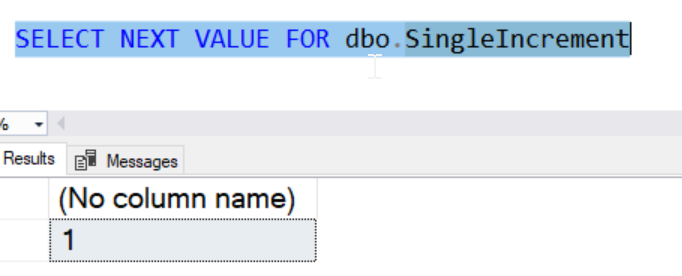
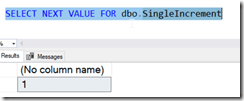
    These can be similar to identity values, and in fact, if I make 5 calls to this object, I’ll get the numbers 1-5 returned. Here I’ve made one call.
    2018-12-04 13_19_48-SQLQuery6.sql - dkrSpectre_SQL2017.sandbox (DKRSPECTRE_way0u (55))_ - Microsoft

    This is interesting, as the NEXT VALUE FOR is what accesses the sequence and returns values. I can use this in some interesting ways. For example, if I have to insert values into a table, I can do this:

    CREATE TABLE SequenceTest
    ( SequenceTestKey INT IDENTITY(1,1)
    , SequenceValue INT
    , SomeChar VARCHAR(10)
    )
    GO
    INSERT dbo.SequenceTest
    (
         SequenceValue,
         SomeChar
    )
    VALUES
       (NEXT VALUE FOR dbo.SingleIncrement, 'AAAA')
    , (NEXT VALUE FOR dbo.SingleIncrement, 'BBBB')
    , (NEXT VALUE FOR dbo.SingleIncrement, 'CCCC')
    , (NEXT VALUE FOR dbo.SingleIncrement, 'DDDD')
    , (NEXT VALUE FOR dbo.SingleIncrement, 'EEEE')

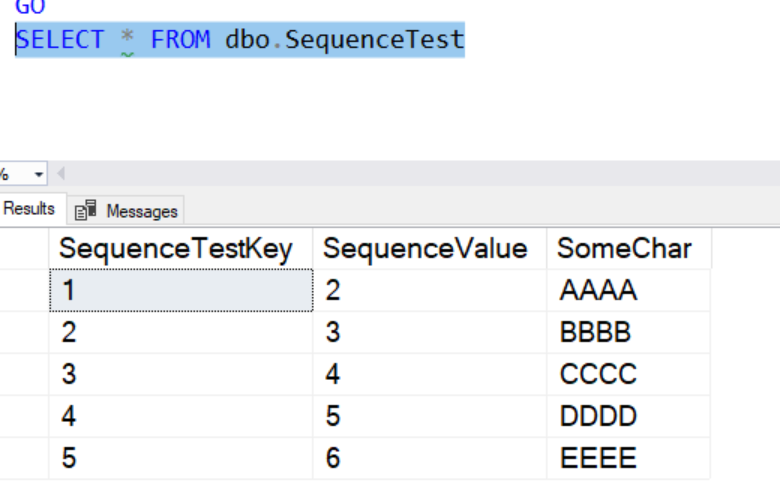
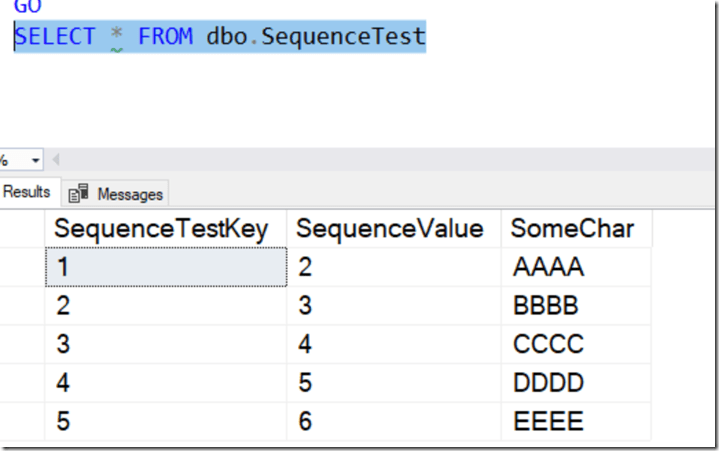
    When I query the table, I see:
    2018-12-04 13_22_50-SQLQuery6.sql - dkrSpectre_SQL2017.sandbox (DKRSPECTRE_way0u (55))_ - Microsoft

    Notice that the sequence number is off by one from the identity. This because I first accessed the sequence above.

    The sequence is independent of a table or columns, unlike the identity. this means, I can keep the sequence numbers going between tables. For example, let’s create another table.

    CREATE TABLE dbo.NewSequenceTest
    ( NewSequenceKey INT IDENTITY(1,1)
    , SequenceValue INT
    , SomeChar VARCHAR(10)
    )
    GO

    Now, we can run some inserts to both tables and see what we get.

    INSERT dbo.NewSequenceTest VALUES (NEXT VALUE FOR dbo.SingleIncrement, 'FFFF')
    INSERT dbo.SequenceTest    VALUES  (NEXT VALUE FOR dbo.SingleIncrement, 'GGGG')
    INSERT dbo.NewSequenceTest VALUES (NEXT VALUE FOR dbo.SingleIncrement, 'HHHH')
    INSERT dbo.SequenceTest    VALUES  (NEXT VALUE FOR dbo.SingleIncrement, 'IIII')
    INSERT dbo.NewSequenceTest VALUES (NEXT VALUE FOR dbo.SingleIncrement, 'JJJJ')

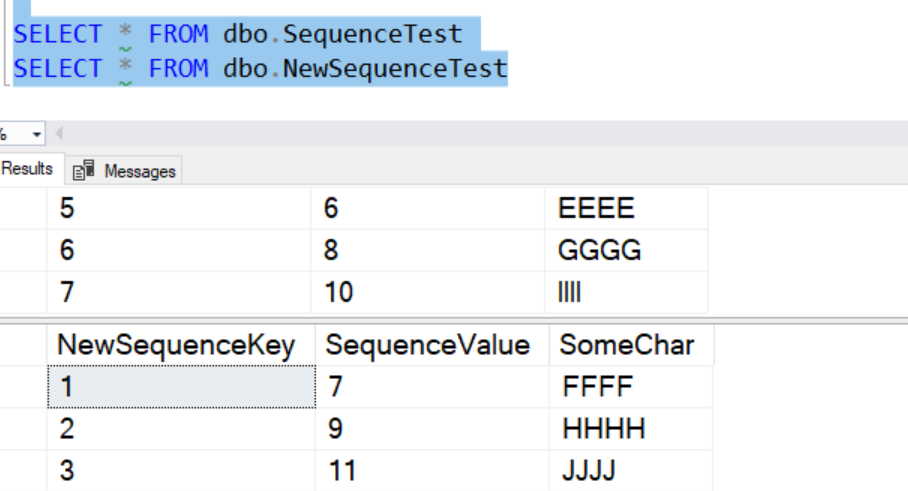
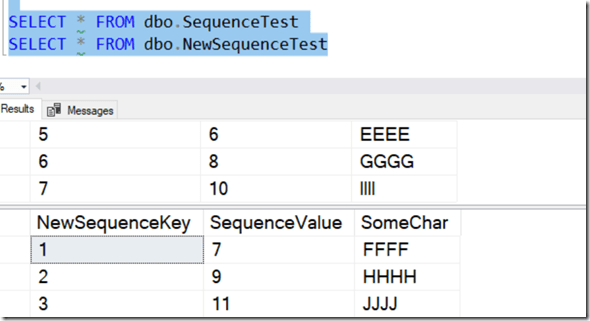
    After running the inserts, I’ll look at both tables. Notice that the values for the sequence are interleaved between the tables. The first insert to the new table has the value, 7, which is the next value for the sequence after running the inserts for the first table.
    2018-12-04 13_27_14-SQLQuery6.sql - dkrSpectre_SQL2017.sandbox (DKRSPECTRE_way0u (55))_ - Microsoft

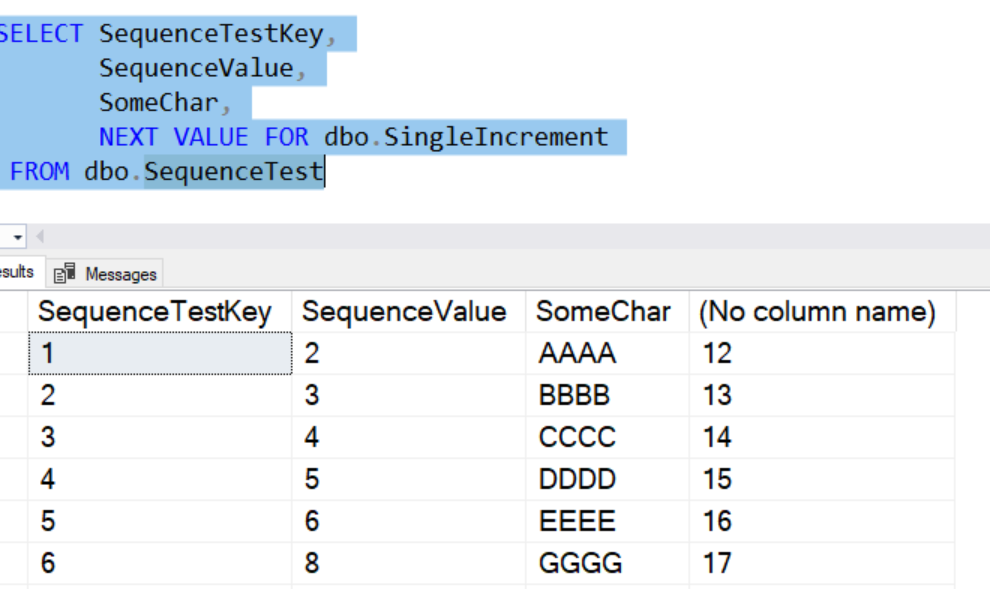
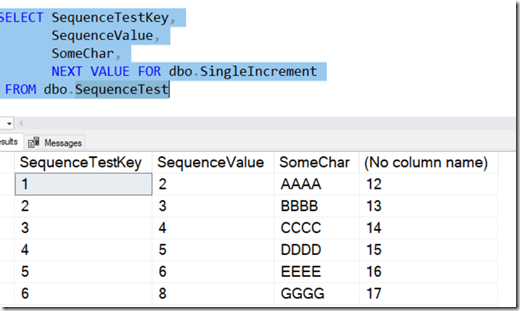
    In these tests, I’ve used 11 values so far. I can continue to use values, not just for inserts, but elsewhere.
    2018-12-04 13_34_02-SQLQuery6.sql - dkrSpectre_SQL2017.sandbox (DKRSPECTRE_way0u (55))_ - Microsoft

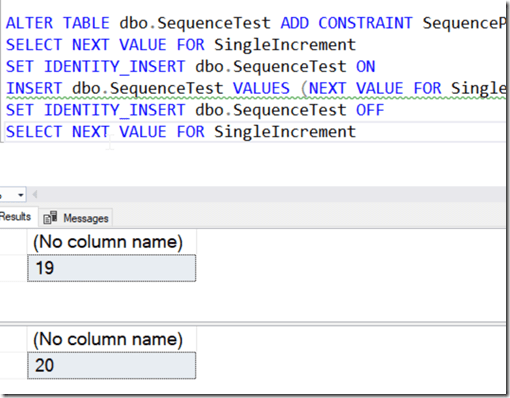
    This behavior is both fun, handy, and useful, but also dangerous. These values get used when I query them, whether the inserts work or not. Here’s a short test to look at this:

    ALTER TABLE dbo.SequenceTest ADD CONSTRAINT SequencePK PRIMARY KEY (SequenceTestKey)
    SELECT NEXT VALUE FOR SingleIncrement
    SET IDENTITY_INSERT dbo.SequenceTest ON
    INSERT dbo.SequenceTest VALUES (NEXT VALUE FOR SingleIncrement, 'ZZZZ')
    SET IDENTITY_INSERT dbo.SequenceTest OFF
    SELECT NEXT VALUE FOR SingleIncrement

    This gives me an error:

    2018-12-04 13_36_52-SQLQuery6.sql - dkrSpectre_SQL2017.sandbox (DKRSPECTRE_way0u (55))_ - Microsoft

    and I can see the last SELECT has the next sequence value.
    2018-12-04 13_36_45-SQLQuery6.sql - dkrSpectre_SQL2017.sandbox (DKRSPECTRE_way0u (55))_ - Microsoft

    There are a lot more to sequences, but I’ve gone on long enough here. This is a good set of basics to experiment further, which I’ll do in future posts.

    SQLNewBlogger

    This post went on longer than expected, and it was more of a 15-20 minute writeup as I set up a couple quick examples, tore them down, and rebuilt them with screenshots for the post.

    This is a place where I can show I’ve started to learn more, and by continuing with other items in this series, I’ll show some regular learning.