Tag: syndicated

  • A Week to SQL Saturday #393 – Redmond

    Only my second SQL Saturday of the year (wow), but SQL Saturday #393 is next week in Redmond, WA. This is my first time at a SQL Saturday in Washington, though I’ve been to the area many times. I’m looking forward to the trip up with a couple days in the Seattle area and getting the chance to catch up with some friends.

    I’ll be talking tSQLt and testing at the event, and the full schedule has a lot of great sessions to choose from. If you’re in the area on May 16, 2015, I’d urge you to register and come by for the day.

    If you can’t make it, hopefully I’ll see you at another event soon.

  • PSA: Update Your PASS Profile

    I got my annual two emails from the PASS organization with the notification to update my profile to vote. I’m not sure why I get two emails to two different email addresses when I’ve only logged into one profile account in the last six or seven years, but I’m sure the data pros at PASS will deupe their list one of these days.

    Last year there were issues with voting and eligibility as many PASS members never logged into their profiles and weren’t seen as eligible to vote.

    This is your Public Service Announcement.

    If you didn’t get the email, or ignored it, go to sqlpass.org and log into your profile. I assume you can do that.

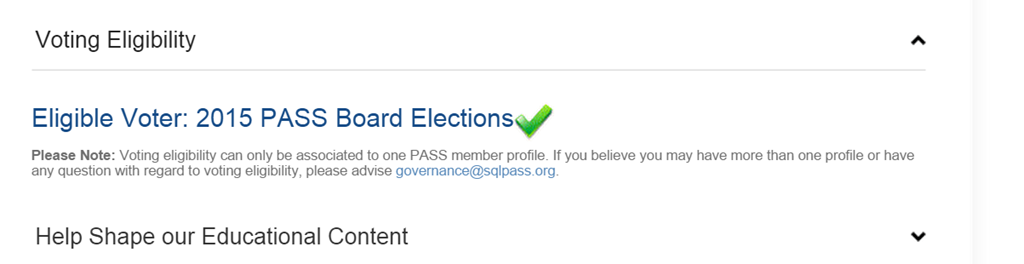
    Once you do that, you should see this checkbox in your profile. If you don’t, contact PASS

    passvote

    This is what  the email says.

    pass_update

    If you didn’t get one and think you can vote, contact PASS and let them know.

  • Reframing to Overcome Filtered Index Limitations

    I’m continuing on with the Blogger’s challenge in this post.

    Turning the Problem Around

    In the last post, I wrote about limitations in filtered indexes. I proposed that my table had lots of data with NULL or blank spaces in the gender column, and I wanted to avoid indexing those rows. I tried this code

    CREATE INDEX Users_Gender_Filtered2
     ON Users (gender)
      WHERE (gender IS NOT NULL OR gender = ' ');


    However, that failed. I can’t use two sets of criteria in the filtered index. But I can use one, so I need to re-frame the problem.

    If I look at the data, I have four choices: ‘M’, ‘F’, NULL, ‘ ‘. I can group two of those choices together, looking for a positive (matching) set of data rather than a negative (non-matching set. The easy way to do that is with an IN clause.

    CREATE INDEX Users_Gender_Filtered2
     ON Users (gender)
      WHERE gender IN ('M', 'F');


    This works, and I’ve got a filtered index. In the real world, I’d actually drop the first index (gender is not null), and only go with this one.

    References

    A few places I used to research this post.

    Quick and Easy Blogging

    This post occurred to me as I was writing the other post. I almost added a note on turning the index around, but realized this is a separate topic, and it makes a nice, second post. This post required < 10 minutes.

    This post continues the April Blogger Challenge is from Ed Leighton-Dick, aimed at new bloggers, but anyone is welcome. I’m trying to motivate and cheer people on.
  • Learn tSQLt and Unit Testing in Philadelphia

    SQL Saturday #390 is in Philadelphia on June 6, 2015. This is my second time attending the event, and not only am I speaking on Saturday, but I’ll be delivering information on Friday at a pre-con.

    My first SQL Saturday pre-con is taking place in Philly. I’m lucky to be asked by Sebastian Meine to co-present a day of training. We’re delivering a precon on Unit Testing in SQL Server with tSQLt. It’s available for the low price of only $99.99 now, with the price rising to $149.99 when the event begins.

    We’ll be covering quite a bit of the framework, showing you the ways in which you can write tests with examples and code that you can run that day. We’d like you to bring a laptop to write tests along with us, but we’ll have the code available later if you want to test back at the office. Here’s our agenda.

    • Introduction to Unit Testing
    • What is tSQLt?
    • Your First Test
    • Executing Tests correctly
    • Effective use of Assertions
    • Separation of Concerns
    • Testing Exceptions
    • Test Case Heuristics
    • Dealing with Test Data
    • Other Types of Testing
    • How Unit Testing fits into your Development Process

    Sebastian is the owner and developer of the tSQLt framework, which I’ve been using quite a bit over the last few years. It’s an amazing project, and really expands the ability of SQL Server developers to build better code and prevent regression issues in their applications. Quite a few SQL Server MVPs and highly successful consultants are using the framework, and I’d urge you to give it a try.

    If you’re in the Philadelphia area and want to jumpstart your testing knowledge, consider coming to our pre-con. It’s a great way to rethink how you write SQL code and put testing in place in a fairly low impact fashion.

    Register today

    Database Source Control

    If you’re in town on Thursday and want to learn about Version Controlling your databases, Redgate is also working with Ike Ellis to put on a full-day workshop covering Database Source Control. It’s $500 for the day, and you’ll get some in-depth knowledge on how to work with SQL Server code and version control as well as participate in hands-on labs that will give you the skills to implement the processes yourself. Find out more..