Tag: syndicated

  • Why Test Table MetaData Tests with tSQLt

    I wrote at SQLServerCentral about using tSQLt to check table metadata. In essence we are testing the API of our table. However, since the table could change, and may need to, what’s the value of having a test fail if the table changes?

    In my mind, I don’t necessarily want to have table structure tests for all my tables. After all, developers need to have flexibility to work with and change tables in our applications. If it’s a pain for a developer to change every table, because a test fails and they have to go change the test, that’s an issue.

    There’s also the problems of a developer changing a table, changing the test, and then having everything pass, without passing along information that a schema change was made.

    I would limit the API tests for a metadata to those tables that are important, with the caveat that anytime someone fails a metadata test, they need to inform the team.

    But Steve, isn’t every table important?

    Yes and no. Certainly all tables should be important to the application in some way, but really many of them are contained in the application. If changes are made, it’s not necessarily a problem to change other objects to catch up to the table change. However, some tables may cross teams or applications and they are an issue.

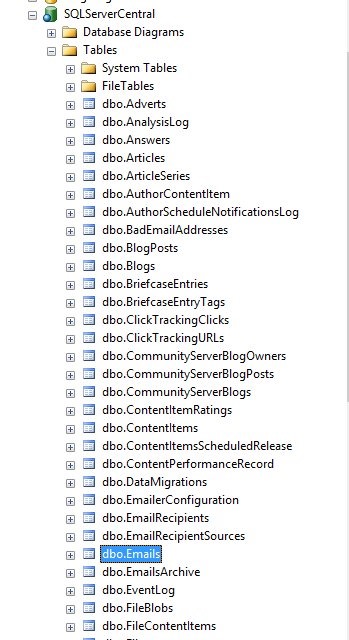
    As an example, I have lots of tables in the SQLServerCentral database.
    tablemetadata_1

    If the Blogs table, or the Articles table changes, then we need to alter stored procedures and possible ASP.NET code for our application. In fact, in this list, pretty much all of these tables could be changed by a developer without a large impact, assuming they’re going to look at the other objects or code affected.

    However the table highlighted, the emails table, along with a few others, are important. These tables not only support SQLServerCentral, the web app, they are also called by our emailer process, which is a completely separate application. In essence, these tables are the opposite of a microservice. They’re shared.

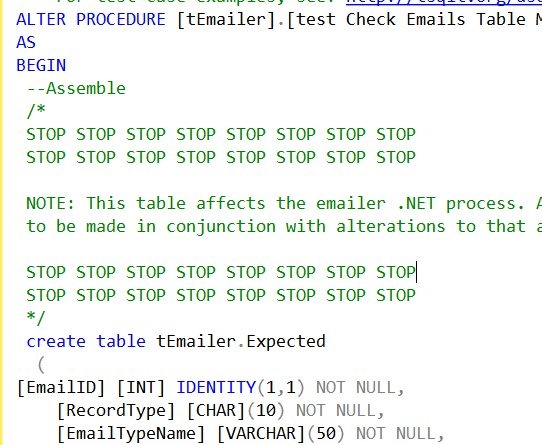
    If someone wants to change the Emails table, I want to be sure that others are informed. In fact, I might choose to include a note in the test header that various groups need to be informed or that the table affects another application. In that case, before a developer went to change the test, they might at least have a chance or noting this has far reaching implications.
    tablemetadata_2

    It’s not a perfect solution, but it does help. The other thing I could do is limit access to metadata tests for various tables/views and merely call these tests in a CI, or other automated, process. That way failures would be public, and a variety of people could be informed, preventing a developer from making changes without a discussion.

    As I mentioned, I wouldn’t do this for all tables. In fact, I’d limit this to particularly sensitive tables that might require lots of rework if they were changed. We want to speed development, and ensure code works, not slow developers down.
  • Quick Installs with Chocolatey–Screen Capture

    I have been looking for a new screen capture tool. I used to use Snagit, but it felt too heavyweight and buggy for me. I just need to snag part of a screen for my job and blog. I used Quick Screen Capture, but in Win 8 it didn’t want to accept my license key. I’d tried a few more, but none really worked well.

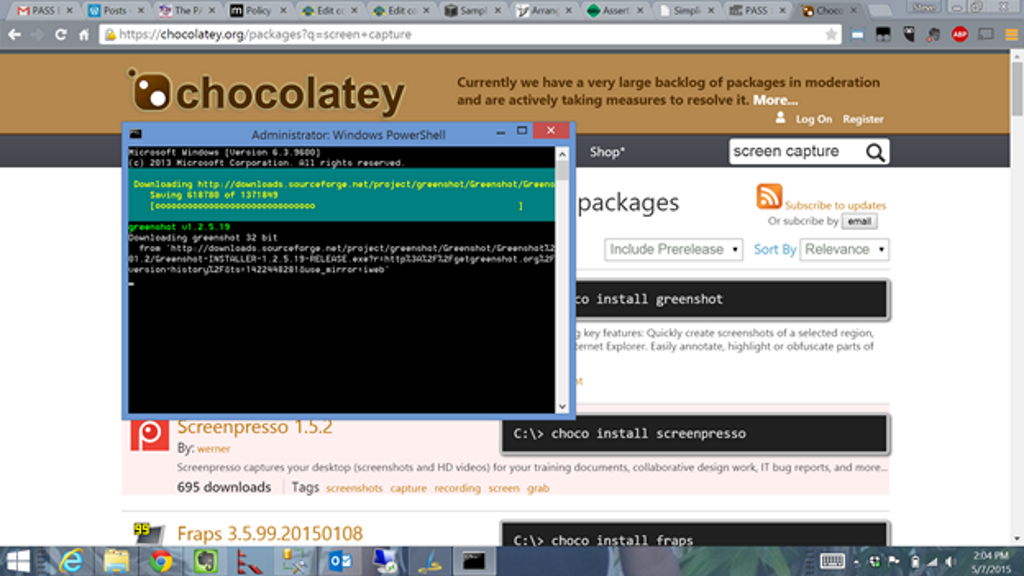
    I mentioned this to Andy Warren on the phone the other day and he told me to try Green something. I decided to do that today, and couldn’t remember the name, so I surfed over to chocolatey.org and searched for screen captures. Sure enough, Greenshot popped up first.

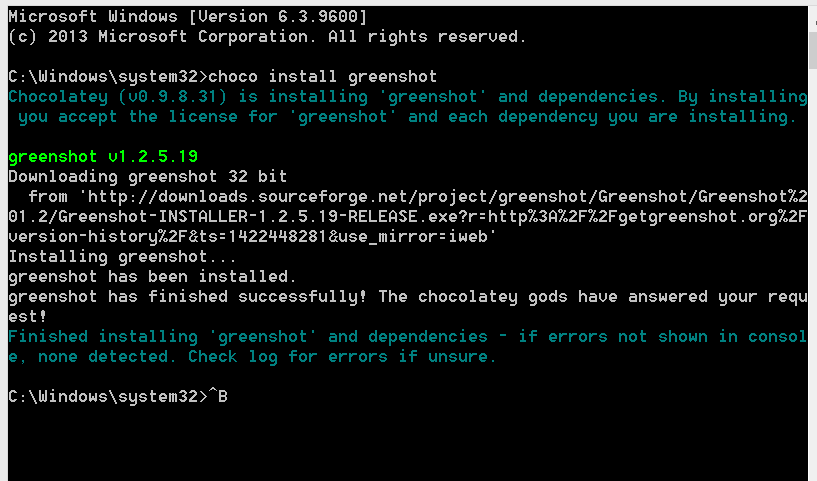
    I quickly opened an administrative level command prompt and typed “choco install greenshot” and went along with my work.

    Chocolatey is an amazing package manager and it started the install for me in the background.

    chocolatey_install

    A few minutes later I noticed the browser pop the greenshot website as the final part of the install. The program was set up with its install defaults and running on my system.

    2015-05-07 14_06_26-Administrator_ Command Prompt

    Chocolatey is amazing and I urge you to look at it for installing software on your system, especially if you’re a developer or consultant that regularly moves hardware or systems.

    If you’re a software developer, get your stuff packaged into here.

  • Getting Database Properties – DatabasePropertyEx()

    Another post for me that is simple and hopefully serves as an example for people trying to get blogging as #SQLNewBloggers.

    I had someone ask me a question about security recently, and while working through the answer, I ran across something I didn’t know well: databasepropertyex(). Here’s a few notes.

    Each database in SQL Server has all sorts of options and settings. Most people (including me) get in the habit of checking here for the information. First we right click the database (after starting SSMS if it isn’t running)

    dbproperty

    Then you get this dialog, with lots of stuff.

    dbproperty2

    And more on the other tabs.

    dbproperty4

    Time consuming, and error prone. As I get older, I find that trying to decide which selection is set for which option becomes harder. I find my finger tracing across the screen. It’s entirely possible I’d make a mistake when glancing at this to check the ArithAbort setting.

    Use T-SQL

    Scripting and querying is usually better. Not the sp_configure scripting where you get a whole list of options, but looking for a particular item. That’s where DatabasePropertyEx() comes in. This lets you query for a database property.

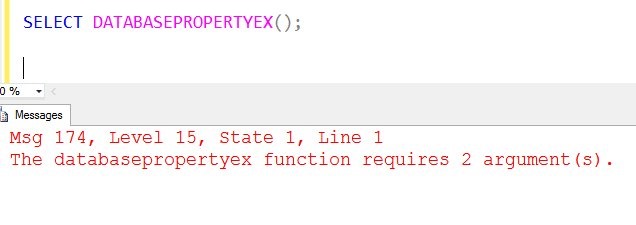
    The problem comes in when you run it. If you run the function, you get little information.

    dbprop_a

    Certainly you can go look at BOL to get more data, but that’s annoying. If I run sp_configure, I get data. However here, nothing. Even if I do what I think would be helpful, with a NULL parameter, I don’t get a list of stuff. SQL Prompt alerted me to the fact that the first parameter is the database, and the second is the property, but that doesn’t work.

    dbprop_b

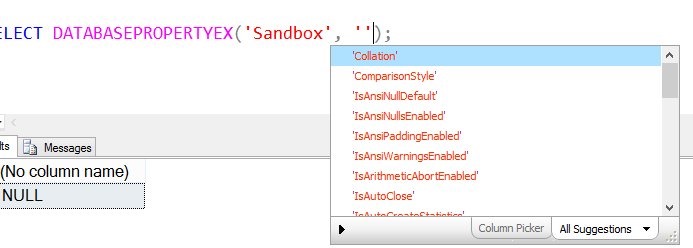
    Fortunately, I have SQL Prompt, so I get this when I put in quotes for the second parameter.

    dbprop_c

    As you can see, the parameters don’t map to the properties, though you can figure out what they mean if you see them. They tend to follow the conventions that most application programmers use (IsAutoClose).

    That’s fine, and it just means you need to have a reference handy for properties to query. I wish MS would give all properties with a NULL parameter, or a link to BOL.

    Writing

    This one took a bit longer to write. Once I realized I didn’t know databasepropertyex() very well, I had to read about it (5 minutes) and experiment a bit. I took some screen shots, which is always cumbersome. As I wrote this, I had to change the wording and ordering a few times to try and convey a simple message. I was originally going to look at more details, but decided to keep this simple and talk about just querying properties.

    This was about 30-40 minutes for me.

    You can do this. Join the #SQLNewBlogger group and start documenting your career. You can see all my posts that fall into this area by looking through the SQLNewBlogger tag here.

    References

  • T-SQL Tuesday #66 – Monitoring SQL Server

    tsqltuesdayThis is a T-SQL Tuesday that not only makes me smile, but makes my boss happy. In fact, I’m sure that quite a few people at Redgate Software, my employer, are thrilled with this topic since we have a product that helps you here: SQL Monitor.

    T-SQL Tuesday #66 has the theme of monitoring, hosted by Catherine Wilhelmsen. Anything having to do with monitoring is fair game. Custom scripts, home grown applications, even third party software.

    If you’re a #SQLNewBlogger, this is a great chance to keep going with a new post. If you can’t write now, come back and publish something later. If you post something on May 12, 2015, you’ll get included in Catherine’s roundup. However if you can’t make it, you’re still a T-SQL Tuesday writer.

    Either way, follow #tsql2sday and learn a few things.

    Self Monitoring

    My post is going to be more of a philosophical one, with a little code.

    Most of the time I’ve worked with SQL Server, I’d had some responsibility for a production instance. Even when I was writing code and building software, I’d still find myself as the backup, if not the primary, accidental DBA. I learned early on that I needed to have some way to track what was happening on an instance.

    One of the ways in which I did this was by ensuring each instance could monitor itself. I’d found far too many times that having a process connect remotely to the instance and gather data was a way to lose data. Too often something would get missed. The exact time that a process connected was the time things didn’t work.

    As a result, I decided to keep some monitoring on the local instance. Even though I usually had a central server roll up information, if that instance dropped off the network (or my monitoring server died), I’d still know what was going on. This was especially important when I worked in the financial industry or was bound by ISO 9000 standards.

    Note: These days I don’t bother to manage monitoring software of my own on an instance. I use SQL Monitor because I work for Red Gate, but no matter who my employer might be, I’d buy software because it’s worth the cost. I don’t have the time to worry about maintaining my own software for most monitoring tasks.

    DBAAdmin

    I had a setup routine that I used to use on every instance. It did a few things, the first of which was create a DBAAdmin database. This was the place I could put anything I needed to monitor my instance. I tried to keep all the code the same between instances, and tried to write idempotent code so that re-running the install wouldn’t cause issues.

    Once I had the database, I’d add tables and procedures for various purposes. For example, one of the things that needed to be tracked each day was the backups for the databases. So I created a table called DBBackups.

    CREATE TABLE DBBackups ( BackupID INT IDENTITY(1,1) , Backupdate DATETIME , DatabaseName VARCHAR(2000) , BackupType CHAR(1) , Filename VARCHAR(2000) , sizeGB NUMERIC(15,2) ) ;

    This table had a corresponding procedure that was designed to scan the filesystem and report back on the latest backups written to the file system. The details of each file are recorded here.

    Why? If there’s a problem with monitoring, the local machine still has the information about backups. What’s more, I can usually get more details here than I’m capturing in a monitoring system that’s looking at the last backup date or just getting full backups. If msdb history is wiped, I have a second copy here.

    However I also need to remove data over time, so this solution usually has three parts.

    • Table for data storage
    • Procedure(s) for gathering data
    • Procedure and job to remove data older than xx days

    That’s simple, but it’s a decent amount of work. However I only use this for certain areas. I used to really care about backups, but SQL Monitor captures that for me. However I might care about sp_configure settings. While SQL Monitor can alert me if there are changes, how do I know what changed? I’ve used a process like this to keep the last week’s worth of sp_configure information, captured every day to let me look back.

    As I noted above, I wouldn’t rebuild a monitoring solution for overall checking of a database, but I might capture specific information using this process, with the table and procedures tailored to the specific information I care about.