Tag: T-SQL

  • Changing NULL to NOT NULL – Dealing with Data

    I wrote recently on how to alter a column in SQL Server from NULL to NOT NULL in a simple way. However I didn’t cover some of the cases where you have data in the column, or other restrictions that you might need to deal with. In this post, I want to look at a few options if you have data in the table.

    Let’s take my SimpleTable and add data:

    INSERT Simpletable VALUES (1, A, 1) , (2, B, 0) , (3, C, NULL) , (4, D, NULL) ;

    Now I have 4 rows. If I run this:

    ALTER TABLE dbo.SimpleTable ALTER COLUMN Status TINYINT NOT NULL;

    I get this error:

    Msg 515, Level 16, State 2, Line 2

    Cannot insert the value NULL into column ‘Status’, table ‘Sandbox.dbo.SimpleTable’; column does not allow nulls. UPDATE fails.

    The statement has been terminated.

    Essentially, SQL Server can’t mark this column as NOT NULL because there are NULLs in there. What can I do here?

    UPDATE the Table

    The only thing I can do is to change the data. I can run a query that removes all the NULLs in the column by setting them to some value. That’s what I’ll do here. I can choose a value here and run an UPDATE statement. Something like this:

    UPDATE dbo.SimpleTable SET Status = 0 WHERE status IS NULL;

    Once I do that, I can easily run my ALTER and it succeeds.


  • Refactoring Mistakes Are Why We Write Tests

    I wrote a short piece the other day trying to show how one can use tSQLt to test code. It’s a simple test built against a user defined function. It works well and when the test is run, it passes.

    Here was my code:

    ALTER function [dbo].[calculateEstimateOfReadingTime] ( @value varchar(max) ) returns int as begin declare @ret as int = 1 , @i as int = 1; while @i <= len(@value) begin if substring(@value, @i, 1) = ' ' begin set @ret = @ret + 1; end set @i = @i + 1; end return @ret / 250; ; end

    Someone in the comments pointed out that we can more efficiently refactor this code to :

    ALTER FUNCTION [dbo].[calculateEstimateOfReadingTime] ( @value varchar(max) ) RETURNS int AS BEGIN RETURN ( SELECT LEN(@value) - LEN(REPLACE(RTRIM(@value), ' ', '')) + 1 ) END

    However when I run the test, I get these results:

    functiontesta

    That’s not good, but that’s why we test.

    I could easily see someone refactoring the code, finding a more elegant method of rewriting this code and after running some quick tests, they check this in to source control (hopefully) and maybe deploy it to production. Hopefully QA catches this, but wouldn’t we want to notice this in development?

    The refactored code misses a divide by 250.

    Write tests, use them to catch mistakes. These simple ones slip through at times and are what make deployments really, really stressful.

  • Why Test Table MetaData Tests with tSQLt

    I wrote at SQLServerCentral about using tSQLt to check table metadata. In essence we are testing the API of our table. However, since the table could change, and may need to, what’s the value of having a test fail if the table changes?

    In my mind, I don’t necessarily want to have table structure tests for all my tables. After all, developers need to have flexibility to work with and change tables in our applications. If it’s a pain for a developer to change every table, because a test fails and they have to go change the test, that’s an issue.

    There’s also the problems of a developer changing a table, changing the test, and then having everything pass, without passing along information that a schema change was made.

    I would limit the API tests for a metadata to those tables that are important, with the caveat that anytime someone fails a metadata test, they need to inform the team.

    But Steve, isn’t every table important?

    Yes and no. Certainly all tables should be important to the application in some way, but really many of them are contained in the application. If changes are made, it’s not necessarily a problem to change other objects to catch up to the table change. However, some tables may cross teams or applications and they are an issue.

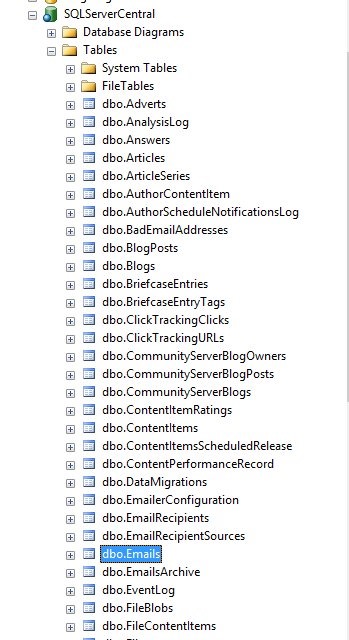
    As an example, I have lots of tables in the SQLServerCentral database.

    tablemetadata_1

    If the Blogs table, or the Articles table changes, then we need to alter stored procedures and possible ASP.NET code for our application. In fact, in this list, pretty much all of these tables could be changed by a developer without a large impact, assuming they’re going to look at the other objects or code affected.

    However the table highlighted, the emails table, along with a few others, are important. These tables not only support SQLServerCentral, the web app, they are also called by our emailer process, which is a completely separate application. In essence, these tables are the opposite of a microservice. They’re shared.

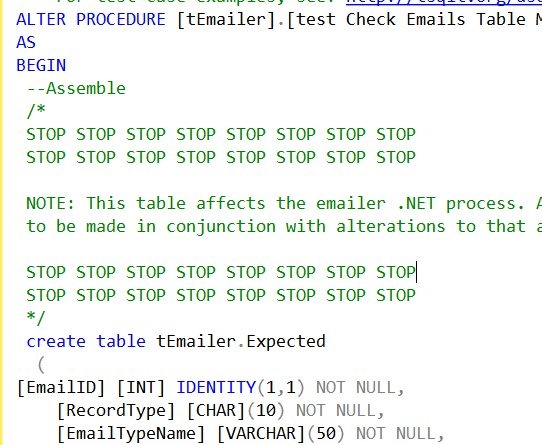
    If someone wants to change the Emails table, I want to be sure that others are informed. In fact, I might choose to include a note in the test header that various groups need to be informed or that the table affects another application. In that case, before a developer went to change the test, they might at least have a chance or noting this has far reaching implications.

    tablemetadata_2

    It’s not a perfect solution, but it does help. The other thing I could do is limit access to metadata tests for various tables/views and merely call these tests in a CI, or other automated, process. That way failures would be public, and a variety of people could be informed, preventing a developer from making changes without a discussion.

    As I mentioned, I wouldn’t do this for all tables. In fact, I’d limit this to particularly sensitive tables that might require lots of rework if they were changed. We want to speed development, and ensure code works, not slow developers down.

  • Getting Database Properties – DatabasePropertyEx()

    Another post for me that is simple and hopefully serves as an example for people trying to get blogging as #SQLNewBloggers.

    I had someone ask me a question about security recently, and while working through the answer, I ran across something I didn’t know well: databasepropertyex(). Here’s a few notes.

    Each database in SQL Server has all sorts of options and settings. Most people (including me) get in the habit of checking here for the information. First we right click the database (after starting SSMS if it isn’t running)

    dbproperty

    Then you get this dialog, with lots of stuff.

    dbproperty2

    And more on the other tabs.

    dbproperty4

    Time consuming, and error prone. As I get older, I find that trying to decide which selection is set for which option becomes harder. I find my finger tracing across the screen. It’s entirely possible I’d make a mistake when glancing at this to check the ArithAbort setting.

    Use T-SQL

    Scripting and querying is usually better. Not the sp_configure scripting where you get a whole list of options, but looking for a particular item. That’s where DatabasePropertyEx() comes in. This lets you query for a database property.

    The problem comes in when you run it. If you run the function, you get little information.

    dbprop_a

    Certainly you can go look at BOL to get more data, but that’s annoying. If I run sp_configure, I get data. However here, nothing. Even if I do what I think would be helpful, with a NULL parameter, I don’t get a list of stuff. SQL Prompt alerted me to the fact that the first parameter is the database, and the second is the property, but that doesn’t work.

    dbprop_b

    Fortunately, I have SQL Prompt, so I get this when I put in quotes for the second parameter.

    dbprop_c

    As you can see, the parameters don’t map to the properties, though you can figure out what they mean if you see them. They tend to follow the conventions that most application programmers use (IsAutoClose).

    That’s fine, and it just means you need to have a reference handy for properties to query. I wish MS would give all properties with a NULL parameter, or a link to BOL.

    Writing

    This one took a bit longer to write. Once I realized I didn’t know databasepropertyex() very well, I had to read about it (5 minutes) and experiment a bit. I took some screen shots, which is always cumbersome. As I wrote this, I had to change the wording and ordering a few times to try and convey a simple message. I was originally going to look at more details, but decided to keep this simple and talk about just querying properties.

    This was about 30-40 minutes for me.

    You can do this. Join the #SQLNewBlogger group and start documenting your career. You can see all my posts that fall into this area by looking through the SQLNewBlogger tag here.

    References