Author: way0utwest

  • Burnout

    I’m sure that many people end going through burnout at some point in their career. While most of us might enjoy technology, and we get a kick out of working with data, at some point you’re not going to like your job. This could be because you’re overworked, or it could be that you don’t have enough to do. Either way, I would bet that many people flow through the phases of burnout that Kendra Little documented in this post.

    Burnout isn’t necessarily the end of a job, but it is a state that most of us wouldn’t want to remain in. Apart from disliking your own situation, and perhaps annoying your fellow employees, you certainly aren’t helping your career. Especially if you are in stages 1 or 2.

    I’ve seen stage 3 be positive or negative, but it doesn’t really work out well to try and outwork the job. Most of the time this leads to unhealthy levels of work for you, and unrealistic future expectations for your employer. When things aren’t going well, do as Kendra suggests and address the issues. Make those small changes that adjust your attitude and help you cope better. Smile, try to view the things that bother you from the perspective of others, and  look to keep perspective with what you do. Most of us aren’t in life-threatening or hazardous jobs, and we should remember that.

    If you think you’re burned out and really need to switch jobs, make a plan to move on. Looking for another job is stressful, and it’s hard, but the best time to do it is while you have another job. Take your time and make a good decision for your future. Perhaps the project of looking for a new job will help ease the troubles you face at this one.

    Steve Jones

    The Voice of the DBA Podcast

    Listen to the MP3 Audio ( 2.0MB) podcast or subscribe to the feed at iTunes and LibSyn.

  • Inception

    This editorial was originally published on Sep 7, 2010. It is being re-run as Steve is on vacation.

    I recently went to see the movie Inception on the recommendation of my wife. She had taken one of my sons to see it and loved it, so she convinced me to go. She actually enjoyed it so much that she went back a third time with another son to see it again.

    The movie is interesting, and deals with the possibility of planting an idea in someone’s head through a dream. It’s a very well done movie, and I recommend it if you haven’t seen it. It’s definitely science fiction (I hope) and not something I think is possible, but it is a very well done movie and gets you to consider the possibility.

    It’s Friday, and no, I’m not asking you what you think about the movie. I’m not looking for more movie recommendations, and I’m not asking if you think inception is possible. Instead, I want to ask you a more basic question, looking for how you find inspiration.

    How do you get your ideas?

    We all work with SQL Server, we solve problems, and we have to write code. More and more I see the work we do in building technological solutions as art, based in science. We must be creative in how we come up with a solution,  and then use best practices and proven techniques to implement the solution.

    Most of us are at work when we respond, so the answers can be based on how you develop solutions in code. But if you have a way that helps you think, a technique that focuses you on any problem, let us know this Friday. Maybe you’ll help someone else find a way to think more creatively about the problems they face.

    Steve Jones


  • Up, Up, and Away

    A long series of flights for me this afternoon. Off to Houston late, then catching an overnight flight to London. However I don’t stop there. Immediately I’m off to Frankfurt and the SQL Konferenz taking place there. I won’t really stop traveling until Tuesday evening, just in time (I hope) for dinner.

    The one upside is I fly on a 787 Dreamliner. I actually searched out to see where these planes are in use by United, and I’ll be taking one across the water.

    I’ll get some pictures and hopefully have time to blog a bit while waiting to connect at Heathrow.

  • Parsing SQL Saturday Data – Getting the Titles

    I wrote about downloading the SQL Saturday data with Powershell, and that has worked well. However, I also need to parse this data. You can look at a sample XML file from the site with this link, and examine the structure.

    Essentially, it’s something like this:

    <event>

      <title>x</title>

      <speakers>

         <id>1</id>

         <speaker>a</speaker>

      </speakers>

    </event>

    I’ve left a lot out, but it’s not important. For my purposes, this is the main stuff I’m concerned about.

    As a first step, I wanted to print out some information. I’m tackling this in stages, so this is the first step.

    SelectNodes

    I found a number of ways to do this, but I liked the SelectNodes method. I won’t include all the code, since the loading of the XML file was covered in the previous post. I have the XML data in the $doc variable, so I did this:

    $doc.SelectNodes("//guide/name")

    That gives me this:

    sqlsatloop_b

    This is the path to an element in the document. However this isn’t what I care about here. I’ll need this later as I store other data, but for now I want session titles.

    If I change my code to:

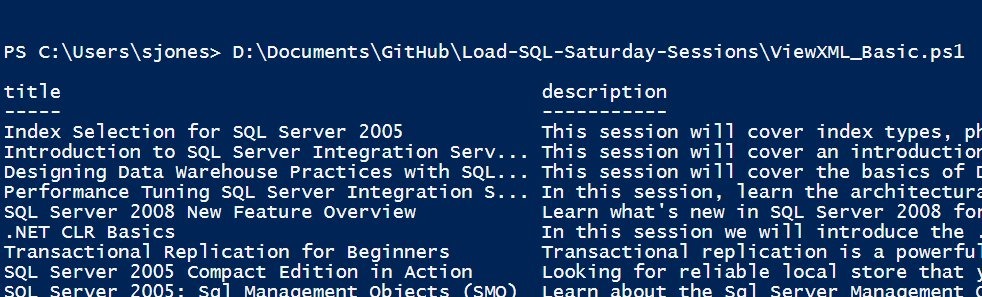
    $doc.SelectNodes("//event") | Format-Table title, description

    I get this:

    sqlsatloop_c

    That’s a good start. I didn’t need the description, but I wanted to show multiple values in the table as a test.

    My plan was to get the speaker, but speaker isn’t an element below event. It’s below "Speakers", which is separate.

    That’s somewhat OK, as I’ll need to parse those out appropriately. The next step is getting the speakers. A little more complicated. The speakers are a child element below the event.

    I’ll tackle that in another post, because it’s slightly more tricky and I want to be sure I can devote a bit more time to discussing a way to do this.

    In the meantime, I cleaned up the code to be simpler and used the

    References