Author: way0utwest

  • The Work Life Balance for Men

    A great piece by LZ Granderson, and one that really make me stop and think a bit. Work and life is always a balance, and men certainly don’t have it easier. We make different choices, or we set different priorities. It’s worth the read, and as you do, before you dismiss it, consider this: how would work life look if women had been a part of business and work for all of history?

    I sometimes look at the way I do things, and wonder if I’m balancing too far one way or the other. Ultimately I don’t know if I’m doing it right, but I keep an eye on it.

  • Resetting DMVs

    I'd prefer more control on when I reset DMV data.
    I’d prefer more control on when I reset DMV data.

    Recently I was working on an indexing presentation and looking for missing, duplicate, and unused indexes. As I set up demos to show the effects of indexing, I was constantly adding and deleting objects, and even resetting the DMVs to show statistics by starting the instance. The documentation for some DMVs, like sys.dm_db_index_usage_stats include a note that the counters are initialized to zero when the instance is restarted. If a database is taken offline, or detached, all rows referencing the database are removed.

    That got me thinking. Why is this data removed? I’m sure some of the data is stored in memory and automatically reset, but is this the best way to handle this data? Wouldn’t it be better to persist this data and allow the DBA to reset values when they were ready? I know we can store this data in a table periodically now, but I think keeping this inside the system views would make sense as an option in SQL Server. When we shut down a database, persist this data inside the database. That would be closer to my vision of self-describing databases, which contain all their own metadata.

    I know there might be performance impacts to persisting this information, but I can also see benefits, especially when you might have system crashes or problems. Being able to recover the information from DMVs, even incomplete information, brings us closer to a robust, flight-recorder kind of system that monitors itself and allows administrators to review information that might help them discover the causes of any issues.

    I don’t think that every piece of data needs to be guaranteed to be written to the DMVs, or that the system should slow down to do so, but give the DBAs some control here. If we have the need for more extensive logging, or we want to retain whatever information we can, allow it to persist in the DMVs, or at least make snapshots of DMV data easy to take and store. It’s another form of logging that I’d appreciate having available from the platform.

    Steve Jones


    The Voice of the DBA Podcasts

    We publish three versions of the podcast each day for you to enjoy.

  • T-SQL Tuesday #40– File and Filegroups

    tsqltuesdayIt’s the second Tuesday of the month and time for T-SQL Tuesday again. This is a monthly blog party, where the participants write on a particular theme. This month Jen McCown, of Midnight DBA fame, invites us to talk about files and filegroups in SQL Server.

    If you’re like to participate, write a post and drop a comment (or pingback) on Jen’s blog. Watch the #tsql2sday hashtag on twitter for next month’s invitation.

    Filestream and Filegroups

    I have a couple talks that deal with Filestream related topics, so I decided on a quick introductory lesson on how this works.

    Filestream was built into the AdventureWorks 2008 sample database. Requiring administrators to turn on Filestream caused some confusion and complaints, despite the fact that it’s easy to do.

    What does Filestream have to do with filegroups? In a database that is enabled for Filestream data, you need to add a filegroup specifically for the Filestream data. This is actually a folder on your file system, which you can access through T-SQL, or through the Win32 API. If you are using SQL Server 2012 or later, you can also access this data with a Filetable, which is built on Filestream.

    Let’s create a database, and add a filegroup for Filestream. We start with the “New Database” dialog in SSMS.

    fs_a

    With the normal defaults, we see a data file (FS_Test) and a log file (FS_test_log). For Filestream data, we need a new place to store it. Let’s add a file:


    fs_b

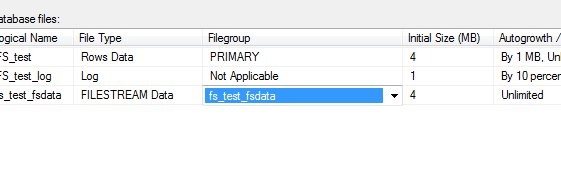
    Once I add the file, I mark it as storing Filestream data. The other options are rows (data files) or log files. However this presents a problem. When I scroll right, I see that there is no filegroup for Filestream data. I can’t put this in an existing filegroup.

    fs_c

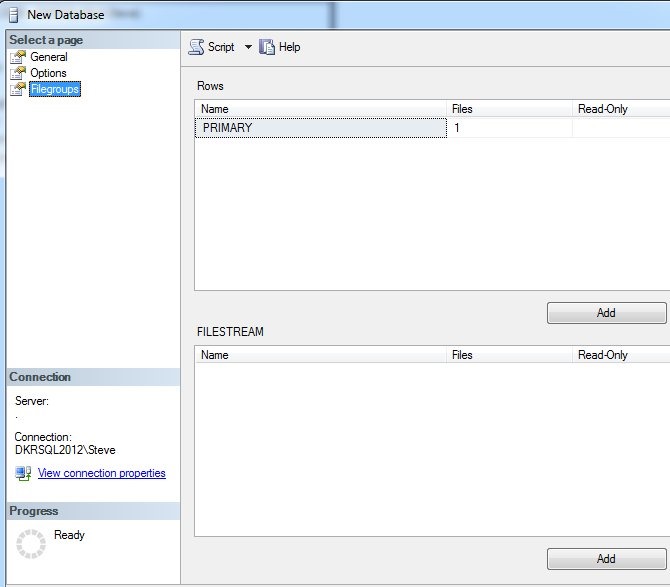
    Let’s add one of those. Here’s the default filegroup dialog.
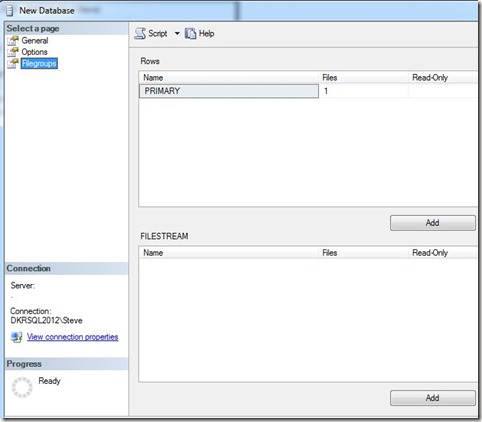
    fs_d

    I can click add, and put in a filestream filegroup. The name doesn’t matter, it’s just for administrative purposes. Once I do that, I can go back to the files dialog, and if I select the dropdown, my new filegroup appears.
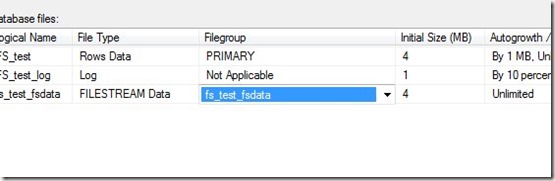
    fs_e

    Now I need a location. Outside of SQL Server, I created a folder in my data directory. This can be anywhere, but I did it in the default location. It’s called FilestreamDataTest.

    fs_g

    I then select this in the files dialog, using the ellipsis to the right of the Path column.

    fs_f

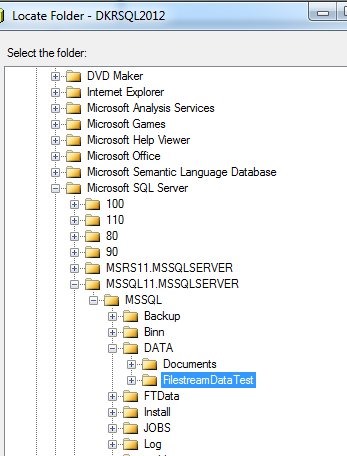
    I see my folder in the file picker and choose it.
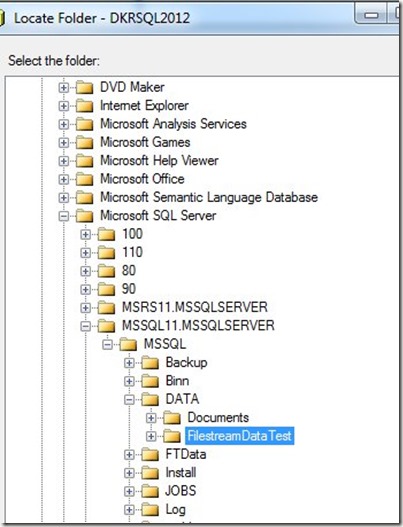
    fs_h

    Once I’ve selected it, I don’t click OK. I click “Script” and get the script below:

    CREATE DATABASE [FS_test]
     CONTAINMENT = NONE
     ON  PRIMARY 
    ( NAME = N'FS_test', FILENAME = N'C:\Program Files\Microsoft SQL Server\MSSQL11.MSSQLSERVER\MSSQL\DATA\FS_test.mdf' , SIZE = 4096KB , MAXSIZE = UNLIMITED, FILEGROWTH = 1024KB ), 
     FILEGROUP [fs_test_fsdata] CONTAINS FILESTREAM  DEFAULT 
    ( NAME = N'fs_test_fsdata', FILENAME = N'C:\Program Files\Microsoft SQL Server\MSSQL11.MSSQLSERVER\MSSQL\DATA\FilestreamDataTest\fs_test_fsdata' , MAXSIZE = UNLIMITED)
     LOG ON 
    ( NAME = N'FS_test_log', FILENAME = N'C:\Program Files\Microsoft SQL Server\MSSQL11.MSSQLSERVER\MSSQL\DATA\FS_test_log.ldf' , SIZE = 1024KB , MAXSIZE = 2048GB , FILEGROWTH = 10%)
    GO

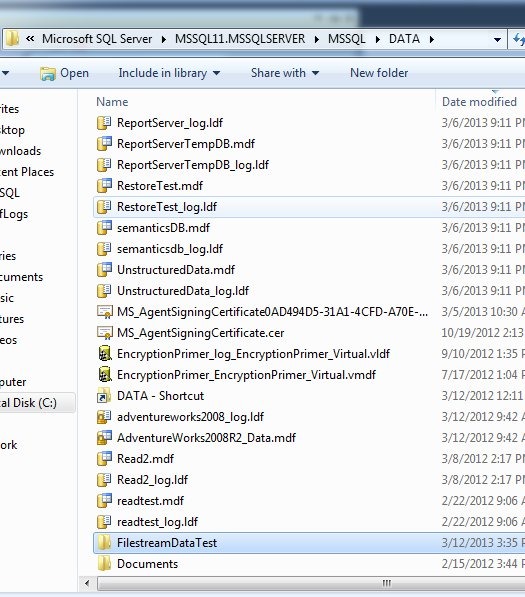
    I can run this, and once I do, if I go into the folder that contains my Filestream file, I see this:

    fs_i

    As I create tables that hold Filestream data, including FileTable data, I’ll see entries in here for each column (or Filetable) that holds this data. There is a folder that holds logging information for this data, which I do not manage.

    Hopefully this is a quick, short piece that helps you understand Filegroups and Filestream.

  • Self Describing Databases

    Self describing databases would be very, very handy.
    Self describing databases would be very, very handy.

    When contained databases were introduced in SQL Server 2012, I thought they were a very nice enhancement to the platform. The idea of having security managed inside the database, thereby removing the problem of orphaned users, was something I looked forward to. Preventing collation conflicts is also a nice benefit, though I’ve never had a problem with this issue. However I was, and still am, hoping that this was just the beginning of what a contained database would be. I had a vision of a self-describing database.

    There are many things that we need to manage with databases: maintenance, backups, auditing, performance statistics, alerts, and more. Most of these are set up at the instance, but I’ve never quite understood why. Software should help us work more efficiently, and work with us, not against us. So many of these administrative items are dependent on the needs of a particular database or application, but we perform all these actions at the instance level.

    Backups are an example of a database dependent item, as we constantly teach new DBAs. However the backup plans are set at the instance level, and if you have disparate requirements for different databases, these result in different backup plans. The MSDN documentation says we should even have a manual for each database. If that’s the case, why is the information about a database backup stored outside of the database? I think it would make more sense for the backup plan to be stored in the database, and when the database is attached, or the plan created, the instance would read this plan and create the necessary jobs. If we detached the database, the jobs would be removed. We run recovery in each database, couldn’t that serve to enable or disable any alerts, jobs, etc. for any database that wasn’t accessible?

    I envision much more than just backups as being a part of the database. Every action we need to manage in a database from alerts to auditing, should be stored there. Let the Agent on the instance read the database and automatically set up the jobs needed. If there are conflicts with scheduling, alert the DBA at the instance level, but keep the metadata about the needs of the database in the database. It would make consolidation, or movement of databases much simpler. It would also fit with the idea of a database service, rather than a database server.

    Steve Jones


    The Voice of the DBA Podcasts

    We publish three versions of the podcast each day for you to enjoy.