Author: way0utwest

  • Messy Job Descriptions

    I saw a job description recently for a DBA that asked for SQL Server experience, but also “other RDBMSes, like Cassandra and PostgreSQL”. Not sure Cassandra fits there, or why this says like. I’ve seen some other ads that ask for C# or Python. Some asking for MDX/DAX knowledge along with AWS Cloud Formation and programming APIs. Some have a required and optional or “nice to have” sections, but many include a laundry list of technologies and skills. For software developer roles, the list of skills often exceeds what I think any person in the world might know.

    There was a debate about this at SQL Server Central in one of the threads. It seems some people are split on whether this is a problem or a good thing. Quite a few people noted that they wouldn’t apply when there are so many items listed that they don’t have experience in. For others, we wouldn’t hesitate if we had around 50% of the items listed. I’m in the latter category, as I’ve had plenty of friends, and myself, get jobs that might have seemed out of reach based on the description and our skills.

    In my experience, often a job description is put together on the fly and in a hurry, usually by someone that isn’t familiar with the job. They ask others what to include, and we end up with a large list of things that would be nice, but not necessary. The end result isn’t always what the job entails, at least not completely. Often I’ve found as a developer or operations person I might end up lightly touching parts of different roles, but not regularly and not too deeply.

    I don’t know that I think it’s worth effort to tightly define a job for a new hire, as the job requirements can change, and we might adapt a job to the individual. Not completely, but if someone knows more about reporting or BI than HA/DR, we might have them tackle more of that work and only partially work on clusters or AGs. Others might fill in with more HA/DR and less BI work. The reverse also could be true, so should we have a job description that is narrowly defined to DBA work with an HADR focus? Or one for BI? I don’t know, but I learn towards not tightly defining a job description.

    Hiring is a difficult enough process, especially today, without too tightly defining the roles. I do think it’s worth spending time with the team doing the work to list out the necessary skills (and levels) needed to help them, but adding in other items is useful. It casts a wider net, and it helps you as the hiring group, think about what tradeoffs you might make. If someone is weak with replication, and we use it, but they have some strong Azure skills, maybe we accept that. We know we’ll need to train this person on replication, but they might help us better understand the cloud. Perhaps that’s a better choice than someone highly skilled with replication but without a lot of other experience.

    Or maybe not.

    Ultimately, on the hiring side, include what you want. It doesn’t have to be perfect. If you don’t get candidates, then re-examine it, but list what you really need, and separately, what you want.

    On the candidate side, don’t be intimidated. If you get to 45% of the skills, apply. If you hit 75% of the requirements, apply. Maybe even if you’re a little short on those but you have other skills. Use what you know, and what’s been listed, to help you drive the interview. Emphasize your strengths, and convince them you can learn. Ask questions, use “I don’t know, but” often with examples of how you might gain the knowledge or get help. That often is more important than what you have done in the past.

    Steve Jones

    Listen to the podcast at Libsyn, Stitcher, Spotify, or iTunes.
  • Daily Coping 16 Jul 2021

    I started to add a daily coping tip to the SQLServerCentral newsletter and to the Community Circle, which is helping me deal with the issues in the world. I’m adding my responses for each day here. All my coping tips are under this tag. 

    Today’s tip is to find fun ways to distract yourself from unhelpful thoughts.

    We likely all have negative and unhelpful thoughts. I know I do on a regular basis. While I can be upbeat and positive, I can also feel stressed, sad, or angry about different things. Working to actively change your thoughts is helpful at times to coping.

    One thing that I’ve done is spend a few minutes doing something that requires some focus. For me, that usually falls into one of a couple areas:

    • Guitar
    • A quick game
    • Duolingo

    These are not in any order, but I have found that I can take a couple minutes to strum a song, open Duolingo and go through a lesson, or pick a game that makes me concentrate. I tend to use things like Sudoku or recently, Water Sort Puzzle, as a fairly quick way of timeboxing. A round here takes 2-3 minutes, which is about what a song or a lesson take.

    I’m slightly running away, but I’m distracting myself. Time is a great healer, and often a short break gives me a slightly different perspective. I can start to cope with my fears, anger, sadness, or whatever in a better way, or at least a more calm way.

    It might take a few rounds of thought, distraction, thought, distraction, etc., but it’s helpful for me.

    A HUGE CAVEAT:  I am not susceptible to depression, at least not as I see it in other friends/family. My coping is much different than I might do with someone who might be more susceptible or have a mental illness that makes it hard to cope. If you have challenges in this area, please seek out others, especially professionals. Illness is illness, and needs treatment at times to ensure you cope and thrive in life.

  • Daily Coping 15 Jul 2021

    I started to add a daily coping tip to the SQLServerCentral newsletter and to the Community Circle, which is helping me deal with the issues in the world. I’m adding my responses for each day here. All my coping tips are under this tag. 

    Today’s tip is to challenge yourself when you feel negative. Look at something from a new perspective.

    It’s been a hard time, with very hot weather, lots of little tasks, and the need to make some decisions. None of them big, but the sheer volume is a little overwhelming to me.

    I’ve been feeling a little negative about getting through the week lately, and wanting to vent and complain a bit. A few people close to me have been good at listening, which is helpful. However, I need to stop and review how I see things.

    One place I’ve felt negative is the lack of progress in a few spring maintenance operations. My wife reminded me I have kids here willing to help and I should review how I look at some chores. Ask for help, remember that it’s not all on me.

    That’s a struggle as I really try to be independent. However, I made an effort to look at it from the new perspective, that others are willing to help, and asked them to take a few things off my plate. It was a good lesson for me.

  • Getting Row Numbers with Window Functions–#SQLNewBlogger

    Another post for me that is simple and hopefully serves as an example for people trying to get blogging as #SQLNewBloggers.

    In a recent post, I started looking at some basics for window functions. This post continues with a look at one of the most commonly used ones: row_number().

    Rows in a table aren’t in any particular order. They can be physically stored in order by the clustered index, but in a SELECT, there is no guarantee of any particular order unless you have an ORDER BY clause. However, even when you get a set or rows, there isn’t any number for the rows that is given.

    Many of us would like to have some number that allows us to know this is row 1, row 2, etc.

    We can do that with ROW_NUMBER(), which is a window function that assigns sequential numbers to rows. In the previous post, I used some baseball data, so I’ll continue with that today, but I’ll use another amazing batter, Ken Griffey Jr.

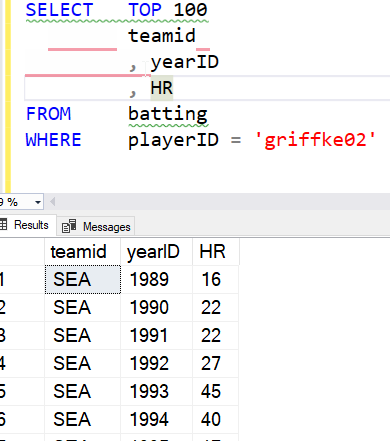
    If I just get the list of batting records for Ken, I see this results (abbreviated) below. Note that there is no ordering I can count on here. The row number to the right is added by SSMS, but isn’t in the result set:

    2021-07-13 11_34_04-SQLQuery1.sql - ARISTOTLE.BaseballData (ARISTOTLE_Steve (75))_ - Microsoft SQL S

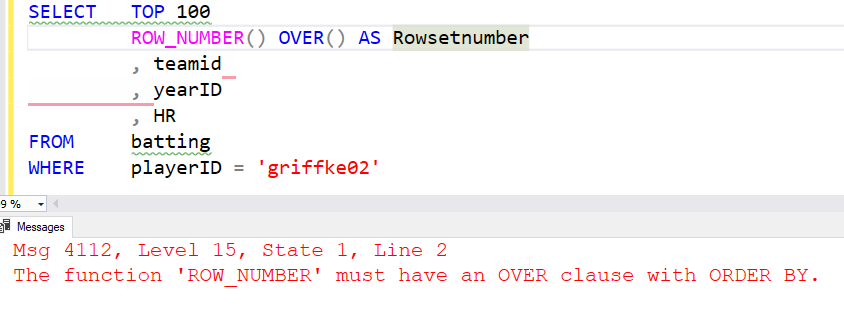
    If I want to ensure every client has a row number, I can use that function with an OVER() clause. Note that I need to include something in the OVER() clause.

    2021-07-13 11_35_33-SQLQuery1.sql - ARISTOTLE.BaseballData (ARISTOTLE_Steve (75))_ - Microsoft SQL S

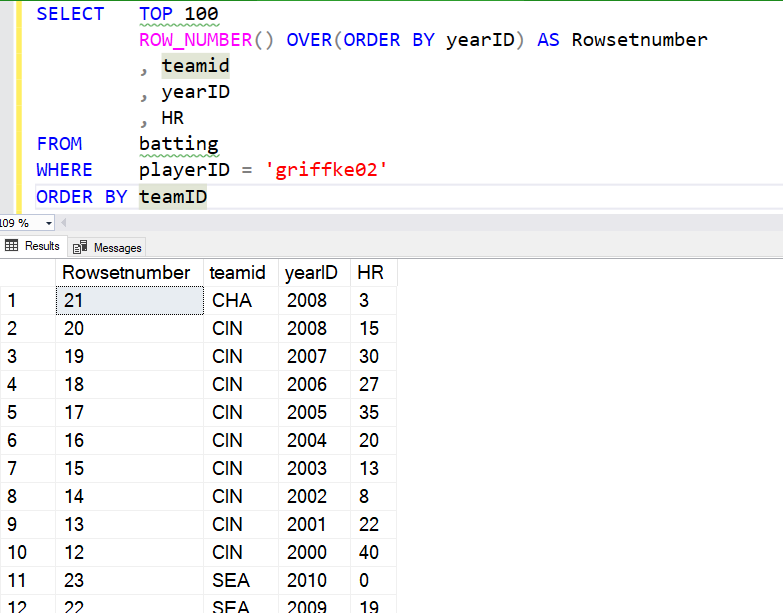
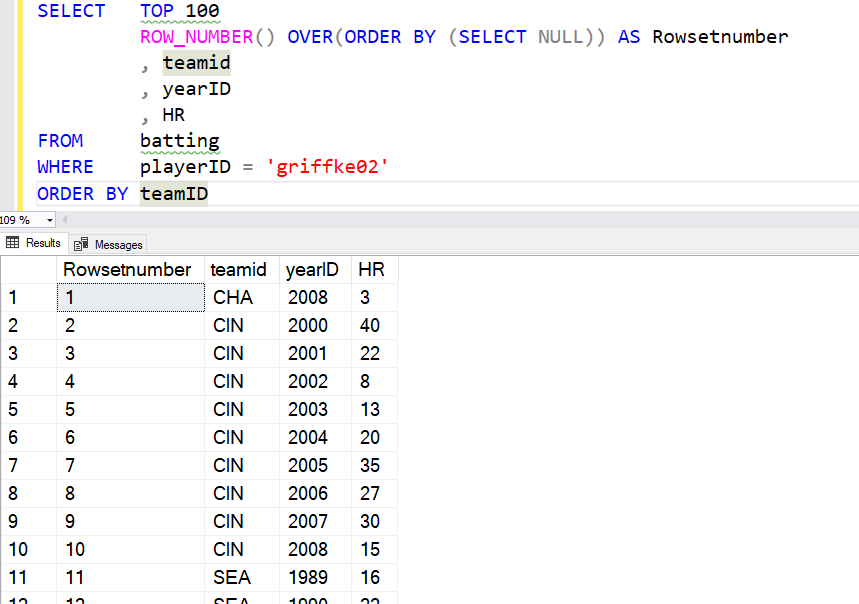
    Let’s fix that. I’ll order by year and then ensure I show the SSMS number added by the GUI. I see the numbers seem to correspond to the years. What if I order the entire query by team?

    2021-07-13 11_38_32-SQLQuery1.sql - ARISTOTLE.BaseballData (ARISTOTLE_Steve (75))_ - Microsoft SQL S

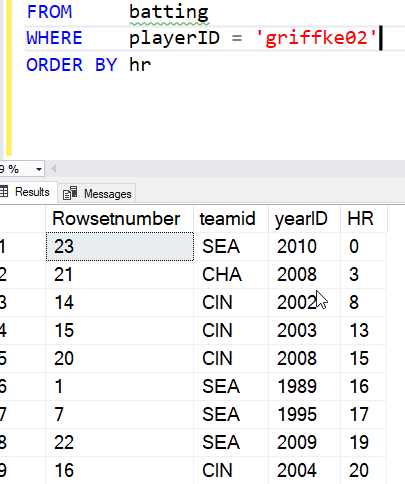
    This appear to have reversed the numbers. However, note that rows 11 and 12 are the 22 and 23. The window function applied the numbers based on the ordering of years for the entire set, then the rows were re-ordered for the query based on the ORDER BY. We see this more clearly with an ORDER BY using the HR column.

    2021-07-13 11_41_59-SQLQuery1.sql - ARISTOTLE.BaseballData (ARISTOTLE_Steve (75))_ - Microsoft SQL S

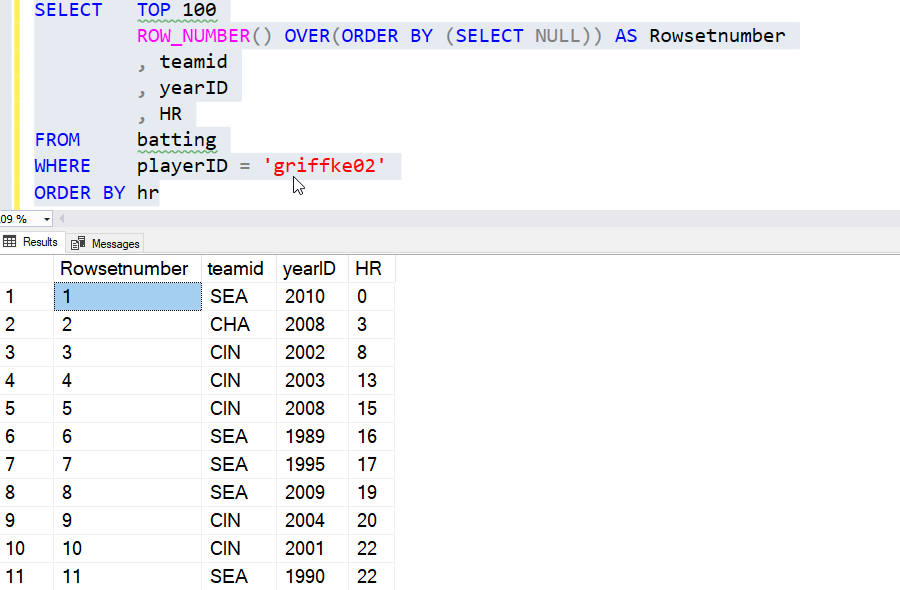
    What about just an ordering for the results? I do need an ORDER BY I can use this trick.

    SELECT   TOP 100
              ROW_NUMBER() OVER(ORDER BY (SELECT NULL)) AS Rowsetnumber
              , teamid
              , yearID
              , HR
    FROM     batting
    WHERE    playerID = 'griffke02'
    ORDER BY hr

    This allows me to just apply the ROW_NUMBER to whatever the query is doing. Here’s the result, ordered by HR.

    2021-07-13 11_45_14-SQLQuery1.sql - ARISTOTLE.BaseballData (ARISTOTLE_Steve (75))_ - Microsoft SQL S

    If I go back to my ordering by team, I see this:

    2021-07-13 11_46_48-SQLQuery1.sql - ARISTOTLE.BaseballData (ARISTOTLE_Steve (75))_ - Microsoft SQL S

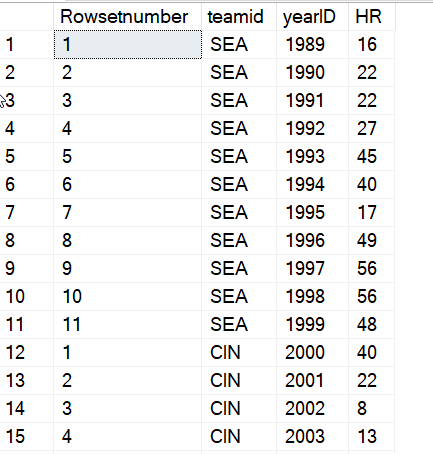
    I can also add a PARTITION BY, and get numbering inside the partition or group. Here I’ll partition by team. I’ll go back to ordering by year, since that makes sense. I’ll use this query.

    SELECT   TOP 100
              ROW_NUMBER() OVER(PARTITION BY teamID ORDER BY (SELECT NULL)) AS Rowsetnumber
              , teamid
              , yearID
              , HR
    FROM     batting
    WHERE    playerID = 'griffke02'
    ORDER BY yearID

    The results are then shown with the numbering restarting with each team.

    2021-07-13 11_49_01-SQLQuery1.sql - ARISTOTLE.BaseballData (ARISTOTLE_Steve (75))_ - Microsoft SQL S

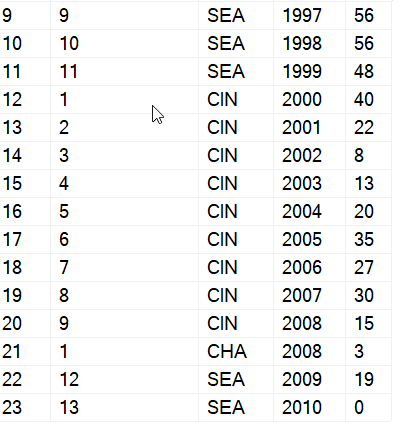
    The one strange thing to note here is that since Ken went back to Seattle late in his career, the numbering for his final two years show a continuation of the numbers from earlier with SEA.

    2021-07-13 11_49_12-SQLQuery1.sql - ARISTOTLE.BaseballData (ARISTOTLE_Steve (75))_ - Microsoft SQL S

    The ROW_NUMBER() function is very powerful and useful when you need some ranking and ordering to show to the client for the rows. As with all data, you need to ensure you understand the data set and be aware of how your partition (grouping) and ordering in the OVER() clause apply to the data, but the final results are dependent on the query’s ORDER BY. This can cause some confusion, so be sure you understand the difference and inform your clients.

    SQLNewBlogger

    This was a quick 10 minute post. I’ve done a lot of work with Window functions and presented on them, so this was a portion of a presentation I’d given, where I took part if a demo and wrote it up.

    However, you can experiment in 15-20 minutes and then spend 10-15 minutes structuring a post on this topic. How have you used ROW_NUMBER(), or if you’ve just learned it, what does it mean to you. Come up with some examples, ensure you understand them, and then explain them back. Might be an easy interview question to answer at some point if they find it on your blog.