Author: way0utwest

  • T-SQL Tuesday Gifts (#121)

    tsqltuesday

    It’s that time of month. I missed last month while traveling, but I wanted to get back in the party. This month, Mala has invited us to talk about the gifts we’ve gotten this year. An easy one for me in 2019.

    Down Under

    The gift for me this year was getting to travel to Australia and New Zealand. I’ve always wanted to go and haven’t been quite able to make it a priority. Last year when I heard we had a Redgate office opening in Australia, I knew this was my chance. We decided to run a few SQL in the City Summit events in 2019 down under and I got to go.

    I was lucky enough to go, and not only attend a few events, but I spent nearly a month in Australia/New Zealand. I spoke at 3 SQL in the City Summits and three SQL Saturdays, which were very enjoyable for me.

    I brought my family along for part of the trip and ended up traveling a little in the middle and taking some holiday. I managed to visit Brisbane, Melbourne, Christchurch, Dunedin, and Queenstown.

    Things went well, and I actually went back to Sydney in September, but just for a couple days. Still, I made the most of it.

    20190926_133919_Burst01

    This was truly a gift for me.

  • Product Platform Teams

    Is infrastructure a product? Should an Ops team start to feel like they are a team involved in building things rather than maintaining them? It’s an interesting idea that is put forth in this blog from Forrester. The piece postulates that the Ops group should be thinking like a product team, just like developers working on an application.

    When a development group moves to a DevOps style of building things, and starts to take some responsibility for the support of their work, what does the Ops group do? If we push infrastructure as code into our VCS, is there much for the Ops group to do?

    I’d argue there still is. From the DBA side, operational staff can help determine what infrastructure is needed, or what changes need to be made. It’s easy to say that devs should add RAM or CPUs, or even another replica, but do they really know when to add them? Or do they just scale everything up? The latter might be easy on people used to writing code, but it’s not necessarily a good idea for the organizational budget.

    Ops staff can still tune systems, add indexes and rewrite code, and give feedback and knowledge to developers to help them understand how to write better code, or infra-as-code code, the first time. There’s also the need to practice and be ready for various DR situations, including the “whoops, I deleted some data”. There are skills that help handle these situations, which are far different from developer skills.

    This is in addition to designing new systems and setting templates for that infrastructure as code that the developers keep in their VCS. There’s also the need to build self-service tools, which might be where Ops becomes a product team. I think that will be necessary, as tooling is important everywhere. I think Operations might even develop other things, like reports requirements that developers don’t have time to build. Ultimately, though, there is still a need for some Ops work, albeit work that ought to be closely aligned, and shared, with developers.

    Steve Jones

    Listen to the podcast at Libsyn, Stitcher or iTunes.

  • Data for Defense

    It’s a dangerous world out there. Many of us hear about data breaches on a regular basis, and we often blame poor security at various organizations. Certainly there are a lot of silly mistakes made, whether in configuration or the mishandling of data in insecure environments. Security is a tough business, however, and most organizations don’t have the budget to combat all the threats they face, at least not as effectively as a larger organization could.

    I have more sympathy for organizations after reading about the work of some Microsoft security teams that go up against the world’s best hackers on a daily basis. To truly understand the vulnerabilities in software, someone must also understand how to attack it. Those of us that only have a defensive mindset are inherently limited in how we design protective measures.

    There is a group, the Microsoft Threat Intelligence Center (MSTIC), that looks for and tracks hackers around the world, trying to understand how they attack organizations. This is a group of multiple teams looking at nation state attacks, as well as complex software tricks, using the tremendous amount of data they gather from telemetry to analyze the different techniques and vectors used to exploit holes in our systems. They notify customers, letting them know when a customer need to be prepared to defend themselves.

    This is a fascinating read, and one that makes me think that most of our organizations are going to be at cyberwar for the foreseeable future. Already we know that any system on the Internet is likely to be probed and attacked if it has vulnerabilities. Most of us are careful about what we expose, but we also know the weakest link in our organization could cause us issues.

    We do the best we can, but often we do depend on other organizations, like Microsoft, to actively be identifying and helping us understand what to patch or change to protect ourselves. I assume Google and Apple have similar groups, notifying their customers of potential threats. These large vendors are likely the best positioned to help, given all the data they collect about their platforms. Certainly I worry about data privacy with these vendors, but I do think that their massive troves of data on how their software works can also benefit all of us.

    Steve Jones

    Listen to the podcast at Libsyn, Stitcher or iTunes.

  • Upgrading Windows 10 Home to Pro

    I use Hyper-V and a few other things that require Windows 10 Pro. When I got my new laptop, it had Windows 10 home on it. Not a big deal, as I’ve run into this a few times over the years when buying consumer laptops. I have a Pro key, so I usually just wipe and reinstall the OS.

    That’s not necessary anymore. Certainly there are unwanted programs that I can remove, but I don’t need an OS reinstall. I found a few articles on the Internet that explain this, but it was simple.

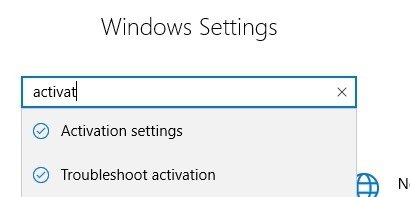
    I first booted the laptop and went through initial Windows setup. I made sure Windows Update didn’t have any pending items. Then I hoped the Control Panel with Win+I. If you’ve never used this, the Windows key with various other items is handy. Win+I gives me settings. I typed in activation.

    2019-12-02 11_53_37-Settings

    You’ll see the activation settings, which you can then click.

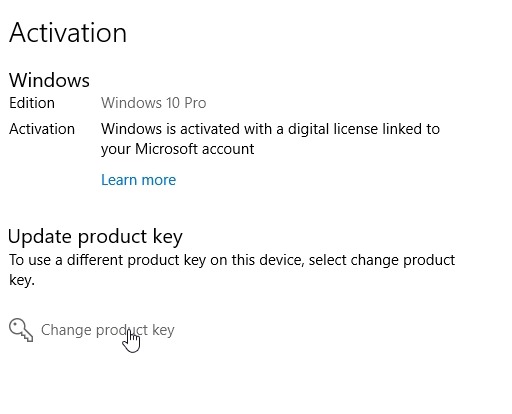
    I already did this, but on my laptop, I saw Windows 10 Home already listed and licensed. I then saw Upgrade options below it, where you see Update Product Key here. There were two links. One was for the MS store, to purchase an upgrade. The second was the Change product key option listed.

    2019-12-02 11_53_45-Settings

    I chose that one and then it prompted me to enter a key. I did and clicked OK. This immediately set my laptop to Windows 10 Pro and I could enable and activate Hyper-V.

    Windows has greatly smoothed this process over time and I’m looking forward to the ease of the setup system for this machine.