Tag: Azure

  • Getting a VHD into Azure with PoSh

    Another post for me that is simple and hopefully serves as an example for people trying to get blogging as #SQLNewBloggers.

    I thought this would make a nice SQLNewBlogger post, an easy get started one. I used the docs from Microsoft as a guide, so here’s how it went.

    Login to my account. I used Add-AzureRMAccount here to get the login dialog. I’m not repeating this for now, so this is just an interactive test.

    2017-03-23 14_09_25-Sign in to your Microsoft account

    Now I tried to create a storage account, but I hadn’t assigned a subscription. I didn’t think I needed to  since I only have one,but hey, I guess I do.
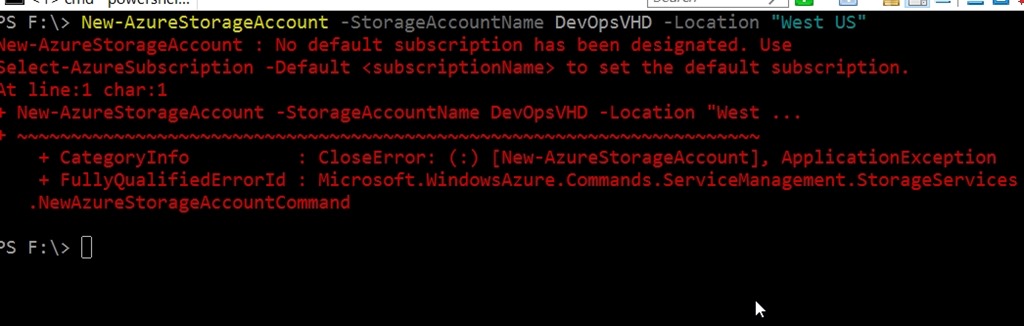
    2017-03-23 14_11_36-cmd - powershell

    I started typing Select-AzureSubscription, but realized I didn’t know what it was. I can’t remember naming this and under my name in the portal, I didn’t see a place to find it.

    2017-03-23 14_13_22-Getting a VHD into Azure - Open Live Writer

    Ah, under All Resources I see something, so I’ll try this.
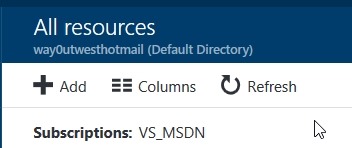
    2017-03-23 14_12_26-All resources - Microsoft Azure

    On second thought, under My Permissions, I see it there.
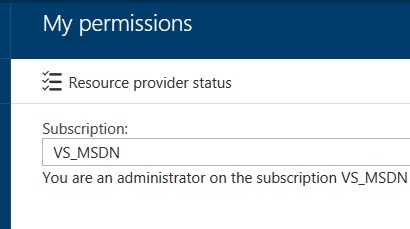
    2017-03-23 14_14_17-My permissions - Microsoft Azure

    Or not

    2017-03-23 14_14_41-cmd - powershell

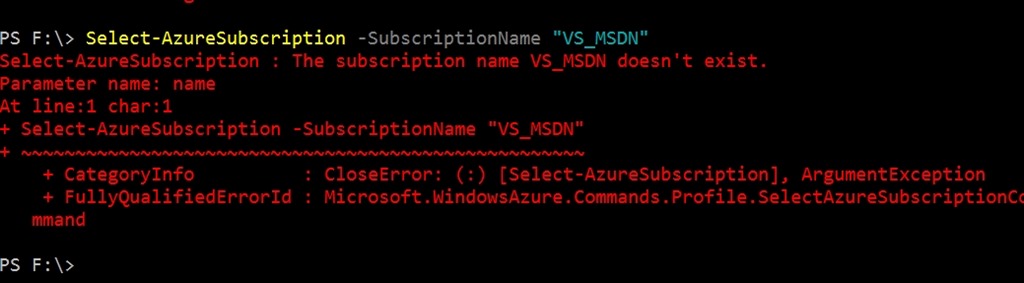
    Get-AzureSubscription doesn’t quite work.

    2017-03-23 14_17_54-cmd - powershell

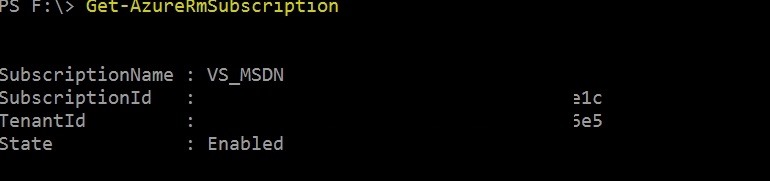
    It’s Get-AzureRMSubscription

    2017-03-23 14_19_02-cmd - powershell

    So, why doesn’t my creation of the storage account work? I should really read error messages. The issue is Select-AzureSubscription fails because I need Select-AzureRMSubscription.

    Sometimes the rev’ing of the cloud is hard.

    Actually, maybe neither work.

    2017-03-23 14_22_02-cmd - powershell

    I retreat.

    2017-03-23 14_23_59-cmd - powershell

    I’m still annoyed. “US West” isn’t valid. FFS, Microsoft. Whether I type any of these, just ask me or process them.

    • “US West”
    • “West US”
    • “USWest”
    • “US_West”

    OK, I decided to go exercise for a bit.

    I’m back (30 minutes later), and I try Get-AzureLocation. I can guess some cmdlets. I get a lot of stuff back and see “West US” is valid. I try a few other valid names of regions, but get errors. It’s not that parameter.

    Let’s try a new name.
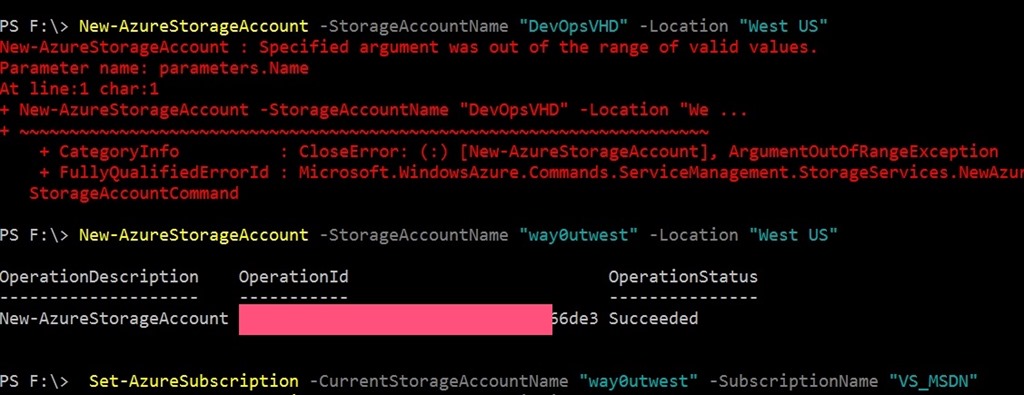
    2017-03-23 14_30_22-cmd - powershell

    #$%#@#@# engineers and developers. That’s a valid error message? Not, this is a duplicate or something that makes sense. Glad I left.

    Maybe not. At least this is an error that makes sense.

    2017-03-23 14_31_27-cmd - powershell

    Finally. Let’s upload the VHD.

    2017-03-23 14_33_25-{0%} cmd - powershell

    And it’s off.

    2017-03-23 14_33_41-{0%} cmd - powershell

    Hopefully this will work. I haven’t tried this with PoSh before, and it was somewhat frustrating, though it really didn’t take that long.

    SQLNewBlogger

    This was a bit of a live blog. Do something, take a screenshot, write some text. It was a bit of a learning experience.

  • TSQLTuesday.com – Quick WordPress Setup in Azure

    When I agreed to host the T-SQL Tuesday site, I wasn’t sure what to do. I thought about just putting up a static page, one I’d edit, but in some conversations with Adam Machanic, he wanted to have a few people able to manage the site. That makes sense and means I have less to do.

    My first thought had been to build a SQL database, set up a web page, maybe add some logins for people, etc. Sounds great, but that can be a lot of work, and while I don’t mind some projects, I don’t want a big project that’s just a small service. Especially for data that’s really just historical logging.

    When I woke up one morning and found a domain transfer request, I felt some pressure to get something up quickly. One of the great things about using domains on the web is that I could build something quick, point the domain to it, and build something else in the background, moving the domain later. There might be redirect issues, but in this case I expect most people just hit the domain, tsqltuesday.com, so I decided to focus there.

    Azure Websites

    I had experimented a bit with Azure websites, setting a few up, and thought this might be easy. In fact, it was really easy, so I decided to write a bit about the experience. Note, this is what the experience is like in Mar 2017. It could change quarter to quarter, so use the process and images as a rough guide.

    To get started, log into your portal. If you don’t have an Azure account, google how to create one, set it up, and then come back.

    Once you have an account, click New and choose .

    2017-03-11 21_01_53-Web   Mobile - Microsoft Azure

    From here, pick “See All” and then find WordPress.

    2017-03-11 21_02_15-Untitled

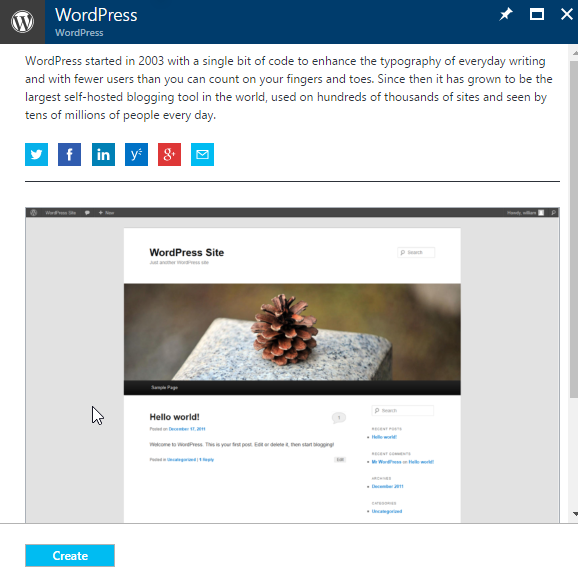
    Once you select WordPress, you just click Create.

    2017-03-11 21_02_56-WordPress - Microsoft Azure

    I tried to keep this simple, and picked these options.

    2017-03-11 21_03_47-WordPress - Microsoft Azure

    one thing I had to do was pick a size above the free service. This is because the free services don’t allow custom domains, and while tsqltuesday.azurewebsites.net works, it’s not as cool at tsqltuesday.com. Plus Brent had already transferred the domain to me, so I was on the hook.

    Once this was done, I had the site created.

    2017-03-11 21_07_42-tsqltuesday - Microsoft Azure

    Once the deployment completes ,you have a blank WordPress site. You log in with your credentials and start configuring, just as you’d do on wordpress.com or with your own installations.

    2017-03-11 21_09_56-WordPress › Installation

    I took a few guesses on how to organize the site, but I’ll discuss those late. This is really about getting a quick site up, one for your business, for your blog, or whatever you’d like. This is my second WordPress site on Azure, and I’m amazed at how easy it is.

    I’

  • Delete an Azure SQL Database from PowerShell

    Another post for me that is simple and hopefully serves as an example for people trying to get blogging as #SQLNewBloggers.

    One of the things I’ve been working on is trying to get my DevOps, continuous delivery pipeline working with Azure. Part of that is a test deployment to an Azure SQL Database, which means I need to be able to update an existing database from a backup. Unfortunately, Azure SQL Database doesn’t support a restore over an existing database (yet).

    That means one task I have is to remove an existing database, in order to replace it with a new database with the same name. A little work in the PoSh documentation found Remove-AzureRMSQLDatabase, which is just what I need.

    To use this cmdlet, I need a connection to the Azure space first. I can do that with a credential that I get with this command. Ultimately I need to store this, but interactively this lets me get started:

    Login-AzureRMAccount

    This gets me an interactive login. I enter my account and password. Since I use a Live account, this won’t work in the pipeline, but it gets me going.

    2017-03-10 09_00_34-Sign in to your account

    From here, I can set a few variables I’ll need. I want the name of a resource group, a server, and a database. In my case, I’ll use a few variables. I call the database the “new” one, since I’ll be using an existing one that I’ll recreate from an “old” one.

    2017-03-10 09_03_07-powershell - How to Login without prompt_ - Stack Overflow

    From here, it’s just a question of calling the Remove-AzureRmSqlDatabase cmdlet with parameters. I do that, and get results. Here’s the call

    Remove-AzureRmSqlDatabase -ServerName $server -ResourceGroupName $rgname -DatabaseName $newname

    Here are the results. I’ve blacked out a few ids.

    2017-03-10 09_05_16-Photos

    This clears the database, and after refreshing, I can see it’s gone from my list of Azure SQL Databases.

    2017-03-10 09_08_12-SQL databases - Microsoft Azure

    Not much to this, but it’s part of a larger scheme, which is getting a copy of the production database and restoring it.

  • More Azure Database Creation in Powershell

    I wrote about Azure SQL Database for T-SQL Tuesday #82, but I had a few mistakes in my process, at least from a cost standpoint. Since I’ll probably use this a bit more as I flesh out some CI/CD, I decided to document a bit more about the database creation process.

    The Old Code

    One of the problems I noticed right away was that I created an S2 level database in my post, which was too large. That wasn’t needed, and it might eat up my database credits. My original code was:

    New-AzureRMSqlDatabase –ResourceGroupName “Default-SQL-WestEurope” –ServerName “dkranchapps” –DatabaseName “TSQLTuesday” –Edition Standard –RequestedServiceObjectiveName “S1”

    In here, there are a few things that are obvious to me, and some that might not be. I won’t delve into detail on how to choose some of these, but I’ll define what they mean. There is a doc page for the cmdlet, which I used to check what I knew.

    ResourceGroupName

    This is the way you organize Azure resources. In my case, I have one resource group, which I named “Default-SQL-WestEurope”. This was the first group I made, intending this to be for SQL servers, and it’s in the West Europe region. Hence the name. 

    ServerName

    This is self explanatory, but you create servers to host resources in Azure. The one I created a long time ago for experiments was “dkranchapps”. I re-used it here, though I could have created another one.

    DatabaseName

    I’m not defining this. If you don’t know, stop reading.

    Edition

    This is the basic edition for your database. There are multiple options, but I used “Standard”, which was in the sample documentation code. However, a Standard incurs a charge from $0.0202/hr to $0.2016/hr. That doesn’t sound like much, but there are 720 hours in a 30 day month. That’s $14.44 to $145.15 a month. Again, not much, but this is per database. This could cause me issues with my $150/month credit.

    ServiceObjectiveName

    This is the scale within the Edition. I’m not sure why this the Edition is needed if we specify this here, but we can use a name or a value (GUID). In my case, I neglected to check the S2 syntax when I made the database. What I’d want for most things is a Basic or maybe an S level if this is short lived.

    Other Options

    There are other options. I can specify the subscription in a parameter, do a “WhatIf” to see what this would do, Force the command without user conformation, set a maximum size, and more. 

    While you might not need these options, I’d encourage you to look through the list and make sure that it’s not your intention to omit something that might be important in your situation.

    Creating a Basic Database

    One of the things I want to try is scripting the creation of a database in my CI process. That’s not quite simple, and it’s a task for another day, but here’s a basic call that I can work on adding to my builds.

    New-AzureRMSqlDatabase –ResourceGroupName “Default-SQL-WestEurope” –ServerName “dkranchapps” –DatabaseName “” –Edition Basic –RequestedServiceObjectiveName “Basic”

    Once I run this, I can check the portal, and sure enough, I see my database at the correct size.

    2016-09-21 10_52_49-SQL databases - Microsoft Azure

    That’s the first step to automating some builds. Now I need to worry about security and API keys, but for now, I can build a database.

    And, of course, remove it with Remove-AzureRMSqlDatabase.