Tag: car update

  • Summon in the Tesla FSD

    This is part of a series that covers my experience with a Tesla Model Y.

    One of the features that came with my FSD subscription was Summon. This allows you to move the car from the mobile app without being in the car. I decided to test this a few times and see what happens. I ran these tests:

    • Coming out of the garage – failure
    • Backing out of a parking space at the gym – failure
    • Crossing the parking lot at the doctor – mostly OK
    • Summon to target in the gym parking lot – mixed
    • Summon to me in the gym parking lot – works

    I’ve described the experiences below.

    Garage

    When I first subscribed, I drove home and parked the car short of coming into the garage. I walked into the garage and selected the forward arrow. The car drove very slowly into the garage, with lots of minor adjustments left and right. Not sure I loved that.

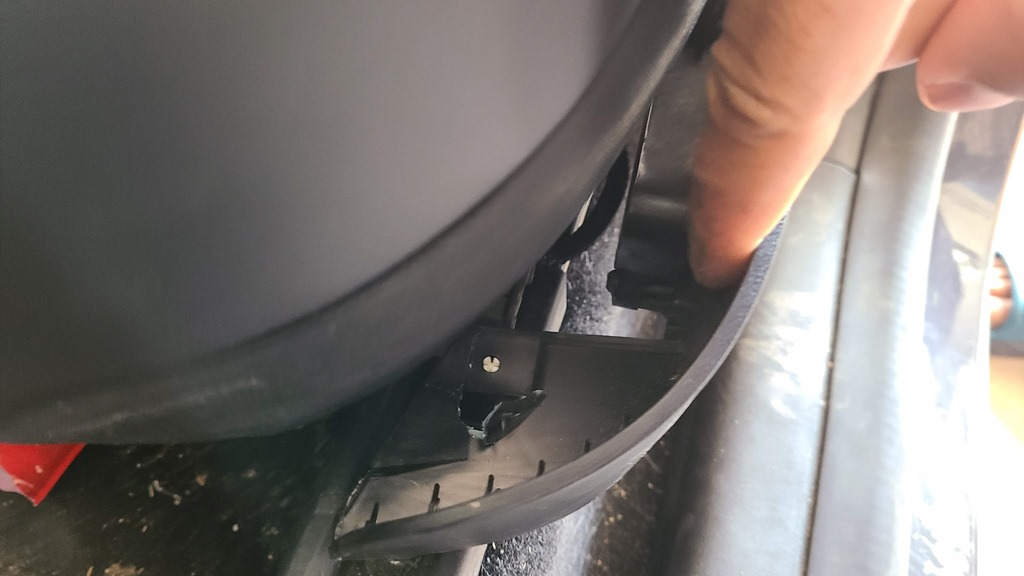
    In the video of my testing, I tried to get the car to come out of the garage. It would wake up and start for an inch, and then stop. I think the right corner of the garage made the car nervous, and it didn’t quite believe it could back straight up. I didn’t test the come to me or come to target.

    In a Parking Lot

    I had tried this at a doctor’s office once, and stood in the middle of a parking lot, away from other cars. When I pressed come to target, the car backed up, turning out of a parking spot and then drove forward to me, though past me to a spot marked on the map. I’m not quite sure how a “target” is picked, but since I could have stopped the car near me, I wasn’t too worried.

    Later I went to the large, mostly empty parking lot at my gym and did some other testing. Two tests couldn’t get the car to back out of the parking space, and I’m not sure why. No other cars around, so it was strange.

    When I backed in, I could get the car to drive to me, though only with selecting “Come to Me”. The “Come to target” again picked a weird spot. Actually across a couple parking spots.

    Summary

    During a month of having FSD, I never really had a time when I wanted to summon the car. Of course, in Colorado in the summer, it rains rarely, and I’m not one to be worried about a little rain on the few days we have some. I also don’t quite know when I find it useful. Maybe if someone parks too close to let me get in or park.

    The feature worked OK, though not great. Certainly not enough, or not consistently enough, for me to want to pay for this.

    I made a video of my tests that you can check out.

  • Proving Minimal Charge Loss for the Tesla

    This is part of a series that covers my experience with a Tesla Model Y.

    One of the reasons I have some data capture taking place on my own systems is in case some vendor I use has a DR event. That might cause me to lose some data, since I’d be depending on them to keep the data around. If I lose my system, I can always (hopefully) go get their copy again.

    Maybe.

    Who knows.

    In any case, my wife and I spent the weekend in LA, coming back Monday. We got home from the airport and my wife said the Tesla was really low. The charge level was at 22%. She thought sitting parked at the airport from Fri-Mon drained a lot of charge. I countered that it hadn’t lost much of anything.

    I had actually left home Tues morning and returned late Thur, so I hadn’t driven the car (or plugged it in) since Monday. My wife said she hadn’t driven much, so there should be more charge.

    To settle the situation and understand, I turned to my Teslamate data logger. It’s been running in a container on my machine (Actually a few) and keeps the data backed up.

    If you look at the charge level, you’ll see that I got up to the 76% level (the max setting for us) on Monday.

    2022-08-17 13_39_55-Charge Level - Grafana — Mozilla Firefox

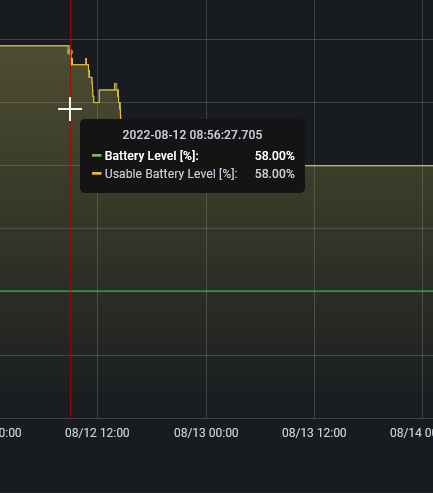
    I was in Seattle at 12:50p Tuesday when someone started driving it around. The normal driving that day took the charge down to 59%. I’m guessing a few errands throughout the day.

    2022-08-17 13_40_05-Charge Level - Grafana — Mozilla Firefox

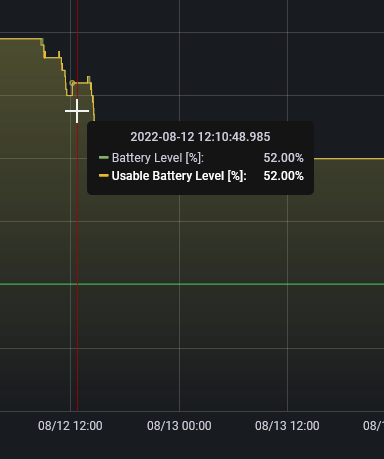
    Then this remained the state until Friday morning just before 9a. That’s when I left for yoga, and you can see I drained down some charge.

    2022-08-17 13_41_40-Charge Level - Grafana — Mozilla Firefox

    I got home and plugged it in, but because I have this set for overnight charging, nothing happened at first. I finally remembered to click “start charge”, but only added 2″%.

    2022-08-17 13_42_15-Charge Level - Grafana — Mozilla Firefox

    That’s what we took to the airport. The drive up drained the batter down to 41%, and I’m guessing another % went down with cabin overheat running. This runs for a bit of time after the car is locked (it was hot in DEN). The charge remained at 40 through the weekend until Monday morning.

    2022-08-17 13_43_24-Charge Level - Grafana — Mozilla Firefox

    Driving home was the dip down to the 22% where we ended up in the right side of the graph above.

    Not that I wanted to win an argument, but more verify that what I told my wife was correct. We have sentry off and we should lose minimal charge from the car being parked.

  • Initial FSD Thoughts with a Tesla Subscription

    This is part of a series that covers my experience with a Tesla Model Y.

    I subscribed to the Tesla FSD in July, since I had a couple trips planned where I’d be driving longer distances on the highways. I wanted to see how well it worked and what value there was from the subscription.

    Cost-wise, this is a good way to try things out. The FSD cost is US$12,000. If I subscribe, it is US$199. Worth a month to test this out and see what it gets me. The additional items for FSD (and Enhanced Autopilot) are:

    • Navigate on autopilot
    • Auto lane change
    • Auto park
    • Summon
    • Smart Summon
    • Traffic Control and Stop Sign Control

    Note: This isn’t the beta version of FSD that everyone is writing about. This is production, which is less capable. I could have opted into the beta, but decided not to.

    Subscription was easy. I clicked a few buttons on the app and within minutes, I had new options in my Autopilot screen. I clicked on a few and set up some confirmations and enabled options.

    I then tried it on some shorter trips. Overall, I appreciated the ability for the car to stop at stop lights and stop signs, though the confirmation from me wasn’t great. However, I don’t completely trust the car, so I liked it.

    I also did like the lane change on the highway. Often when I’ve used Autosteer, I get behind a slow person at some point and I’d like to be able to change lanes. It did work well when I confirmed a lane change and waited for other cars that were close to pass (or fall back) before the car moved lanes. I could not initiate these changes, however. I had to wait for the car to ask if it could change lanes.

    There still is some phantom breaking and some weird speed changes at times, so it’s not anywhere close to perfect, but I liked the feature.

    I don’t think this is worth US$200 a month for these features, but maybe at $100 I’d use it I drove more. I just don’t go on enough longer rides to use this very often.

    I’ll write a few posts and shoot video of a couple of the features.

  • Driving Costs With a Tesla Compared to Gas

    This is part of a series that covers my experience with a Tesla Model Y.

    I wrote recently about the costs for me to charge at a Supercharger. The USD$0.43 was higher than I expected, but lower than the USD$0.58 I’ve seen some CA people post about.

    With the intricate linkages of the World Wide Web, I’ve seen a few articles lately about charging. First, there was a debunking of a meme at Jalopnik, which I thought was crazy. Especially since I own a horse trailer. Then there was a user posting at Reddit that ended up poorly shared on Autoevolution. For the record, I find that site have poor journalism standards.

    I also caught a post on Facebook about new public electric chargers coming to Colorado and was amused by all the comments about the grid failing and not being able to handle things and how expensive and poor for the environment electric cars are.

    A lot of hype and silliness, or FUD, from lots of non electric positive people. However, I wanted to check on the real costs for me. So I got some of my data.

    Comparing Costs

    I still have a 2012 BMW X5. I was thinking to replace it with something similar when we got the Tesla. So purchase costs are out for me, but I did decide to compare the cost of operating that car with the Tesla. I also decided to add a Prius in. Now, our old Prius would get around 47-48 in the summer, 43-44 in the winter. This car was rated at 50mpg. A newer one, like the Prime, is rated at 54, so I’ll use these values for my MPG:

    • BMW – 22
    • Prius 50

    I also compared the cost of home charging v Supercharging. My experience recently is these costs:

    • Home – $0.14
    • Supercharging $0.43

    I have solar, but since I just use power, if I spend it charging the car, I pull more from the grid, so I’ll leave that cost the same.

    Trips

    I run Teslamate, which logs all my drives. I can see the distances and power usage for each trip. As you see below, there is a lot of data.

    2022-07-27 10_25_50-Drives - Grafana — Mozilla Firefox

    I grabbed a sampling of trips, long and short, around town and into the mountains. The gas cars do worse in the mountains, as does the Tesla, but rather than try to make things complex, I left the same MPG for the gas cars.

    Methodology

    • For a particular trip, I get the mileage and kWh used. I can multiple kWh by cost and get a simple cost for electricity in two ways: home and Supercharging. This isn’t my actual cost, but hypothetical if all my charging were in one of these two places. As an example, for a 20.2mi trip, I get:
    • home cost –  $0.56
    • Supercharger cost – $1.72

    For the gas cars, I divide the miles by mpg. This gives me gallons used. For that 20mi trip is just under a gallon for the BMW and under half a gallon for the Prius. I then multply by the gas cost. I set that at $4.30 for now. It’s been higher lately, but I paid that last week on a trip to the airport (I took the BMW).

    I put a set of 11 random trips in a spreadsheet and compared things. This is what I see:

    2022-07-27 10_30_21-Book1 - Excel

    For my 2o mile trip, I see these costs:

    • Home: $0.56
    • Supercharging: $1.72
    • BMW: $3.95
    • Prius: $1.74

    For a longer trip in the mountains, 55mi, I see:

      • Home: $2.03
      • Supercharging: $6.24
      • BMW: $10.81
      • Prius: $4.76

    The aggregates for 418.8 miles (this sample) are:

    • Home: $15.76
    • Supercharging: $48.42
    • BMW: $81.86
    • Prius: $36.02

    Clearly the Tesla is a lot cheaper if I charge at home. My power costs are mostly fixed, though the Supercharger can be cheaper than $0.43. It could be more expensive, but I haven’t seen that. Gas certainly goes up and down and even at $4, home charging is cheapest.

    The Prius looks good in a bunch of places compared to Supercharging. I had 4 of those 55mi trips in the mountains, all on Supercharger charging, but I also know the Prius would not be getting 50mpg there. Probably more in the 25-ish range. Mountains are steep.

    My Experiences

    I’ve owned lots of cars. My experiences in the last year, in looking at data and comparing to the Prius, BMW, RAM 3500, and other cars, is that the Tesla is a lot less expensive to operate. My back of the napkin thoughts before this were the Tesla is about 1/2 of the Prius cost and 20-25% of the BMW to operate.

    You can make all sorts of comparisons on ROI and costs, and you should. For your situation. For me, given my life and choices, this was a great purchase. I’d have spent $45-50k anyway on a car, so the purchase wasn’t something I calculated in. I also carry 5 adults at times and that wasn’t very comfortable in the Prius. The BMW worked fine, as does the Tesla.

    Charging isn’t simple, and while I got a wall charger + installation for US$760, I would not be surprised if a lot of people paid closer to $1500. However, it’s not a crazy cost, and it’s essentially adding another circuit for your clothes dryer. A good portion of us can do this, and then we have a “full tank of fuel” every morning. That alone is a very neat experience.

    I think Tesla is great. If we needed another car, we’d look at Polestar, Hyundai, Rivian, and a few others. I’m sold on them as an every day car that is relatively cheap to operate. We’ll always have the diesel pickup for towing and trips if we need it, but having owned different types of cars, the electric paradigm makes a lot of sense.

    And if we really wanted a car for a trip and worried about charging, like through Montana, we’d just rent a car. We’ve done that in the past to save wear and tear, and it’s hard enough to find fuel in Montana and Wyoming at times. A rental would be an easy choice, so range anxiety isn’t a problem. If I have it, I get rid of it for that trip. Not for the rest of my life.