I think SQL Clone is a useful, handy product. It’s what I’ve needed in a number of organizations, or it’s what would have saved us (literally), $100,000s of dollars by avoiding larger SANs with snapshot technology. At one company, we actually bought a second six-figure SAN when our customer service people wanted a copy of our SQL Server database from a point in time overnight that they could use to respond to customer requests and test issues on the next day.
Now that v1 is out, and many of you were impressed by the demos and details from our Livestream launch, what should we do to the product?
We are getting feedback from some customers, we are getting a few questions here and there in presentations, at conferences, and on Twitter. However, it helps to give feedback directly in a way that we can tally things up.
As much as I like getting feedback, and Grant does, it’s good to vote with your voice and send a note to the company. If you want a louder voice, send a few emails to the salespeople. They can really put some emphasis on feature requests.
For most of the time I’ve been working for Redgate, we’ve had some sort of R&D group that tries out new ideas. Over the years we’ve done this in a few ways, evolving things over time. I had the chance recently to meet with The Foundry, which is formally investigating ideas for feasibility, interest, and general knowledge. Not all their ideas will move forward to actual pieces (or parts) of software, but it was interesting to meet with them.
One of the areas they’re investigating is data masking, which is a much larger topic than you might think. I got the chance to review some of their research areas and thought a few of you might be interested in helping research and giving your thoughts.
Data Masking Demos
In looking at data masking, the group spent some time getting feedback from individuals, trying to understand the challenges and possible solutions, and then build some interactive demos. These aren’t really software, but they are a bit more than wireframes. you can see all the demos in the Data Masking Demo section of their site.
Each of the items deals with a different aspect of data masking. The demos aren’t completely intuitive, which is both interesting and frustrating. It’s good that there is some open-ended-ness that gets me to think. Hard that I don’t always quite get the intention. I had the luxury of getting some time where someone would sit down and explain a scenario, but I’d be curious what some of you think.
If you have a few minutes and want to play with potential areas of data masking research, try a demo and give some feedback. I particularly think the Manage Test Cases and Realistic Generation demos are things I’d like to see engineered, particularly together. I would really like the idea of some production-like data and some real test cases being moved into good, not-production, data sets that I can use for development and testing. I’ve given some feedback, but I’ll play more and leave notes here, and at foundry@red-gate.com .
If you have a few minutes, maybe you want to do the same.
Yesterday was the SQL Clone launch livestream from the Redgate office in Cambridge, UK. I flew over on Monday, along with Grant Fritchey, to help broadcast a few sessions about the product. I’ve been excited to see SQL Clone for a few years now, ever since I saw a POC in 2015.
Having only one day to prep was tough, but family commitments meant I couldn’t arrive until Tuesday morning. A long night on a flight across the water, but I made it and landed in time to get to Cambridge before lunch.
The event was actually a three-peat, broadcasting the same sessions three times to cover various time zones around the world. A long day, arriving at the office around 6:30am and not leaving until after 8pm. It’s not that bad, as my sessions were spread throughout the day.
We had some fun as well getting ready. Grant and I did a short commercial, which made me chuckle when I saw it.
The sessions were based on some demos and testing we’ve done over time, and I think they showed some of the power of the SQL Clone product. We’ve got some intro videos, one of which is below, to help you understand how the product works. We’ve also been publishing lots of short pieces on specific SQL Clone use cases on the Redgate blog.
The behind the scenes was fun, with prep and rehearsals occupying a very long day for me on Tuesday. However, after our SQL in the City Streamed last year, everyone involved at Redgate has had some practice in how to setup and run a live event.
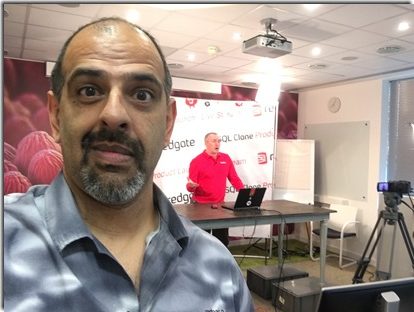
There’s a dedicated double conference room that we’ve turned into a broadcast studio, with lots of equipment and a small set. I’m especially glad we had four microphones for all the presenters. Switching mics with limited time is a challenge.
Last year we used a podium, but I’ve found that trying to work with demos on a small platform is hard. In various conferences around the world, I’ve found there isn’t enough space to easily type or maneuver a mouse in the typical space that a speaking podium offers. I asked for a desk, and sure enough, our engineers found one, raising it up to accommodate a standing height.
SQL Clone is sheep-themed, after the scientific work with Dolly the sheep. Our product marketing manager, Karis, was a good sport, donning a costume for a short promo video. I grabbed a short video and a few pix.
SQL Clone short promo segment
Early Wednesday, we started the event, to a small audience in Asia and a few early birds in Europe.
The flow is similar to a television broadcast. Our engineer will give us a few countdowns (30s, 10s), and an audible 5, 4, 3, then a thumbs up to start presenting. It’s slightly odd to present to a screen, and it does take some getting used to remembering the camera and not the people in the room are the ones that need your focus.
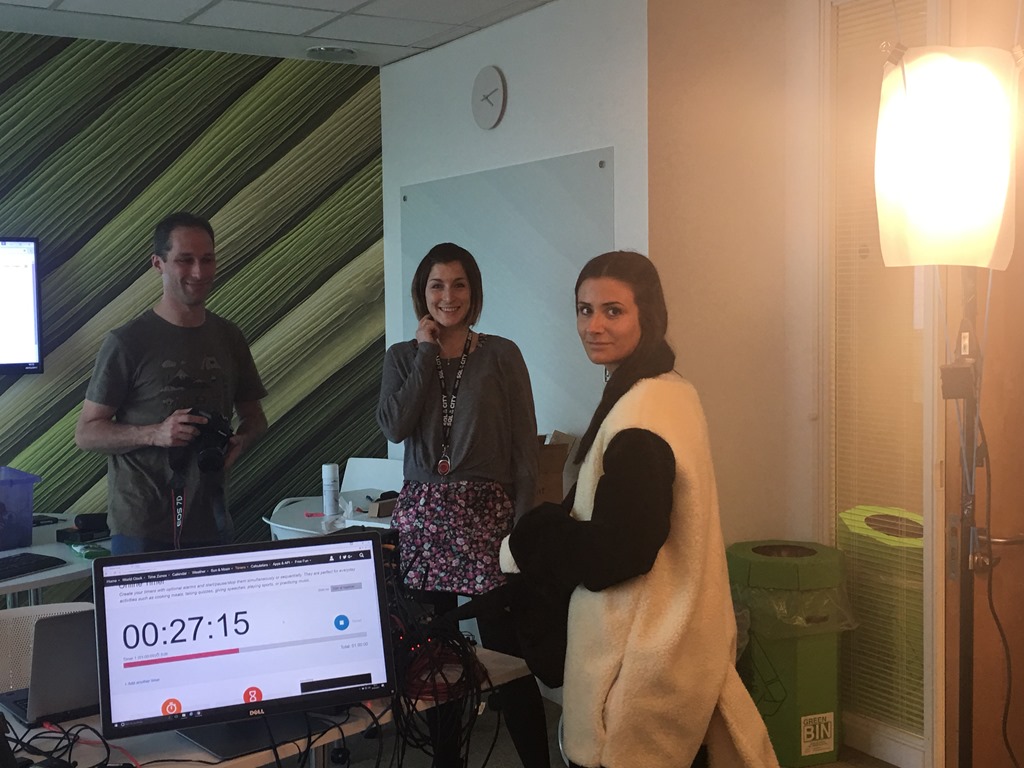
We also have multiple clocks and timers on various screens. Below you can see the view from the table. There is a monitor in the upper left that shows what the laptop is outputting. Since some people like PowerPoint’s presenter mode, we have to switch between extend and duplicate on the laptop. Seeing the output in front of you is handy.
To the lower right we have a monitor that has a countdown timer for this particular session. This is handy in keeping an eye on how much time is remaining in the presentation. I wish there were a scheduled end time as sometimes our start times are off, but I try to keep an eye on the start time and guess how much over I might go. In our case, the intro and Grant’s piece were short, so I could go over a bit. The one thing that would be nice is a negative count up once we hit zero. Right now the timer stops.
At the rear of the room we have a large clock on one screen that shows the local time. Since I know roughly when I’m supposed to start and end, that’s helps. On the upper right screen, showing the Windows background we put up a large Word document where someone can type questions from Twitter/YouTube/Slack, etc. They use a large font so we can read them from the stage area.
We have a series of buffer videos, ads, and transitions that are setup between live talks. Watching the engineers switch between audio and video, moving between different inputs is fascinating. Mechanical, and perhaps not so exciting if it were happening all day, but for a a few events a year, it’s neat. I’m looking forward to seeing how we can improve the process in the future.
The Event
The day started with Grant talking about the challenges of database provisioning. I’ve dealt with all he noted, regulatory issues, space, time, repeated work, etc. Until I started working with the SQL Clone team, I hadn’t realized quite how much of a hassle the copying and provisioning of databases can be. I’ve fought with storage admins for space, and with developers over the time it takes to copy and restore. SQL Clone makes this easier, and if you want to move faster, then you might find the space and time savings worth the cost of the product.
Or you might just keep dealing with the time and space issues. Your choice, and there are plenty of companies that are happy to spend your time and effort on copy/restore tasks.
Once Grant finished, it was my turn to show how SQL Clone solves some of these issues. I got to demo the GUI, self-service implementation and then discuss the code solutions with Richard McCaskill, our product manager. Hopefully I didn’t distract Grant, but it’s a bit boring to watch the same presentation 3 times when you aren’t involved and are just sitting in the room.
The PowerShell cmdlets for SQL Clone are the real power of this tool, allowing you to easily provision new images and clones for developers. I’ll have to write more on this, but we demoed a similar setup to one of our customers where they create a new set of databases on developer instances for new branches. That is very cool.
We had growing audiences throughout the day as we moved across the globe. If you watched, let us know if the time and length worked for you, as well as where you are. I think we’ll do more of these, and with the number of products that Redgate has, I bet we end up with some sort of broadcast every couple months.
Over the years I’ve seen a lot of products launched. I still remember the fanfare around Windows 95, and the efforts to make this an event of sorts, back when virtual events didn’t make sense. There have been a few Windows or SQL Server launches, some of which took place at large conferences, but quite a few were launched in different communities with small physical events. In Denver, there were a few times when Microsoft rented a hotel conference space and scheduled speakers, some from Microsoft, and some local. These would be all day events, showcasing new features, with customers talking about their experiences in previewing the product.
Just a few weeks ago, Microsoft launched Visual Studio 2017, with some fanfare, and two days of virtual events. I watched one, and hope to find some time to watch a few of the second day’s events. While I don’t necessarily learn a lot, I go get a bit excited seeing new technology and how different people use it. It’s inspiring to see demos and solutions work well on stage. I think it’s a welcome respite from the drudgery of dealing with my own or other people’s code, and the various problems it presents, as well as the various bugs and limitations of the tools and IDEs I use. It seems there’s always some devil in the details that slows me down.
However, for a short time, I get rejuvenated and excited by the new features. I want to dig in and experiment. It can be a struggle to find time, but watching someone demo a new way of working reminds me of the things I love about computers and technology. I think this is one of the reasons I love attending SQL Saturdays or other conferences and watching other presenters talk. I always see some new and interesting things that generate ideas and excitement. I’m really looking forward to SQL Bits in a few weeks (still time to register), and a few days of seeing what others have been accomplishing with SQL Server.
I also have pride when I’m a part of the company launching a product. At Redgate, we’ve had a number of SQL in the City shows, which I’ve been honored to be a part of in many cities around the US and UK. Last year we tried a streamed version, which was yet another experience, but one I hope we repeat again. And, in fact, I get to be a part of another product launch next week. We’ve already release SQL Clone, but we have a live-streaming launch coming next week. I’ll be traveling over to Cambridge and getting ready for a few presentations that will hopefully inspire you to try the product. If nothing else, check out the stream and see if we show anything that sparks an idea in your mind.
I know many of us work inside companies, and our product launches are small, to relatively few customers that are often our fellow employees. Some of you work with companies and the results of your work are visible to lots of others. No matter which environment you work in, I hope you feel the same pride and excitement I do when you release a new idea for your users to enjoy.